A Scale, a Feather, and the Weight of a Life: the Egyptian Duat
The ancient Egyptians judged the dead not by creed but by conduct: a golden scale, the heart of the deceased, and a single ostrich feather decided whether a soul earned paradise or ceased to exist. This issue traces the full journey through the Hall of Two Truths, from the nine parts of the soul to Ammit the Devourer, and reads what that theology reveals about a culture in love with the living world.

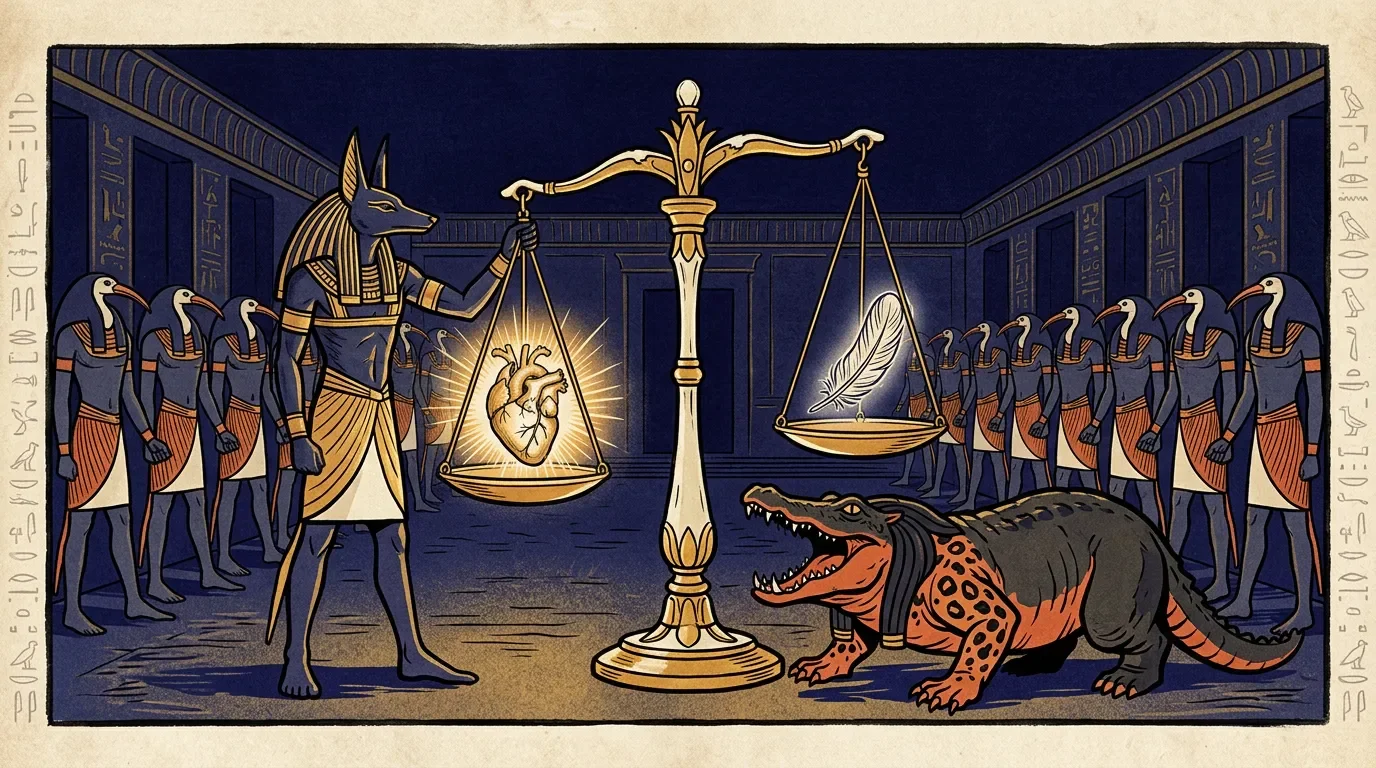
A scribe kneeling before the golden scale. On the left pan: a human heart, still warm from a lifetime of choices. On the right: a single white feather, the plume of the goddess Ma'at. The scale tips. If the heart rises, the soul walks forward into paradise. If it sinks, a creature waiting in the shadows, part crocodile, part leopard, part hippopotamus, opens its mouth and swallows the heart whole. The soul does not go to hell. It simply stops existing.
This is the Weighing of the Heart, the central act of the ancient Egyptian afterlife, and it tells you nearly everything you need to know about what the Egyptians valued in a life.
The world the dead entered
The Egyptians called the afterlife Aaru, the Field of Reeds: a land mirroring the living world of Egypt, but without sickness, without loss, without death. 1 The Nile still ran; sycamores still gave shade; harvests came in every season. A tomb inscription carved around 1400 BCE says simply:
May I walk every day unceasing on the banks of my water, may my soul rest on the branches of the trees which I have planted, may I refresh myself in the shadow of my sycamore. 1
Notice what is not there: no white light at the end of a tunnel, no transcendence into pure spirit, no dissolution into the divine. The Egyptians imagined eternal life as more of the life they already loved, complete with home, pets, and favorite possessions waiting for the soul that earned entry. This was a culture profoundly in love with the present world, and their paradise was the present world made permanent.
To get there, the soul had to pass through a single, precise ritual of moral accounting. No faith profession, no deathbed repentance, no intercession from a priestly class. Just a scale, a feather, and the accumulated weight of a whole life.
The soul, in nine pieces
Before following the dead into the Hall, it helps to know what the Egyptians believed a person was. The soul was not a single unit but a nine-part assembly. 2 The physical body was the Khat. The Ka was a double-form, a kind of life-force twin. The Ba a human-headed bird that could move freely between earth and the heavens. The Shuyet was one's shadow self. The Akh was the immortal, transformed self, the part that actually made the journey after death.
Most crucially: the Ab. The heart.
The heart was not merely a pump. Egyptian theology held it as the seat of memory, thought, emotion, and every choice a person had ever made. 2 It was, in essence, the moral record of a life: etched by every act of covetousness, every generous deed, every petty cruelty and every quiet kindness. At death, the heart carried all of it into the judgment hall. Nothing could be revised. Nothing could be hidden.
This is why the Egyptians took such care with the body. During mummification, most organs were removed and stored in canopic jars. The heart was not. It stayed inside the body, or was reinserted, because it would be needed at the weighing.
The hall of two truths
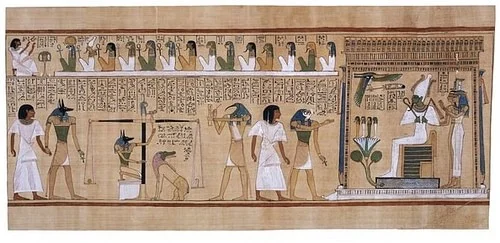
The Book of the Dead describes what came next with meticulous specificity. The dead were met by Anubis, the jackal-headed god who presided over embalming and escorted souls through the underworld. He led the Akh into the Hall of Two Truths (the Hall of Ma'at), a vast formal space where the gods sat as a tribunal.
At the center: the golden scale.
On one side of the scale: the feather of Ma'at, the white ostrich plume representing ma'at itself, the Egyptian concept of cosmic order, truth, and moral balance that held the universe together. 1 On the other: the soul's Ab, placed on the pan by Osiris, the green-skinned lord of the dead.
Around the hall stood the Forty-Two Judges, divine assessors corresponding to the forty-two nomes (administrative districts) of Egypt. Before the scale could be read, the soul had to address each one in turn, reciting what scholars call the Negative Confessions, the Declaration of Innocence.
The declarations ran something like this:
I have not done wrong. I have not stolen. I have not been covetous. I have not told lies. I have not caused suffering. I have not robbed the offerings of the gods. I have not cheated at the scales...
There were no fixed confessions that applied to every person. A military commander's list looked different from a farmer's. The forty-two declarations were calibrated to a life, not to a generic soul. 1 Each sin named in the declaration was one that had disrupted ma'at, cutting the person off from harmony with others and the divine order.
The god Thoth, ibis-headed scribe of the gods, stood beside the scale and recorded the result. The goddess Ma'at herself was present, embodied, the standard against which the heart was measured.
What the scale decided
If the heart balanced with the feather, or came up lighter, the Forty-Two Judges conferred and, if satisfied, pronounced the soul ma'a-kheru: "true of voice," justified. Anubis then led the soul out of the hall. It crossed Lily Lake by boat and entered the Field of Reeds. Everyone it had loved who had died before was waiting.
If the heart was heavier, it was thrown to the floor of the hall and devoured by Ammit: "the Devourer," the creature that combined the three most dangerous animals the Egyptians knew into one body: crocodile, leopard, hippopotamus. Once Ammit swallowed the heart, the soul ceased to exist. No punishment. No torment. Nothing.
This distinction is worth pausing over. The Egyptians did not invent a hell. The worst outcome was not eternal suffering but annihilation: the second death, from which there was no return. The threat was not pain but erasure from existence and from memory. Given that the Egyptians believed a person's name continuing to be spoken was a form of continued life, this was a form of damnation specific to their deepest values.
The texts that carried the dead
The Book of the Dead that we know today, properly titled the Book of Coming Forth by Day, was not a single canonical scripture. No two papyri are identical. 2 It was a flexible collection of spells and instructions, written on papyrus and placed in the tomb, whose purpose was to orient the newly dead, remind them of what was coming, and equip them with the words they would need.
Its oldest ancestors are the Pyramid Texts, carved on the walls of royal tombs around 2400-2300 BCE. These then gave rise to the Coffin Texts (c. 2134-2040 BCE), which democratized access, allowing non-royal Egyptians to carry protective spells into death. 1 The fully illustrated Book of the Dead papyri, the ones that survive in museums today, date from around 1550-1070 BCE, the New Kingdom period.
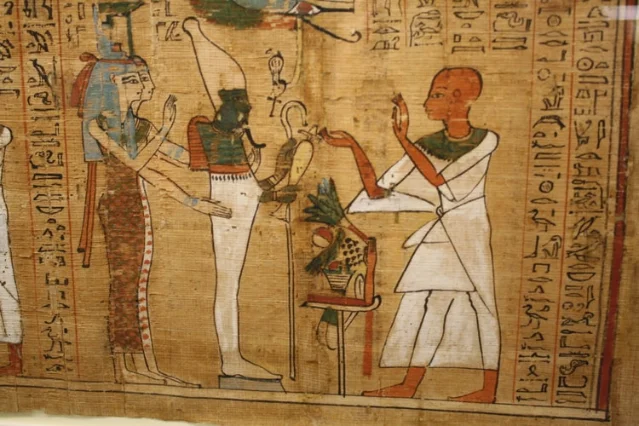
The most famous surviving example, the Papyrus of Hunefer, is held in the British Museum. Its heart-weighing scene is among the most precisely rendered images in all of Egyptian art: Anubis at the scale, Thoth with his palette, Ammit crouching in readiness, Osiris enthroned. The sequence reads from left to right with the visual logic of a diagram, because that is what it was: not religious decoration but instructions, a map drawn by the living for the use of the dead.
Spell 30B, found in many papyri, records the soul's address to its own heart before the weighing:
O my heart which I had from my mother! O my heart of my different ages! Do not stand up against me as a witness, do not be opposed to me in the tribunal, do not be hostile to me in the presence of the Keeper of the Balance...
The soul feared, above all, that its own heart might betray it. That the record carved into the Ab by years of choices might speak against the soul's declaration of innocence, that the heart and the conscience might give different testimony.
What it tells us about the culture
The weighing of the heart is not a difficult theology to read once you sit with it.
The Egyptians were not primarily worried about ritual impurity, about eating the wrong food, about offending divine vanity. The forty-two declarations focus overwhelmingly on conduct toward other people: stealing, lying, causing suffering, cheating at the scales in the market, robbing the poor. The criterion for paradise was not doctrinal correctness. It was the quality of a life lived in relationship.
The concept of ma'at sitting at the center of all this is telling. Ma'at was cosmic harmony, the principle that made the Nile flood on schedule, that kept the sun rising, that maintained the social order. It was both a goddess and a description of how the universe worked when things were right. To live in ma'at was to be in alignment with the structure of existence itself. To sin was not to break a divine commandment so much as to create disorder, to add weight to a world that needed to stay in balance.
This is a culture that had spent three thousand years managing one of the world's most complex hydraulic societies, utterly dependent on the predictable flooding of a single river, on the coordination of enormous labor forces, on the calibration of resources across a long narrow valley. The theology is, at its root, the theology of a people who understood, in their bones, that everything depends on balance and that selfishness breaks the machine.
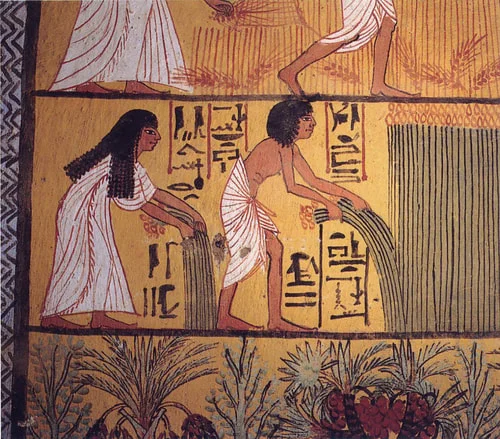
The afterlife they imagined was not a reward for suffering through a hard world. It was a permanent version of the world they loved, given to those who had kept faith with it.
The Book of the Dead in popular imagination
It is worth noting where the canonical tradition ends and later popular depiction begins, because the two travel together and occasionally diverge. The weighing of the heart scene, as depicted in the Papyrus of Ani (British Museum EA 10470, c. 1275 BCE) and the Papyrus of Hunefer, is genuinely ancient and primary. 3 The broad outlines, Anubis, Thoth, Osiris, the scale, the feather, Ammit, appear consistently across the tradition.
What popular culture tends to add is drama: the idea that the judgment was adversarial, that souls could be tricked or bribed, that the heart-weighing was a test the living could "cheat" by acquiring the right spells. Some of this is present in the ancient texts, particularly the instructions for what to say to the Forty-Two Judges. But the ancient Egyptian understanding was ultimately more austere: the heart did not lie, and no spell changed what was written there. The spells were guidance for the disoriented dead, not loopholes for the guilty.
The elaboration, the maze of dangers, the demonic gatekeepers in the Duat, these grew over centuries of textual accumulation. What stayed constant, from the Pyramid Texts of the Old Kingdom to the decorated papyri of the New Kingdom, was the simple image at the center: a scale, a feather, and the question of whether a person had lived lightly enough to earn their way into the world they loved.
Primary sources: the Papyrus of Ani and Papyrus of Hunefer (British Museum); the Pyramid Texts (c. 2400-2300 BCE); the Book of the Dead (c. 1550-1070 BCE). Scholarly references: Rosalie David, Religion and Magic in Ancient Egypt (Penguin, 2003); R. O. Faulkner, The Egyptian Book of the Dead (Chronicle Books, 1991); Geraldine Pinch, Egyptian Mythology (Oxford University Press, 2004).
Añade más opiniones o contexto en torno a este contenido.