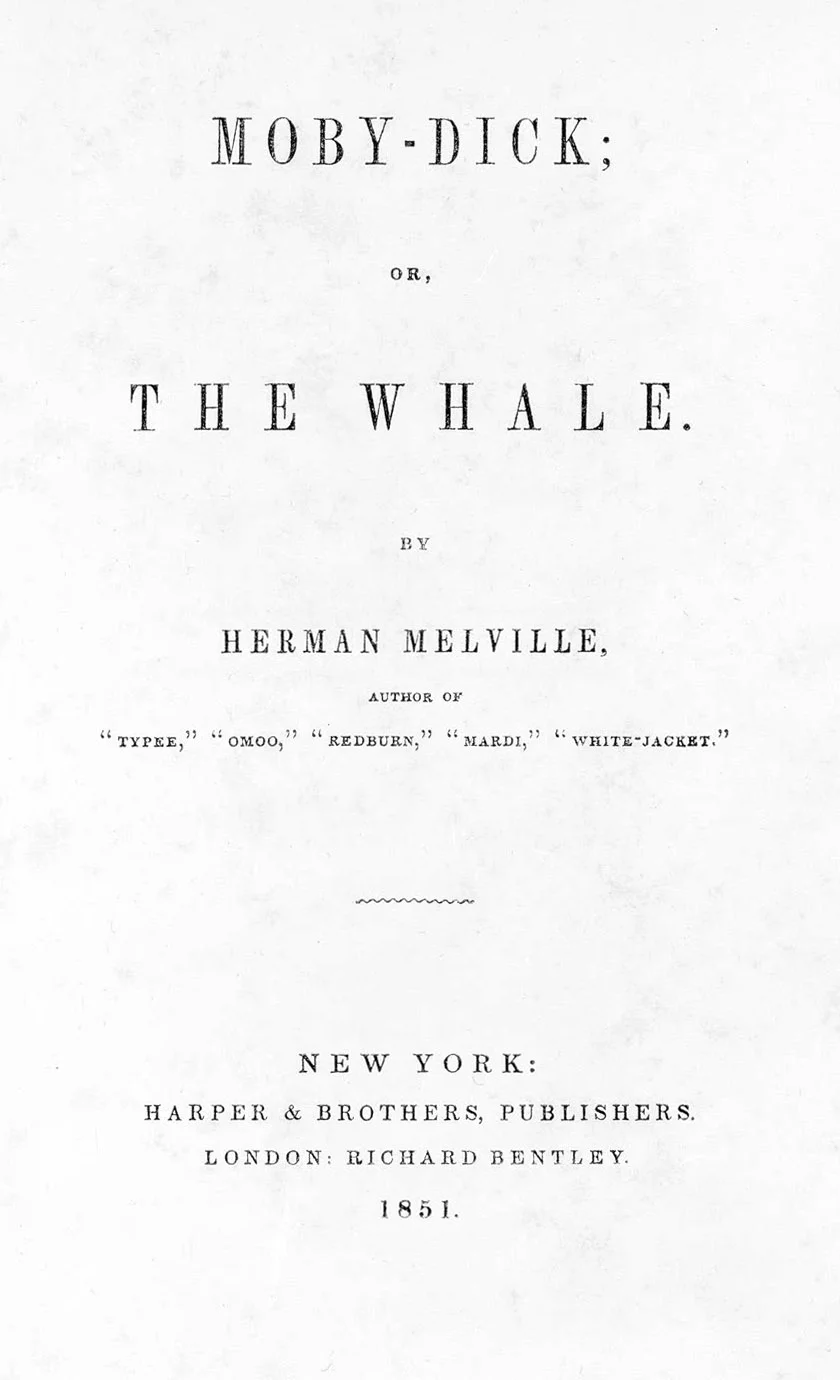
"Call me Ishmael" — how Melville recruits his reader in three paragraphs
Melville opens Moby-Dick with an imperative — "Call me Ishmael" — and spends the rest of Chapter 1 quietly enrolling the reader in Ishmael's oceanic depression and restlessness. A close read of the apostrophe device, three glosses on period vocabulary (spleen, hypos, Cato), and a reflection on what we return to when we cannot stay still.

Herman Melville, Moby-Dick; or, The Whale, Chapter 1: "Loomings," 1851. 1
Call me Ishmael. Some years ago—never mind how long precisely—having little or no money in my purse, and nothing particular to interest me on shore, I thought I would sail about a little and see the watery part of the world. It is a way I have of driving off the spleen and regulating the circulation. Whenever I find myself growing grim about the mouth; whenever it is a damp, drizzly November in my soul; whenever I find myself involuntarily pausing before coffin warehouses, and bringing up the rear of every funeral I meet; and especially whenever my hypos get such an upper hand of me, that it requires a strong moral principle to prevent me from deliberately stepping into the street, and methodically knocking people's hats off—then, I account it high time to get to sea as soon as I can. This is my substitute for pistol and ball. With a philosophical flourish Cato throws himself upon his sword; I quietly take to the ship. There is nothing surprising in this. If they but knew it, almost all men in their degree, some time or other, cherish very nearly the same feelings towards the ocean with me.
There now is your insular city of the Manhattoes, belted round by wharves as Indian isles by coral reefs—commerce surrounds it with her surf. Right and left, the streets take you waterward. Its extreme downtown is the battery, where that noble mole is washed by waves, and cooled by breezes, which a few hours previous were out of sight of land. Look at the crowds of water-gazers there.
Circumambulate the city of a dreamy Sabbath afternoon. Go from Corlears Hook to Coenties Slip, and from thence, by Whitehall, northward. What do you see?—Posted like silent sentinels all around the town, stand thousands upon thousands of mortal men fixed in ocean reveries. Some leaning against the spiles; some seated upon the pier-heads; some looking over the bulwarks of ships from China; some high aloft in the rigging, as if striving to get a still better seaward peep. But these are all landsmen; of week days pent up in lath and plaster—tied to counters, nailed to benches, clinched to desks. How then is this? Are the green fields gone? What do they here?
[...]
And still deeper the meaning of that story of Narcissus, who because he could not grasp the tormenting, mild image he saw in the fountain, plunged into it and was drowned. But that same image, we ourselves see in all rivers and oceans. It is the image of the ungraspable phantom of life; and this is the key to it all.
Gloss
Spleen. In Melville's day the word still carried its humoral-medicine meaning: the spleen was the organ believed to produce black bile, which caused melancholy, irritability, and a generalised dark restlessness. "Driving off the spleen" isn't a metaphor for mild boredom—it's Ishmael describing something close to a clinical episode.
Hypos. A contraction of "hypochondria," used in the 19th century to mean a state of morbid depression rather than its modern medical sense. Ishmael's hypos are not imaginary ailments but a named, period-recognised condition—and his cure, notably, is not rest or medicine but motion toward the sea.
Cato throws himself upon his sword. Cato the Younger (95–46 BCE) chose suicide over surrender to Julius Caesar—his death was famous in the classical tradition as the purest act of Stoic principle. Ishmael invokes it with precise irony: Cato enacts "a philosophical flourish" by dying; Ishmael enacts his by going to sea. The scale of the comparison is absurd, and the absurdity is the point.
Close read: apostrophe and the narrator who won't be pinned down
The device running through this opening is apostrophe—the direct address of an audience or absent party ("Look at the crowds of water-gazers there"; "Circumambulate the city")—but Melville does something unusual with it. He keeps slipping the identity of the person being addressed.
The chapter opens with "Call me Ishmael"—an imperative aimed squarely at the reader. This is not "My name is Ishmael." It is an instruction, a performative speech act. The name may be a pseudonym; the "me" may not be a stable self. Notice that Ishmael gives his reader no birth, no family, no last name. He offers only a command: accept this designation. From the opening three words, the narrator has established control of the terms on which he'll be known.
What follows is a catalogue of his inner states—the grimness, the drizzly November, the funeral processions, the hat-knocking urge—delivered as accumulated whenever clauses. The syntax delays its main clause for a full sentence. By the time Ishmael arrives at "then, I account it high time to get to sea," the reader has absorbed five separate images of spiralling depression. The structural effect is a coiled spring releasing: all that subordinate darkness, and then the simple remedy.
Then the apostrophe shifts. "There now is your insular city of the Manhattoes"—"your," suddenly, implicating the reader as a fellow New Yorker, a citizen of commerce. Then "Circumambulate the city"—the reader is now being ordered about like a pupil. Then "What do you see?"—interrogated. Ishmael recruits his audience through a series of rhetorical positions: confessor, fellow sufferer, tour guide, and finally prophet, arriving at the Narcissus myth.
The Narcissus passage is where the apostrophe cracks open into something cosmic. "That same image, we ourselves see in all rivers and oceans." The we has quietly replaced the you. The reader has been absorbed. Ishmael and his audience are now the same creature, gazing at an ungraspable phantom. The whole chapter is one long act of enrollment.
About the author
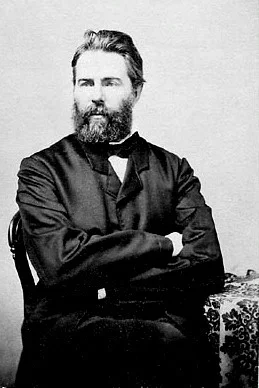
Herman Melville was born in New York City in 1819. He went to sea at nineteen—first on a merchant vessel, then on a whaling ship that departed New Bedford in 1841. He jumped ship in the Marquesas Islands, lived briefly among Polynesian islanders, and worked his way home via Tahiti and Honolulu. His first two books, Typee (1846) and Omoo (1847), drew directly on those experiences and made him briefly famous. Moby-Dick, published in 1851, was a commercial failure in his lifetime—reviewers found it formless, overcrowded, philosophically unruly. Melville died in 1891 largely forgotten. The novel's rehabilitation came in the 1920s, when critics began reading its excesses as exactly the point.
He wrote Moby-Dick at his farmhouse, Arrowhead, in Pittsfield, Massachusetts, reportedly working in long marathon sessions and corresponding passionately with Nathaniel Hawthorne, who lived nearby. The letter in which Melville describes Moby-Dick as a "wicked book" is one of the stranger documents in American literary history.
Reflection question
Ishmael says the sea is his "substitute for pistol and ball"—his alternative to self-destruction. Is there something in your own life that functions this way: a recurring motion or practice you return to not out of pleasure exactly, but because not returning would cost you something you can't name?
Añade más opiniones o contexto en torno a este contenido.