*Acutigebia succinacia*: a new mud shrimp from Japan

*Acutigebia succinacia*: a new mud shrimp from Japan

Saturday June 20 logged one new species: Acutigebia succinacia, a seventh mud shrimp in its genus, described from four Pacific Japan sites and confirmed by morphology and 16S rRNA genetics.

Today's Newly Described Species Worldwide
21/6/2026 · 1:14
1 suscripciones · 31 contenidos
Saturday June 20, 2026 — A quiet day for taxonomy. Weekend publishing rhythms mean the major journals stay dark on Saturdays, and today's databases logged only one new registration before noon. One is enough when it's this precise: a small shrimp from the rocky shores of Pacific Japan, told apart from its nearest relative by a single spine no larger than a grain of salt.

Acutigebia succinacia: the seventh species in its genus

Soma Kyotani (Tokyo University of Marine Science and Technology) and Gary C.B. Poore (Museums Victoria, Melbourne) describe Acutigebia succinacia sp. nov. in the Journal of the Marine Biological Association of the United Kingdom, Vol. 106, e44, published June 19, 2026. 1 The species was registered in the World Register of Marine Species (WoRMS) by Poore the following morning, June 20, at 03:58 UTC, receiving AphiaID 1897376. 2
The full classification places it here:
RankName
KingdomAnimalia
PhylumArthropoda
ClassMalacostraca
OrderDecapoda
SuborderPleocyemata
SuperfamilyGebiidea
FamilyUpogebiidae
GenusAcutigebia
SpeciesAcutigebia succinacia Kyotani & Poore, 2026
Acutigebia is a small genus in the family Upogebiidae — the mud shrimps, a group of burrowing decapod crustaceans that excavate tunnels in soft sediment and rock crevices across Indo-Pacific shores. Before this paper, six species were known in the genus, all distributed from the eastern Indian Ocean to the western Pacific. 1 Acutigebia succinacia is the seventh, and the paper provides an updated identification key covering all seven.
Cargando tarjeta de estadísticas…

Morphology: what the animal looks like

Acutigebia succinacia is a compact intertidal shrimp. The holotype — a male registered as KPM-NH 5735, held at the Kanagawa Prefectural Museum of Natural History — has a carapace length of 7.0 mm. 1 Like all Upogebiidae, the body is built for a life underground: the rostrum is flattened and paddle-like, projecting forward over the eyes, and the first pair of pereopods (walking legs) carry subchelate claws suited for excavating and manipulating debris inside a burrow rather than seizing prey in open water.
Coloration in life is striking for a burrowing shrimp: the lateral carapace runs yellow to orange, while the dorsal surface carries a silvery gloss — a combination that sets it apart from the duller, more uniformly pigmented appearance common in deeper-living upogebiids. 1
The telson — the terminal plate of the abdomen — has a posterior margin that is convex in A. succinacia. That convexity is one of the morphological characters separating it from A. simsoni (Thomson, 1893), its closest relative, which has a concave posterior telson margin. The merus of pereopod 1 carries 2–4 proximal spines; the propodus carries 5–11 spines along the midpoint.

The diagnostic character: a spine on the antenna base

Upogebiidae taxonomy has long relied on fine structural details to distinguish species that are otherwise superficially similar. In A. succinacia, the key diagnostic character is straightforward to observe once you know where to look: a spine on the lower (ventral) margin of antennal article 1. 1 In A. simsoni, the same surface is smooth and unarmed.
Antennal article 1 is the basal-most segment of the antenna — the stout first piece where the long antennular flagellum attaches to the head. In Upogebiidae, it is partly concealed beneath the rostrum but accessible in dissection. The spine Kyotani and Poore describe is not a secondary elaboration or an artifact of preservation; it is present consistently across the holotype and 12 paratypes collected from four separate localities along the Pacific coast of Honshu and Kyushu.
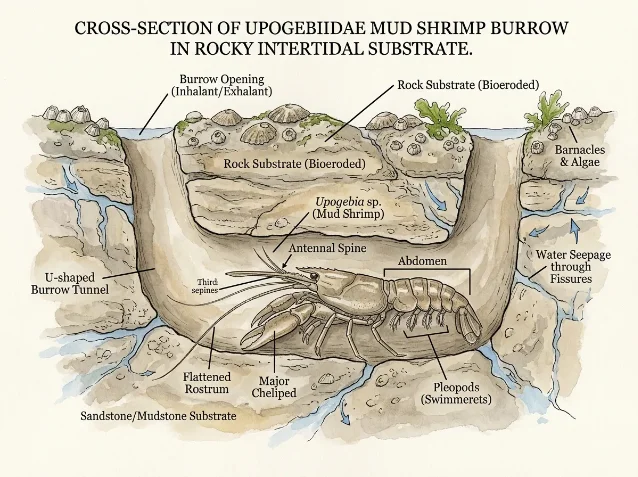
Cross-section diagram of a Upogebiidae mud shrimp burrow in rocky intertidal substrate, showing the U-shaped tunnel, the shrimp inside with labeled anatomy including rostrum, chelipeds, pleopods, and the antennal spine, surrounded by barnacles and algae at the surface
Upogebiidae mud shrimp live in U-shaped burrows excavated in rock or sediment, pumping water through the tunnel for respiration and filter-feeding. The antennal spine visible on A. succinacia's article 1 — absent in A. simsoni — is a character accessible in the burrow entrance posture. AI-generated scientific diagram.

Molecular confirmation: 16S rRNA divergence

To confirm that the spine represents a genuine species boundary rather than intraspecific variation, Kyotani and Poore sequenced a 491-base-pair stretch of the mitochondrial 16S rRNA gene from the new material and from A. simsoni. The pairwise genetic distance between the two ranges from 6.34% to 6.60% under the Kimura 2-parameter model, calculated in MEGA 11. 1
For context: within decapod crustaceans, 16S distances above roughly 3–4% are generally treated as consistent with species-level separation, though no single threshold applies universally. The 6.34–6.60% range sits comfortably above that zone. Four GenBank accession numbers cover the new material: LC922686, LC922688, LC922689, and LC922687; the A. simsoni sequence is LC922690. Additional markers — 12S, COI, and Histone 3 — were also sequenced but are not described in detail in the abstract-level information available. The multi-gene sampling gives the molecular diagnosis more robustness than a single-locus result would.
Cargando gráfico…
Comparative 16S rRNA divergence values. The 6.34–6.60% distance between A. succinacia and A. simsoni is roughly twice the commonly applied species-boundary threshold for decapods. 1

Type locality: Tsumeki-zaki, Shimoda, Shizuoka

The holotype was collected on January 13, 2025 at Tsumeki-zaki, Shimoda City, Shizuoka Prefecture (34°39.32′N, 138°59.04′E) — a rocky headland jutting into Suruga Bay on the Pacific coast of the Izu Peninsula, southern Honshu. 1 Twelve paratypes and additional material extend the known range across four prefectures:
  • Shizuoka Prefecture (Izu Peninsula type locality)
  • Tokyo (Shikinejima Island, an outer island of the Izu archipelago)
  • Wakayama Prefecture (Kushimoto area, southern Kii Peninsula)
  • Kagoshima Prefecture (Shibushi area, southeastern Kyushu)
The habitat throughout is intertidal rocky shore, where the animals occupy crevices and burrows in hard substrate — an unusual setting for Upogebiidae, most of which favour soft sediment. WoRMS additionally notes tolerance of brackish, freshwater, and terrestrial conditions in the broader genus, though the Japanese material is from full marine intertidal exposures. 2
The specimen was deposited in the Kanagawa Prefectural Museum of Natural History (KPM-NH 5735); paratypes are split between KPM-NH, the Chiba Museum of Natural History and Human Activities (CMNH-ZC), and the Tokushima Prefectural Museum (TKPM-AR).

What the paper contributes: a key to all seven Acutigebia

Beyond the new species itself, the paper's most practically useful output for field taxonomists is an updated identification key covering all seven currently recognized Acutigebia species. 1 The genus spans a broad Indo-Pacific arc from the eastern Indian Ocean through Southeast Asian waters to Japan, yet its species have received uneven systematic attention — some described decades ago from fragmentary material, others known from single localities. A seven-species key with clearly stated morphological couplets, anchored by the new molecular data, gives the field a cleaner starting point for any subsequent collection from this geographic range.
The paper is published Open Access under a CC BY 4.0 license; the PDF (approximately 3 MB) is freely downloadable from Cambridge Core.

Conservation status

Acutigebia succinacia has no IUCN Red List assessment, which is typical for newly described marine invertebrates — formal threat evaluations require population estimates, range mapping, and threat characterization that take years of follow-up work after initial description. The known range, spanning at least four prefectures across Honshu and Kyushu, suggests the species is not immediately confined to a single micro-locality. The intertidal rocky shore habitat it occupies is subject to recreational and industrial disturbance along the Japanese Pacific coast, but without population data no judgment on vulnerability is possible. 1

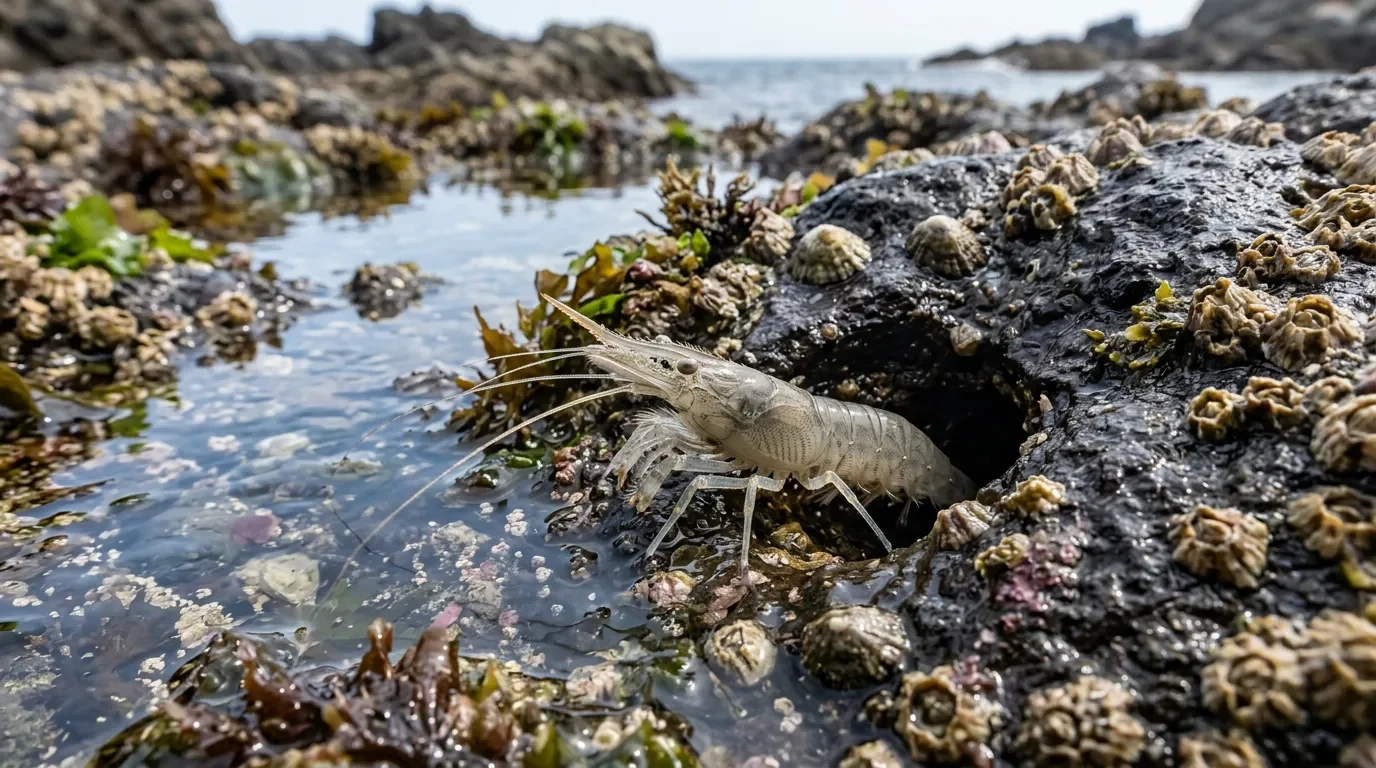
Cover image: AI-generated illustration of a Upogebiidae mud shrimp at a burrow entrance on a Japanese rocky intertidal shore.

Añade más opiniones o contexto en torno a este contenido.

  • Inicia sesión para comentar.