
24/6/2026 · 4:15
Why do we yawn? It is probably not about oxygen

A four-minute explanation of why yawning is probably less about oxygen and more about state changes, brain cooling, and social attention cues.
A yawn feels like a tiny betrayal. You are trying to look awake, polite, and interested; your face decides to open like a drawbridge anyway.
The old schoolyard explanation says you yawn because your brain needs more oxygen. That answer is tidy, memorable, and probably wrong. In a classic experiment, people breathed pure oxygen, air with extra carbon dioxide, and ordinary air; none of those gas mixtures changed how much they yawned, even though breathing rate did change. Exercise that doubled breathing rate did not change yawning either. 1
So why do we do it? The best short answer is: a yawn seems to be a state-change tool. It nudges the body when the brain is drifting between modes: waking and sleeping, boredom and attention, private drowsiness and social alertness.
The yawn is more than a deep breath
A normal yawn is a surprisingly choreographed movement. The Cleveland Clinic describes it as a long inhale, a powerful stretch of muscles around the mouth and throat, and a quick exhale, usually lasting about four to seven seconds. 2 It is mostly involuntary, but it is not just breathing with your mouth open.
Robert Provine, one of yawning's great sidewalk scientists, liked to show this with tiny self-experiments. Pinch your nose and a yawn can still work. Clench your teeth, and the yawn gets stuck in an unsatisfying halfway state. In other words, the open jaw is not decoration. It is part of the motor program. 3
That matters because it points away from oxygen and toward mechanics. A yawn moves the jaw, throat, face, chest, eyes, and blood flow in a coordinated burst. The act looks lazy, but the body is doing a lot.
The leading suspect: brain cooling
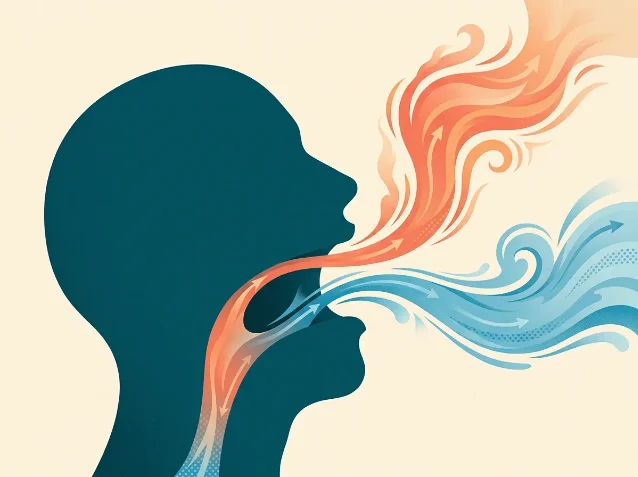
One influential theory says yawning helps regulate brain temperature. The idea is not that the brain is overheating like a laptop fan screaming under load. It is subtler: small changes in temperature can affect neural performance, and yawning may help move warmer blood away while bringing cooler blood and air into the system.
A review of the thermoregulatory theory lays out three possible cooling routes: changes in circulation during the yawn, heat exchange from cooler inhaled air, and ventilation of the sinus system as the jaw and facial muscles move. 4 Another human physiology study found that yawning came with changes such as increased heart rate, lung volume, and eye-muscle activity, and the authors judged the pattern more consistent with the brain-cooling hypothesis than with a plain deep breath. 5
That also helps explain why yawns cluster at transition points. They often appear when we are waking up, getting sleepy, bored, hungry, stressed, or trying to maintain attention. 2 Those are exactly the moments when the brain is switching settings.
| Popular explanation | What the evidence suggests instead |
|---|---|
| "You yawn because you need oxygen." | Extra oxygen and extra carbon dioxide did not change yawning rates in Provine's breathing experiments. 1 |
| "Yawning means you are bored." | Boredom can trigger yawning, but yawns also happen around sleep-wake transitions, stress, hunger, and anticipation. 2 |
| "A yawn is just a big inhale." | The jaw gape and facial-muscle stretch are part of the program; a clenched-teeth yawn feels incomplete. 3 |
The best anecdote is boring on purpose
Provine once had people watch either a static television color-bar test pattern or music videos for 30 minutes. The test pattern worked like a yawn farm: subjects yawned about 70% more during the boring condition. 3

But boredom is not the whole story. Provine also noted anecdotal yawning among paratroopers waiting for a first jump, Olympic athletes before an event, and musicians before going on stage. 3 That pattern makes yawning look less like surrender and more like a reset button. Your body may yawn when attention is sagging, but also when attention is about to be needed.
Then it gets contagious
The strangest part is that yawning escapes the individual. Seeing, hearing, reading about, or even thinking about yawning can set one off. 6 If you have yawned while reading this, sorry. Also: predictable.
Researchers often connect contagious yawning with social mirroring, empathy, and group coordination. Cleveland Clinic summarizes the common view: people are often more likely to yawn contagiously when the yawner is emotionally close to them, and some studies link susceptibility with empathic skills. 2
But the empathy story has cracks. In a 2022 study, 296 participants viewed yawns from fish, amphibians, reptiles, birds, mammals, apes, cats, and dogs; 69% reported yawn contagion during testing, and the response did not neatly track evolutionary closeness or domestication. 7 A yawn may be social, but it may also be a very basic attention trigger: the brain recognizes a familiar motor pattern and starts running its own copy.
The twist: yawning probably has no single job
The neat answer would be: "Yawning cools the brain." That is probably closer than "you need oxygen," but it is still too clean.
Yawning is ancient. It shows up across vertebrates, and human fetuses begin yawning in the womb. 2 A behavior that old has had plenty of time to pick up side jobs. It may help with arousal, thermoregulation, facial and airway mechanics, and social synchronization, depending on the species and situation.
So the next time someone yawns in a meeting, the kinder interpretation is not "they are bored." Their nervous system may be trying to change gears. The ruder interpretation may still be correct, of course. Biology rarely hands us an excuse this convenient without making it ambiguous.
Fuentes de referencia
- 1Yawning: no effect of 3-5% CO2, 100% O2, and exercise
- 2Yawning Definition & Causes
- 3Yawning
- 4The thermoregulatory theory of yawning: what we know from over 5 years of research
- 5Changes in Physiology before, during, and after Yawning
- 6Yawning and its physiological significance
- 7Interspecific Contagious Yawning in Humans
Añade más opiniones o contexto en torno a este contenido.