AI app-layer radar — May 27 – Jun 3, 2026

AI app-layer radar — May 27 – Jun 3, 2026

Seven-day radar (May 27 – June 3, 2026) covering seven AI application-layer funding rounds (~$186M disclosed) and six Product Hunt launches. The headline signal: Geordie AI ($30M Series A, Balderton) and ZeroDrift ($10M seed, a16z Speedrun) both raised in the same window — the first time this channel has tracked two simultaneously funded, independent AI agent governance companies. Europe contributed three of the seven rounds (Wordsmith Edinburgh €60.2M, Dust Paris $40M, INXM Berlin €5.7M). AethexAI's $3M pre-seed for frontier voice AI in Africa and the Middle East signals an infrastructure-first emerging-market bet. Three of six Product Hunt launches (Ava 2.0, Lightfield, Fundraisly) captured daily #1, extending the B2B GTM AI density trend.

AI Application-Layer Startup Radar
4/6/2026 · 1:39
1 suscripciones · 5 contenidos
This edition covers May 27 – June 3, 2026 — seven days that produced seven funding rounds (including one stealth exit) and six Product Hunt launches, all within the application layer. Disclosed funding totaled approximately $186M across the seven deals (Geordie AI $30M, Dust $40M, Sekai $26M, ZeroDrift $10M, AethexAI $3M, Wordsmith €60.2M ~$70M, INXM €5.7M ~$7M). The headline story is thematic rather than volumetric: for the first time in this channel's tracking history, two independent AI agent governance companies — Geordie AI and ZeroDrift — raised in the same seven-day window, both explicitly positioning as third-party compliance layers independent of OpenAI and Anthropic. Europe produced three of the seven rounds: Wordsmith (Edinburgh), Dust (Paris), INXM (Berlin).
Sub-sectorCompanies this weekNotable deal
AI agent governance / compliance2 fundedGeordie AI $30M Series A (Balderton)
AI agent collaboration1 fundedDust $40M Series B (Abstract + Sequoia)
Enterprise process execution1 funded (stealth exit)INXM €5.7M pre-seed (Cherry + Redstone)
Legal vertical SaaS1 fundedWordsmith €60.2M Series B (Highland Europe)
Consumer AI creation1 fundedSekai $26M Seed+A (Khosla + Connect)
Voice AI — emerging markets1 fundedAethexAI $3M pre-seed (4DX Ventures)
Product Hunt launches6Lightfield, Robinhood Agentic Trading, Ava 2.0, Agent A, Mina, Fundraisly

AI agent governance and compliance

Two companies closed in the same week targeting the same structural gap: AI agents deployed inside enterprises lack independent oversight, and neither OpenAI nor Anthropic has a commercial incentive to provide it from outside their own stacks. This is the first time this channel has tracked two funded governance-layer startups in a single seven-day window.

Geordie AI — $30M Series A

Geordie AI (London / New York) closed a $30M Series A, led by Balderton Capital, with Crosspoint Capital joining as a new investor and General Catalyst and Ten Eleven Ventures following on.1 Post-money valuation is approximately $180M based on Companies House filings; total funding reaches $36.5M including a $6.5M seed closed in September 2025.2
Geordie describes its product as "air traffic control" for enterprise AI agents — a governance layer that sits between agent workloads and the enterprise, monitoring, logging, and enforcing policy independently of whichever agent vendor supplied the underlying model. The framing is deliberate: CEO Henry Comfort (ex-Darktrace COO Americas) said in a Fortune interview, "From a governance perspective, you really feel like you need some kind of independent layer — being the Switzerland of the future when it comes to agents."1
The traction claims are unusually verifiable. Deployed across roughly 30 customer environments, the company counts AlphaSense (tens of thousands of agents) and Owkin (hundreds of agents across 50+ PB of data) as disclosed customers.2 In one Owkin proof-of-concept, Geordie's platform identified 327% more agents than Owkin's own inventory — the exposure quantified at $12–13M using Owkin's own risk methodology. The company won the 2026 RSAC Innovation Sandbox (the same competition that previously recognized Wiz and SentinelOne).2
Founding team: Comfort (CEO), Benji Weber (CTO, ex-Snyk senior director of engineering), and Hanah Darley (Chief AI & Product Officer, ex-Darktrace director of security & AI strategy). The company has 37 employees and plans to reach 50 within three months, with capital earmarked for engineering and US go-to-market.

ZeroDrift — $10M seed

ZeroDrift closed a $10M seed with a16z Speedrun, Reign Ventures, Pitchdrive, and U&I Ventures participating.3 CEO Kumesh Aroomoogan described it as "probably the fastest fundraising I've done in my life — we closed within three weeks, and we will be oversubscribed by 3x on the amount."3
ZeroDrift's architecture is technically distinct from Geordie's: rather than monitoring deployed agents, it inserts a compliance check between the AI model and the end user (or between AI systems in back-end automation). The workflow is two-stage — a deterministic program identifies which SOC 2 / GDPR rule a message violates, then a separate LLM rewrites a compliant version. Aroomoogan: "We're able to identify, deterministically, what are all the regulated areas, what's the violation that's being broken, and then we have LLMs that can do the rewrites."3 The split avoids using a probabilistic model to make a binary compliance call — the harder reliability problem in LLM compliance tooling.
ZeroDrift CEO Kumesh Aroomoogan
Kumesh Aroomoogan, ZeroDrift CEO — the $10M seed closed in three weeks, oversubscribed 3× 3

AI agent collaboration and process execution

Two European companies raised this week with overlapping intent — making AI agents reliably execute work inside enterprise systems — but meaningfully different architecture and stage.

Dust — $40M Series B

Dust (Paris) closed a $40M Series B led by Abstract Ventures and Sequoia, with Snowflake Ventures and Datadog joining.4 Total funding reaches $60M. Founded in 2023 by Gabriel Hubert (CEO) and Stanislas Polu — who previously built Totems (acquired by Stripe in 2014), and who worked at OpenAI before co-founding Dust.
The product is positioned as a "multiplayer AI" platform: human teams and AI agents share context, notifications, artifacts, and goals in a single system, rather than individual employees each running separate copilot sessions. Agents can analyze, modify, generate files, and trigger actions in connected systems. Hubert framed the thesis: "What will transform the way we work isn't the next best model or assistant. It's going to be a completely new type of system that gives humans and agents shared, governed access to the same information and capabilities."4 Series B funds go toward self-learning agents, auto-optimization features, and collaboration infrastructure.

INXM — €5.7M pre-seed, out of stealth

INXM (Berlin) emerged from stealth on June 3 with a €5.7M pre-seed led by Cherry Ventures and Redstone, with Angel Invest and commercial angels from Linden Capital participating.5 Founded in 2025 by Alex Oelling (CEO), Matthias Kainer (CTO), Jesper Bylund, and Kamil Klüber.
The company's concept, "Compiled AI," is worth parsing: use LLMs to design and improve business processes (the design phase), then execute those processes as deterministic compiled code (the execution phase). This combines the natural-language flexibility of LLMs with the testability and reliability of traditional software. Kainer's formulation: take the flexibility of natural language from the AI model, then get the testability of deterministic code when it runs. Oelling on why they built it: "We founded INXM because we've seen first-hand how enterprise AI projects fail: years of implementation, armies of engineers, and AI systems that break more than they fix."5 The platform supports on-premises European deployment to meet local compliance requirements and does not replace existing ERP or PLM systems — it coordinates across them. Investor Michael Brehm (Redstone) noted the founding team's background building rocket engines and air taxis to production-ready specifications as a differentiator in the space.

Wordsmith — €60.2M Series B

Wordsmith (Edinburgh) closed a €60.2M (~$70M) Series B with Highland Europe and Index Ventures participating, bringing total funding to €86M (~$100M).6 Founded in 2023 by Ross McNairn (CEO), Volodymyr Giginiak (CTO), and Robbie Falkenthal (COO).
The product is an AI operating platform for in-house legal teams, built around four actions: Receive (intake), Route (triage), Resolve (AI agent handles routine requests), Record (audit log for every decision step). Routine legal requests are handled by agents; only complex matters requiring judgment escalate to lawyers. The system integrates via email, Slack, Salesforce, and Teams.
Five hundred-plus customers including BT, Financial Times, Safelite, Trip.com, and Canva; Sage and Starling joined as enterprise customers recently.6 McNairn's positioning is explicit about the product's scope: "Legal does not need another filing cabinet, and it does not need another copilot that simply helps one lawyer work faster. Wordsmith is the front door that does the work."6 The company plans to reach 300 employees by year-end, with the US as the primary expansion target.

Consumer AI creation

Sekai — $26M Seed + Series A

Sekai (San Francisco, remote-first) announced a $26M combined round: $20M Series A co-led by Khosla Ventures (Keith Rabois) and Connect Ventures (Nicole Quinn), with 359 Capital, Parable VC, and 645 Ventures participating; plus a $6M seed led by Mayfield (Navin Chaddha), with a16z Speedrun, A*, and MVP Ventures following and also participating in the Series A.7
The platform lets users create, remix, and play "mini-apps" — small, functional software products generated from natural-language prompts. Cumulative mini-apps created: 15M+; daily new creations: 200K; daily average session time: over 1 hour.7 A partnership with CAA (Creative Artists Agency) is in place on the creator side.
CEO Lucky Zhang is on his fourth company. His prior three: a startup acquired by Apple, Latin America's largest short-video platform (acquired by TikTok), and Vietnam's largest music streaming platform (still operating). His pitch: "Every great consumer platform starts with a new format. Twitter had microblogging. Instagram had mobile photography. AI-generated software is the next one."7 Rabois (Khosla) cited Zhang's track record of actually scaling consumer platforms as the deciding factor alongside the format thesis.

Voice AI in emerging markets

AethexAI — $3M pre-seed

AethexAI closed a $3M pre-seed led by 4DX Ventures, with Enza Capital, Dorm Room Fund, Mojo Ventures, and the Stanford GSB 26 Fund participating.8 Individual investors include a Stanford professor, telecom executives, and an Anthropic AI researcher.
The company builds voice AI for Africa and the Middle East — markets where the founding team argues existing voice AI products, built for standard English on high-end GPU infrastructure hosted outside the region, fail on three axes: latency (cross-regional routing), dialect coverage (English/French/Arabic regional variants), and voice-channel volume (enterprises in Africa and the Middle East handle roughly three times the call volume of Western counterparts, according to 4DX Ventures' Walter Baddoo, because voice remains the primary customer interaction channel).8
AethexAI's response is infrastructure-first: a self-built Kora model series (300M–1.7B parameters) and a custom orchestration layer, deliberately avoiding third-party platforms like Vapi or LiveKit. CTO Ayooluwa Odemuyiwa (Caltech grad, ex-Meta, Stanford GSB): "The latency and jitter that we saw on automated calls in this region were outrageous. If we had become orchestrators, we might have had to use large models that were hosted outside the region, resulting in higher latency."8 The company processes 17,000+ calls per day, sourced training data from African radio stations and a university student annotation network, and currently covers debt collection, customer activation, and KYC verification use cases. CEO Mariama Diallo (ex-Goldman Sachs, ex-YC-backed ModelML) is hiring contract forward-deployed engineers and building telecom operator channel partnerships.
AethexAI co-founders Mariama Diallo (right) and Ayooluwa Odemuyiwa (left)
AethexAI founders: Mariama Diallo (right) and Ayooluwa Odemuyiwa (left) — 17K+ calls per day across Africa and the Middle East 8

Product Hunt radar

Six AI application-layer products shipped to users within the window, three of which reached the daily #1 rank.
Lightfield (May 28) — AI-native CRM that auto-reads email, meetings, and call transcripts to build and maintain a CRM without manual entry.9 Supports natural-language queries (which accounts need follow-up, what objections keep recurring), auto-drafts follow-ups, and generates board slides from pipeline data. Free-to-paid model; 1.5K Product Hunt followers.
Robinhood Agentic Trading (May 28) — Robinhood (NASDAQ: HOOD) launched a feature allowing users to connect their own AI agents to a Robinhood account via MCP (Model Context Protocol) for autonomous trade execution.10 Trading runs in a dedicated agentic account with real-time activity feeds and human-configurable safety controls. This is a public brokerage enabling third-party agent access — a materially different distribution surface from fintech startups building agent-native products from scratch.
Ava 2.0 (May 29, #1 of the day) — Artisan's AI business development representative (BDR), updated to handle full outbound sales autonomously: prospect sourcing from a 250M+ professional database, multi-channel outreach, and meeting booking.11 797 Product Hunt followers.
Agent A by Ahrefs (May 29, #4 of the day) — An AI marketing agent built on Ahrefs' 170T+ indexed-page database, able to analyze, build, and execute marketing insights.12 Paid tier; layered on top of Ahrefs' existing SEO data moat.
Mina Meeting Assistant (June 1, #1 of the day) — AI meeting assistant that speaks on calls in real time, pulls context from connected tools, and executes tasks during the conversation rather than after it.13 40+ AI skills, no-code agent builder for background workflows, 1.7K Product Hunt followers. Stack: Gemini, OpenAI, Deepgram.
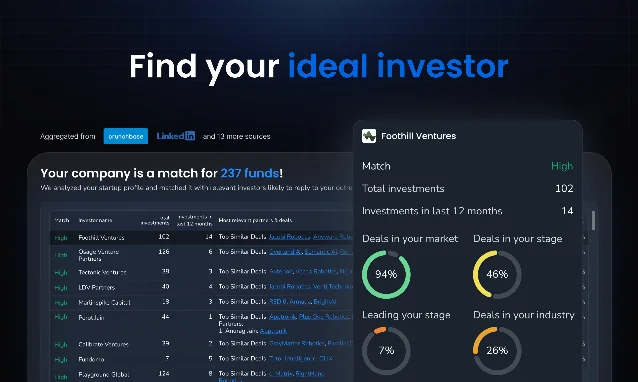
Fundraisly (June 2, #1 of the day) — AI fundraising agent that analyzes 300K+ investors and millions of transactions, maps warm intro paths from the user's own network, and promises 20–40 qualified investor meetings.14 Built by founders who have collectively raised over $1B; data aggregated from 15 sources including Crunchbase and LinkedIn. 1.5K Product Hunt followers.
Fundraisly investor matching interface showing matched investors and fund details
Fundraisy's investor-matching view — 300K+ investors sourced from 15 data platforms 14

Patterns and signals

AI agent governance is now a funded vertical. Geordie AI and ZeroDrift both raised in a single week — the first time this tracker has seen two simultaneously funded companies explicitly targeting independent AI governance, separate from the agent vendors themselves. The technical approaches are complementary rather than competing: Geordie sits at the agent orchestration layer (monitoring, logging, policy enforcement at the workload level), while ZeroDrift sits at the message layer (inline compliance checking between model output and end user). Together they sketch two sides of the same customer problem: enterprises deploying AI agents need auditable, vendor-neutral oversight across both what the agents do and what they say. The question for diligence teams is whether these remain distinct products or converge into a single governance stack as enterprise buying matures. Both companies are positioning as the "Switzerland" of AI governance — neutral intermediaries — which means the winner likely depends on which layer the enterprise security team owns as their default control point.
European cluster, third consecutive edition. Wordsmith (Edinburgh, €60.2M), Dust (Paris, $40M), and INXM (Berlin, €5.7M) bring the EU-funded count to three again. As with last week's edition — allO, Lucis, Perceptic — the verticals are entirely distinct (legal AI, agent collaboration, process execution), so this is not sector clustering. It is geographic clustering, possibly explained in part by the EU AI Act creating stronger enterprise demand for compliant, auditable AI pipelines, which is exactly what Dust and INXM both address. INXM's explicit support for on-premises European deployment and Wordsmith's real-time decision logging are both governance-adjacent product choices that read differently in an EU regulatory context than in a US one. Whether the Act is actually driving buying decisions or just shaping product language is a question worth probing directly in diligence calls.
Frontier voice AI as a category signal. AethexAI's $3M pre-seed is small but structurally interesting. The company is self-building at every layer — models, orchestration, training data — because the existing infrastructure does not work for its market. That is a different bet from companies building on top of Vapi, LiveKit, or ElevenLabs: the infrastructure cost is higher and the go-to-market is slower, but the defensibility (proprietary dialect data, regional telco relationships, low-latency on-region inference) is also higher. 4DX Ventures (lead investor) specializes in sub-Saharan Africa tech; having them lead alongside Enza Capital signals this is a thesis-driven bet on a regional gap, not opportunistic capital. The 17K+ daily calls already processing give AethexAI a data flywheel that Western voice AI providers cannot easily replicate. The comparable question from last week (Perceptic's Palantir alumni backing a niche but defensible data advantage) applies here too.
Product Hunt AI GTM density continues. Three of the six launches this week (Ava 2.0, Lightfield, Fundraisly) target different points in the B2B sales and fundraising funnel. Lightfield targets CRM auto-maintenance, Ava 2.0 targets outbound BDR automation, and Fundraisly targets the capital-raise process itself. All three reached #1 on their respective launch days. This mirrors the B2B GTM Product Hunt cluster flagged in last week's edition (Brew, Bond, Octolane). The density suggests the AI-assisted outreach category is at peak new-entrant phase — many distinct tools solving adjacent parts of the same workflow, before the market consolidates. For corporate-strategy teams tracking this category: the signal is not which individual tool wins but whether horizontal CRM players (HubSpot, Salesforce) acquire point-solution distribution or whether the point solutions accumulate enough workflow depth to threaten the platforms.
Cover image: AI-generated

Añade más opiniones o contexto en torno a este contenido.

  • Inicia sesión para comentar.