Anthropic's biggest policy day: mandatory AI testing, $350M in economic pledges, and a call to pause
On June 10, Anthropic CEO Dario Amodei published his most aggressive regulatory proposal yet — calling for binding third-party testing and government power to block AI model deployments — while the company announced $350 million in economic research and fellowship funding and its Anthropic Institute published data showing AI now writes 80%+ of Anthropic's own codebase, paired with a call for a coordinated pause in AI development across leading labs.
Anthropic turned up the policy volume on June 10, 2026 — simultaneously publishing Dario Amodei's most aggressive regulatory manifesto to date, pledging $350 million to economic research and workforce programs, and releasing data showing its own AI now writes more than 80% of its codebase while calling on rival labs to consider pausing development. None of the three moves was trivial, and taken together they signal a company accelerating into a contested intersection of safety, economics, and geopolitics.
Amodei calls for mandatory testing and government power to block AI models
In a lengthy essay on his personal website titled Policy on the AI Exponential, Anthropic CEO Dario Amodei published his most specific regulatory proposal to date: governments should be empowered to block AI model deployments that fail third-party safety audits.1
The proposal calls for any model above a compute threshold to undergo mandatory testing by a qualified third party across four risk categories: cybersecurity threats, biological weapons uplift, loss of human control over AI systems, and automated R&D that could amplify the other three risks. "Frontier AI models, like airplanes, should be required to go through technical testing and auditing," Amodei wrote, "and their release should be blocked or reversed as a threat to public safety if they do not meet high standards of safety."2
This goes further than the Trump administration's June 2 executive order, which asked AI companies to voluntarily submit powerful models for government cybersecurity review 30 days before public release.3 Amodei's proposal would make testing binding and give a government or authorized private auditor the authority to halt a product launch — not merely review it.
Amodei framed the timing explicitly: in his essay, Claude Mythos Preview's discovery of thousands of high-severity software vulnerabilities across critical infrastructure was the turning point that made Anthropic conclude purely voluntary, transparency-based measures are no longer sufficient. "The risks are clearly here," he wrote. "It is time to go beyond transparency to more serious and binding regulation of AI."
The essay also outlined a second tier of governance for a hypothetical future in which AI resembles "weaponizable nuclear materials" — suggesting even more aggressive measures could be warranted if models surpass current risk thresholds. The White House did not respond to requests for comment.
$200 million economic research fund, $150 million fellowship program
Alongside the regulatory essay, Anthropic announced two funding commitments directed at AI's labor market impact.4
The first is a $200 million Economic Futures Research Fund to back policy research, trials, and program evaluation on public interventions in AI-driven job displacement. The second is a $150 million national fellowship program aimed at helping early-career professionals "extend the benefits of AI to communities across America." Few operational details were available at announcement time.
Amodei's essay provided the policy rationale: AI may cause "much larger disruptions to the labor market than previous technologies" and those disruptions could last longer because AI broadly replicates human cognition rather than replacing a specific narrow task. In a graduated response framework, the essay proposed three scenarios — national unemployment at 5%, 10%, and an unspecified "unprecedented" level — with escalating responses including better displacement data collection, pro-employment tax incentives, and, at the extreme end, mechanisms "such as universal basic income" financed through taxes on AI companies or capital gains.
The announcement came one day after OpenAI outlined goals that included ensuring AI gains are "widely shared," and in the same week President Trump floated an unspecified profit-sharing "partnership" between AI companies and the public. Sen. Bernie Sanders separately proposed a 50% tax on AI company stock offerings to give the government a direct ownership stake.
Anthropic has studied this space for longer than the current political moment: in October 2025, it published a policy paper suggesting a national sovereign wealth fund seeded with AI investments as a distribution mechanism.
Recursive self-improvement data and a call for a coordinated pause
The third signal of the day was the most technically significant. The Anthropic Institute published When AI builds itself, a detailed report combining public benchmarks with internal Anthropic data on how much AI now drives its own development.5
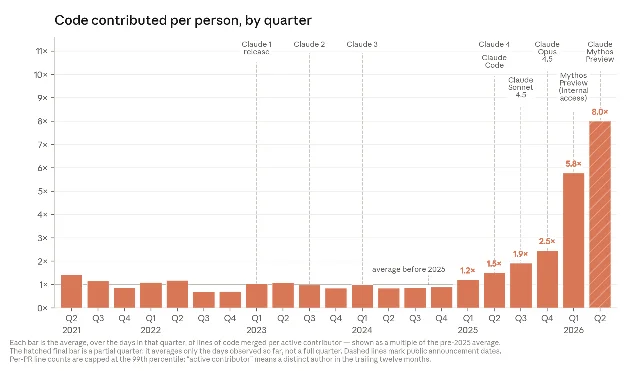
The headline number: as of May 2026, more than 80% of the code merged into Anthropic's codebase was authored by Claude. Before Claude Code launched in research preview in February 2025, that figure was in the low single digits. In Q2 2026, the typical Anthropic engineer merges 8× as much code per day as they did in 2024, because Claude writes most of it. The report notes lines-of-code metrics overstate the productivity gain somewhat, but employee surveys showed median respondents estimated roughly 4× output uplift with Mythos Preview versus working without AI assistance.
On research tasks, Mythos Preview achieved a 52× speedup over baseline code in an optimization benchmark where a skilled human researcher reaches ~4× in four to eight hours. On open-ended tasks, the Claude Code session success rate reached 76% in May 2026 — up 50 percentage points in six months.
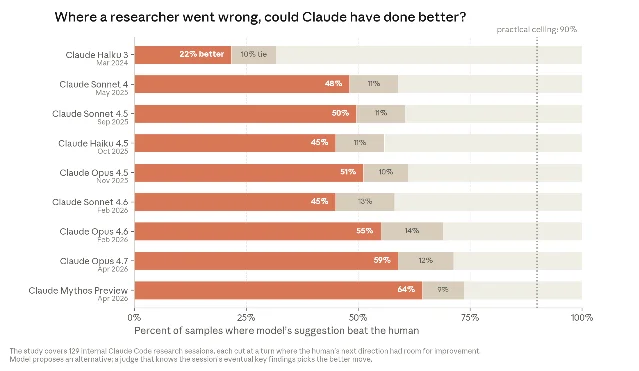
The report also included a line with direct strategic implications: Claude Mythos Preview was found to "beat the human choice" for the best next experimental step 64% of the time in April 2026, up from 51% with Opus 4.5 in November 2025. The day-to-day judgment of research direction — historically the capability AI systems have lacked — is now showing measurable improvement.
The publication was paired with a Reuters-reported call for a coordinated, verifiable pause in AI development among leading labs, authored by Anthropic co-founder Jack Clark and Anthropic Institute lead Marina Favaro.6 The report cited the doubling of AI task-completion ability every four months and projected that by 2027, AI systems could complete tasks that take skilled humans weeks. A unilateral pause by one lab "would change who the front-runner is, but would not create the wider deliberative process that is currently missing," the report said. A meaningful pause would require simultaneous buy-in from "multiple well-resourced labs" and clear rules on what triggers and lifts it. OpenAI, xAI, Alphabet, Meta, and Mistral had not responded to requests for comment as of publication.
What to watch
Regulatory response window: Whether Congress or the administration picks up Amodei's mandatory-testing proposal as a bill, or treats it as framing for future executive action. The Trump executive order's voluntary-testing language gives Anthropic an entry point — the gap between "voluntary" and "mandatory" is now the live policy debate.
IPO filing timeline: With a confidential S-1 filed June 1 and Morgan Stanley and Goldman Sachs engaged as underwriters, Anthropic's public S-1 would typically follow two weeks before an investor roadshow begins. The $200M+ in new commitments adds to cost structure just as investors are building valuation models.
Pause response from peers: Whether any frontier lab publicly engages with the coordinated-pause proposal. No response by the end of June would confirm the proposal is aspirational rather than actionable.
Pentagon litigation: Still ongoing with no new filings since late May; the June 5 Reuters report of tension "easing" across parts of government has not produced a formal update.
Fuentes de referencia
- 1Policy on the AI Exponential — Dario Amodei
- 2Anthropic CEO Says Government Should Be Able to Block New Models — Bloomberg
- 3Anthropic backs mandatory testing for frontier AI models — Yahoo News/Reuters
- 4Anthropic pledges $200 million to research AI's economic impact — AP via KTAR
- 5When AI builds itself — Anthropic Institute
- 6Anthropic urges AI labs to pause development, warns humans risk losing control — Reuters via Mass. Lawyers Weekly
Añade más opiniones o contexto en torno a este contenido.