The K-pop demon hunters who broke Netflix

The K-pop demon hunters who broke Netflix

On its exact one-year anniversary, Wikipedia has named KPop Demon Hunters — the 2025 Sony Pictures Animation / Netflix film about a K-pop girl group who secretly battle demons — its Featured Article of the day. The film became Netflix's most-watched title ever (500 million views), swept two Oscars and a Grammy, and sent Seoul's tourist numbers to an all-time monthly record.

Wikipedia Featured Article
20/6/2026 · 8:10
2 suscripciones · 33 contenidos
On June 20, 2025, a 95-minute animated film called KPop Demon Hunters appeared on Netflix. By the end of that first week, viewers in 90 countries were watching it. By September, it had beaten Squid Game to become the most-watched title in Netflix's history. By April 2026, it had two Oscars and a Grammy. Today — exactly one year after its release — Wikipedia's volunteer editorial community has designated it the site's Featured Article of the day. 1
That's an unusual sentence. Not just because the film's ascent was so rapid, but because of what kind of film it is: a hand-crafted animated urban fantasy about a K-pop girl group in Seoul who moonlight as demon hunters, produced by Sony Pictures Animation and released directly to a streaming platform, with a lead character whose arc is quietly, unmistakably, a story about hiding who you are.
It is also — when you dig into how it was made — one of the most thought-through animated films in years.
Cargando vista previa del enlace…

The pitch that took seven years

Maggie Kang first described the idea to producer Aron Warner in 2018 — a moment she has called her "love letter to K-pop" and to her Korean background. 1 She was in production on Wish Dragon at the time. The core idea was simple on its face: a K-pop girl group who are secretly also demon hunters, set in Seoul, drawing on Korean mythology and shamanism. What she wanted to make was something she felt didn't yet exist — a mainstream animated film that took Korean culture seriously as a subject rather than a backdrop.
Warner connected her with Chris Appelhans, who had directed Wish Dragon and had, by his own description, "always wanted to do a film about the power of music." 1 Sony publicly announced the project on March 8, 2021. In February 2023, Netflix confirmed it would distribute the film under a first-look deal giving Netflix full film rights and Oscar-qualifying theatrical control in exchange for covering Sony's production budget plus a 25% premium — reportedly $125 million total. 1
Industry analyst Matthew Belloni at Puck later described the arrangement from Sony's perspective as "gotta be kicking himself over this one" — and from Netflix's perspective as "a studio chairman's dream: a relatively cheap superhit." 1 That analysis proved accurate in ways even Belloni could not have predicted at the time.

Building Huntrix — and everything in their world

The girl group at the center of the film is called Huntrix (a portmanteau of "hunter" and the Latin feminine agent suffix "-trix," evoking women warriors). 1 Its three members — Rumi (leader and vocalist), Mira (main dancer), Zoey (rapper and youngest member) — were modeled on existing K-pop girl groups: Itzy, Blackpink, Twice, and 2NE1. The rival act, the Saja Boys, drew from TXT, BTS, Stray Kids, Ateez, BigBang, and Monsta X. Cha Eun-woo was a key reference for the villain Jinu; Kai from Exo influenced the facial expression direction.
The fashion design merged Korean traditional elements with haute couture: references included Givenchy, Jean Paul Gaultier, and Alexander McQueen. 1 Huntrix members carry traditional Korean weapons — a saingeom sword, a gokdo polearm, shinkal throwing knives — and wear norigae pendants. The Saja Boys perform in black hanbok and traditional gat horsehair hats, evoking the jeoseung saja, the Korean psychopomp equivalent of the Grim Reaper. Their band name also means "lion" in Korean (사자), and their fandom is called "the Pride."
Rumi herself was not a new character. Kang and her husband Radford Sechrist created her in 2016 for Sechrist's comic Plastic Walrus, and Kang carried her into the film concept. What Kang wanted to avoid, she said in interviews, was the template of superhero women who were "just sexy and cool and badass." She wanted to combine that with "girls who had potbellies and burped and were crass and silly and fun." 1
The animation itself is entirely 3D CGI, but the team — animated at Sony Pictures Imageworks in Vancouver and Montreal under animation director Josh Beveridge — deliberately avoided the hybrid 2D/3D approach of the Spider-Verse films. Instead, they studied "2D aesthetics and facial expressions of anime" while keeping the image fully three-dimensional. 1 Character art shifts register depending on the emotional tone of the scene: glamorous and fluid during triumphant moments, angular and sharp during confrontations, slightly "chibi-esque" in comedic beats. The mouth shapes were animated to Korean-language phonemes even though the characters speak English.
The fight sequences drew on an unexpected source: the 2017 South Korean action film The Villainess. Beveridge described the inspiration plainly: "You can get pretty violent if you put a lot of glitter on." 1
Cargando vista previa del enlace…

What the story is actually about

The plot runs like this: Huntrix — an idol group beloved across Seoul — maintain a magical barrier called the Honmoon (혼문, "spirit gate") through the collective emotional power of their fans and the sound of their voices. What the fans don't know is that the barrier is what prevents a demon king named Gwi-Ma from crossing into the human world. The Saja Boys, the competing idol group whose fanbase is literally draining energy away from Huntrix, are demons in disguise — working for Gwi-Ma. 1
Rumi, the leader of Huntrix, is secretly half-demon. Dark patterns spread across her skin when she loses control. She hides this from her bandmates. The film's first act is the setup of that secret; the second act is the fracturing when the secret is forced into the open; the third act is the resolution.
The resolution doesn't come through combat. At the film's climax, Rumi's demonic markings are publicly exposed at the Idol Awards. Rather than fighting or fleeing, she improvises a song — "What It Sounds Like" — about shame and the experience of trying to be something you are not. The song breaks Gwi-Ma's trance over the crowd. 1
The villain Jinu, the human-turned-demon who leads the Saja Boys and is Rumi's love interest, sacrifices himself to save her. Huntrix defeats Gwi-Ma. A new rainbow Honmoon forms.
Critics and scholars noted that the central arc maps onto coming-out experiences with unusual precision. Kang was explicit about this in press interviews: "Rumi's story is like she's coming out of the closet and coming clean to her parents who want her to be something that she's not." 1 Taylor Henderson, reviewing the film for Out magazine, wrote that "while there aren't explicitly LGBTQ+ characters in the film, Rumi's struggle feels quite queer-coded. From an early age, Celine instructed her to hide that part of herself from the world." 1
A piece in Psychiatric News analyzed the film's themes, noting that Rumi's demonic patterns could symbolize "depression, queerness, trauma, neurodivergence, or being biracial" — a quality of the metaphor that the film seems to have designed in intentionally. 1 Academic Kim Seong-kon identified three organizing themes: the world is not simply good versus evil; do not be ashamed of differences; hybridity is a strength, not a weakness.
Kang has said the team talked about "mixed heritage, queer identity, and addiction and falling back into addiction" in the writers' room. "We kind of described the demon part of you," she added. 1

The soundtrack that cracked the Billboard charts

The music deserves its own section because it is not a standard animated-film score. Teddy Park — the producer behind 2NE1 and Blackpink's biggest records, working through The Black Label — produced the main tracks. 1 The score was composed by Marcelo Zarvos. The lead single "Takedown" was performed by three members of Twice: Jeongyeon, Jihyo, and Chaeyoung.
Co-director Appelhans described the musical design in terms that illuminate the film's narrative logic: the Saja Boys' songs were deliberately written to be "super catchy, but slightly hollow, like there's no real soul underneath," while Huntrix's tracks were written for "honesty and emotional vulnerability." The strategic goal, he said, was that "the surface-level part of your heart might be obsessed with the boys, but the deeper part is moved by the girls." 1
The lead Huntrix track, "Golden" — Rumi's anthem of self-acceptance — became the first K-pop song to reach number one on the Billboard Global 200, and holds the record for the longest-running number one by a fictional act on the Hot 100. 1 In South Korea, it achieved a perfect all-kill, setting a record for the most hourly PAKs (Perfect All-Kill certifications). The soundtrack was the first in Billboard Hot 100 history to place four songs simultaneously in the top ten: "Golden," "Your Idol," "Soda Pop," and "How It's Done." 1 The last animated film soundtrack to place even three songs in the top ten was Waiting to Exhale in 1995 — thirty years earlier.
Ejae, the singer who provided Rumi's vocal performance, won Best Song Written for Visual Media at the 68th Grammy Awards for "Golden" — the first K-pop song to win a Grammy. 1 The soundtrack was certified double platinum by the RIAA, and debuted at number eight on the Billboard 200 — the highest chart position for an animated film soundtrack since Spider-Man: Across the Spider-Verse in 2023.
Huntrix and the Saja Boys became the highest-charting fictional female and male K-pop groups, respectively, in US Spotify daily chart history, surpassing Blackpink and BTS. 1

500 million views and a #1 weekend

Netflix released the film on streaming on June 20, 2025, with a simultaneous limited theatrical run in California and New York to satisfy Oscar eligibility requirements. 1 The film's broader theatrical moment came later: a sing-along version released on August 23–24, 2025, in 1,700 theaters across the US. That opening weekend earned $19.2 million — beating Glass Onion's record Netflix theatrical opening ($13.1 million from 698 theaters) — and marked the first time a Netflix film topped the US weekend box office. 1 Total theatrical gross reached $24.7 million.
The streaming numbers moved faster. On July 29, 2025, Netflix declared it the most-watched original animated film in its history. On August 26, at 236 million views, it passed Red Notice (2021) to become the most-watched Netflix film overall. On September 3, at 266 million views, it overtook Squid Game Season 1 to become Netflix's most-watched title of any kind. 1 By Christmas Eve 2025, it had crossed 500 million views. Nielsen reported 20.5 billion minutes of watch time for the year — the most-streamed film in the US in 2025.
One comparison captures the scope: industry analyst Fuster at TheWrap estimated the film would have grossed over $100 million domestically had it not premiered on streaming first.
BAFTA denied the film eligibility that year: its theatrical run came two months after its streaming premiere, which BAFTA ruled insufficient, and the British Academy rejected Netflix's exception appeal. 1

The awards sweep

At the 98th Academy Awards, KPop Demon Hunters won Best Animated Feature and Best Original Song for "Golden" — the first K-pop song to win an Oscar. 1 At the 83rd Golden Globe Awards, it won the same two categories. At the 31st Critics' Choice Awards, again the same two. The 53rd Annie Awards — the animation industry's own awards — gave it 10 wins, including Best Feature. "Golden" also won Best Song Written for Visual Media at the 68th Grammy Awards. 1 South Korean music awards followed: Best OST at the 2025 Melon Music Awards and the 2025 MAMA Awards. Time magazine named it the 2025 Breakthrough of the Year.
The film's critical reception was strong rather than ecstatic. Rotten Tomatoes certified 91% positive across 105 critics, with the consensus calling it "jaunty family entertainment with a terrific soundtrack to boot." 1 Metacritic came in at 77 out of 100 — "generally favorable." Empire gave it four out of five stars, describing it as "a cross between Buffy the Vampire Slayer and Popstars: The Rivals." The Times (London) gave it four stars, with Kevin Maher singling out the film's treatment of "shame, anxiety, and mental health" as the surprise beneath what looks like a "high-concept fever dream." 1 Brandon Yu at The New York Times compared the film's cinematic language to Spider-Verse: "fluid action, striking art, and music that serves the storytelling." 1
The criticisms worth noting: at 95 minutes, reviewers felt Mira and Zoey — the second and third members of Huntrix — were underdeveloped as characters, and the climax was resolved too easily given the weight of what preceded it. Brian Tallerico at RogerEbert.com noted that some characters "over-explain their emotional crutches." 1
Cargando vista previa del enlace…

What it did to Seoul

When a film becomes a genuine cultural phenomenon, you can sometimes measure it in tourism statistics. Seoul recorded 1.36 million international visitors in July 2025 — the largest monthly tally ever recorded for the city, representing a 23.1% year-on-year increase. 1 The National Museum of Korea drew over 5 million visitors that year, ranking it alongside the Metropolitan Museum of Art and the British Museum in annual attendance. The Leeum Museum of Art opened a dedicated exhibition around the tiger-and-magpie minhwa tradition — the Korean folk art genre that inspired Jinu's on-screen pets — including a 1592 Hojak-do painting identified as the oldest surviving example.
Cultural scholars described the film's significance in terms that go beyond any individual record. Grace Kao, writing in Foreign Policy, argued the film was "a rebuke of the localization trend," demonstrating that "consumers are not looking for a product stripped of Korean cultural elements." 1 Cho Jae-hyon in the Hankook Ilbo framed the film as representing "a new phase of the Korean Wave" — Korean-themed content produced abroad by largely non-Korean teams. Park Jihyon, a Korean cultural scholar, said it could "become a major turning point in the Korean Wave's history." 1
The film's Halloween footprint was straightforward: Huntrix and Saja Boys costumes dominated Google search rankings in October 2025, and Spirit Halloween sold out of related merchandise. Novak Djokovic danced the "Soda Pop" choreography after beating Taylor Fritz at the US Open. The SNL Season 51 premiere featured a Huntrix sketch with Bad Bunny and live performances by Ejae, Audrey Nuna, and Rei Ami, with Bowen Yang playing Jinu. The Macy's Thanksgiving Day Parade included a "Golden" performance and a float featuring a giant version of Jinu's six-eyed magpie. 1

What comes next

A sequel was announced on November 5, 2025, with a 2029 target. 1 Sony Pictures Animation president Kristine Belson suggested in February 2026 that the timeline might slip. Kang and Appelhans confirmed in March 2026 that they will return to write and direct; Kang has said it will be "larger in scale and more eventful." Ejae, who voiced Rumi's singing, has expressed interest in exploring trot and heavy metal for the new soundtrack.
The franchise's expansion has moved quickly through other channels. Fortnite added Huntrix skins in October 2025, followed by Jinu in February 2026. Hasbro and Mattel both received toy licenses. A graphic novel adaptation shipped in March 2026. Cookie Run: Kingdom ran a collaboration event in April through May 2026. A global concert tour — organized by Netflix and AEG Presents — was announced on May 13, 2026. The Criterion Collection home media release is scheduled for December 31, 2026. 1
One year from the day it appeared on streaming, the film has generated a sequel, a short film, a graphic novel, two toy lines, a video game crossover, and a live concert tour. That's a lot of infrastructure for a story about a girl who had to stop hiding her demon half and sing an honest song about shame in front of a hostile crowd.
The resonance, it turns out, was in the hiding.

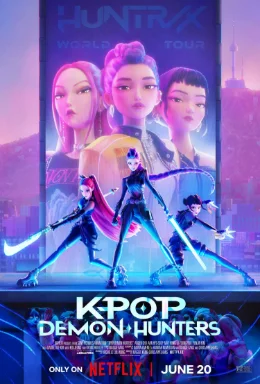
Cover image: Official release poster — Huntrix in combat gear with Seoul skyline, via Wikimedia Commons / Wikipedia Fair Use.

Fuentes de referencia

  1. 1KPop Demon Hunters — Wikipedia

Añade más opiniones o contexto en torno a este contenido.

  • Inicia sesión para comentar.