
Claude Fable 5 and Mythos 5: one model, two access tiers, and a new classifier architecture
On June 9, 2026, Anthropic released Claude Fable 5 to the general public — a Mythos-class model with dedicated safety classifiers covering cybersecurity, biology/chemistry, and distillation — while simultaneously upgrading its Glasswing partners to Claude Mythos 5 with those classifiers lifted. This article breaks down the benchmark results, the new classifier architecture and its false-positive trade-offs, the trusted access program for life sciences, and what the alignment assessment actually found.

One model, two names, one large bet on safeguards
On June 9, 2026, Anthropic released Claude Fable 5 to the general public and simultaneously upgraded its cybersecurity partners to Claude Mythos 5 — two model names for what is, underneath, a single set of weights. 1 The distinction between Fable and Mythos is not architecture but access policy: Fable 5 ships with safety classifiers that intercept requests in cybersecurity, biology/chemistry, and distillation; Mythos 5 has those classifiers lifted for vetted users who go through Project Glasswing or Anthropic's new trusted access program.
This is the model Anthropic has been building toward since April, when it released Claude Mythos Preview through Glasswing to a narrow group of cyber defenders. 2 At the time, Anthropic said it hoped to eventually release Mythos-class capabilities broadly once safeguards were ready. With Fable 5, it is making good on that commitment — while pricing the pair at $10 per million input tokens and $50 per million output tokens, less than half what Mythos Preview cost.
What the model can actually do
Anthropic does not publish a single benchmark number and call it a day. The Fable 5 / Mythos 5 launch post includes a wide benchmark table across coding, knowledge work, vision, and science tasks, and several of the numbers are worth examining closely.
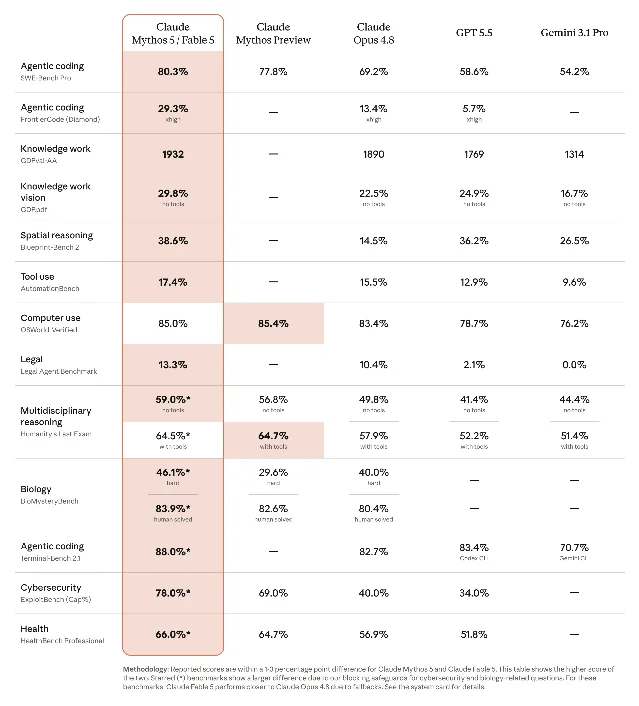
Software engineering is the category where partner feedback is most concrete. Stripe reported that Fable 5 compressed months of engineering into days on a 50-million-line Ruby codebase — it completed a migration that would have taken a whole team more than two months, in a single day. On Cognition's FrontierCode evaluation, which tests production-quality output (not just correctness), Fable 5 scores highest among frontier models even at medium effort. Cursor, GitHub Copilot, and Replit all gave early-access endorsements pointing in the same direction: longer-horizon reliability, fewer tokens per completed task.
Knowledge work shows gains in document-heavy reasoning. Hebbia's Finance Benchmark for senior-level tasks shows Fable 5 with the highest score of any model; IMC reported it aced their trading-analysis evaluations across factual lookup, conceptual reasoning, root-cause analysis, and expected-value analysis. A legal services company in the early-access cohort noted that in blind review, Fable 5's contract redlines matched or beat their existing model every single time.
Vision is a new standout. Previous Claude models could not play Pokémon FireRed without a scaffolded harness that fed them maps and navigation aids. Fable 5 finished the game with a vision-only setup — just raw game screenshots. It can also extract precise numbers from detailed scientific figures and reconstruct web app source code from screenshots alone.
Memory and long-context performance improved in ways that compound on longer tasks. In a test using the deck-building game Slay the Spire, giving Fable 5 access to persistent file-based memory improved performance three times more than the same addition improved Opus 4.8. Fable also reached the game's final act three times more often.
Life sciences is where Mythos 5's capabilities become genuinely unusual. Internal protein design experts using Mythos 5 accelerated aspects of the drug design process by around ten times. More specifically: Mythos 5 with protein design and bioinformatics tools, given no human assistance, matches or beats skilled human operators in choosing binding sites, selecting and running protein design tools, and recovering from failures. Nine of 14 tested protein targets yielded strong drug design candidates that Anthropic is actively investigating. In genomics, Mythos 5 assembled single-cell data for millions of cells across 138 animal species and trained a custom model to identify cells performing the same role in distantly related organisms — that model outperformed a recently published Science paper's model while being 100 times smaller.
The biology results matter because they are the same capabilities that make Mythos 5's dual-use risks real, which is why the biology/chemistry classifier exists at all.
The classifier architecture and what it costs
Fable 5 is the first Claude model shipped with dedicated safety classifiers as part of its standard product architecture — not applied retroactively, but designed in as the method for making a Mythos-class model safe for general release. 1 The classifiers cover three domains:
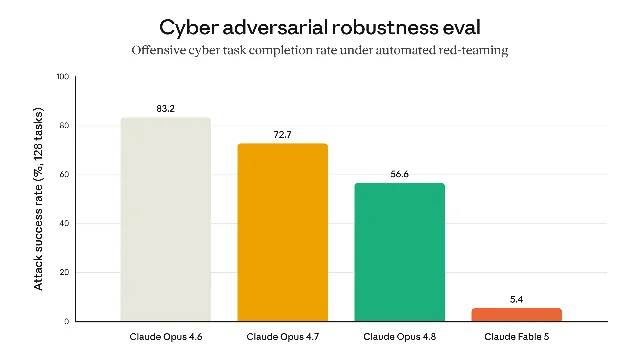
Cybersecurity. Mythos-class models are already strong enough to handle offensive cyber tasks that go beyond exploit-finding — reconnaissance, lateral movement, defense evasion. Fable 5's cyber classifiers block the model from making any progress on those tasks. When triggered, the response falls back to Claude Opus 4.8 instead of Fable 5. Anthropic ran an external bug bounty to test robustness: over 1,000 hours of testing produced no universal jailbreaks. The UK AI Security Institute made progress toward one within a brief initial testing window — Anthropic acknowledges it is likely impossible to completely prevent universal jailbreaks, but says the goal is to make them slow and costly enough to catch before they scale.
Biology and chemistry. Mythos-class models can now complete meaningful steps in gene therapy design. Anthropic tested whether the models could predict how a genetic modification would affect the assembly of an adeno-associated virus's outer shell — a dual-use capability that matters equally for gene therapy development and for dangerous virus design. Mythos-class models outperformed dedicated protein language models on that task using biological reasoning alone. Given that finding, Anthropic extended its classifier coverage well beyond the narrow bioweapons-related queries it has blocked historically.
Distillation. Anthropic has previously identified large-scale attempts to extract Claude's capabilities into competing model training runs in authoritarian countries. Fable 5's classifiers flag suspected distillation attempts and route those sessions to Opus 4.8.
The practical cost is false positives. Anthropic estimates that fewer than 5% of Fable 5 sessions involve any classifier fallback — meaning for 95% of users, Fable 5 performs as if Mythos 5's safeguards were not present. But for users working in biology, cybersecurity, or adjacent fields, the classifier will catch legitimate requests. Anthropic is explicit that the safeguards are tuned conservatively on purpose and that reducing false positives is active work for the months ahead.
Alongside the classifiers, Anthropic introduced a new 30-day data retention policy for Mythos-class traffic — including Fable 5. Anthropic will not use retained data for model training; it will use it to detect novel jailbreaks and attacks that operate across many requests. Human access to the data is logged, and the data is deleted after 30 days in almost all cases.
Mythos 5 and who gets unrestricted access
Claude Mythos 5 is the same underlying model as Fable 5 — same weights, same architecture. The difference is that Mythos 5 has the cyber classifiers lifted for its users. It is currently available only to Project Glasswing partners (cybersecurity organizations and critical infrastructure providers working with the US government) and will soon be available to select biology researchers through a new trusted access program for life sciences.
For cybersecurity partners, this means Mythos 5 replaces Mythos Preview as the production model. Anthropic says users will find Mythos 5 comparable to or somewhat stronger than Mythos Preview in most tasks, at substantially lower cost. The Glasswing partnership model gives Anthropic continuous feedback on how the most capable version of the model is actually being used in high-stakes security work.
The trusted access tier for biology is new. Anthropic plans to enroll a small number of researchers from life sciences organizations spanning fundamental and translational research, giving them Fable 5 with biology and chemistry classifiers removed (but cyber classifiers still in place). The rationale: the same biology capabilities that create dual-use risk also have the potential to accelerate new therapeutics. Restricting them entirely would block legitimate drug design work of the kind the Mythos 5 internal tests already demonstrated.
What the alignment assessment found
Anthropic's automated alignment assessment measured the frequency of "misaligned behaviors" — including deception and cooperation with model misuse — across Fable 5 and Mythos 5. The result: misalignment rates are low and approximately equal to Opus 4.8's rates.
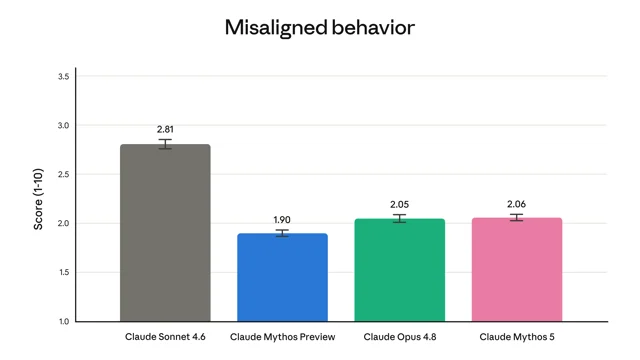
This matters because Opus 4.8 was already notable for matching the alignment profile of Mythos Preview — a data point Anthropic flagged explicitly when it shipped Opus 4.8 in late May. 3 Fable 5 extending that property to a substantially more capable model suggests the alignment improvements are tracking capability improvements, rather than trading off against them.
The full detail on safety and capability tests is in the model's system card and Anthropic's most recent risk report.
Availability and the usage-credits caveat
Fable 5 is available on the Claude API today via the
claude-fable-5 model identifier. Pricing for both models is $10 / $50 per million input / output tokens.For subscription plan users, the rollout has a wrinkle worth knowing. Anthropic anticipates demand will be hard to predict at launch, so it is staging access:
- Through June 22: Fable 5 is included on Pro, Max, Team, and seat-based Enterprise plans at no extra cost.
- Starting June 23: Fable 5 will require usage credits on those subscription plans.
- Later, when capacity allows: Anthropic aims to restore Fable 5 as a standard part of subscription plans.
API users and consumption-based Enterprise plans are unaffected — Fable 5 is fully available from day one. For subscription users who do heavy work with Claude, the June 23 date is the relevant deadline.
The model's name is an etymology note buried in the footnotes: Fable derives from the Latin fabula, "that which is told," cognate with the Greek mythos. The safeguards are what distinguish the two models — which is why they have different names.
Añade más opiniones o contexto en torno a este contenido.