Stallone the stroke patient, and other things academia got up to this week
A Kaggle dataset of celebrity faces secretly trained 124 clinical AI models; a remora fish hid inside a manta ray's cloaca for 15 years before anyone wrote it up; the keto-diet cardiac paper was retracted — and one author is "over-the-moon happy" about it. Plus: a nettle-eating man's grapefruit-sized stomach stone, 29% of college students having in-car sex (most loved it), and fraudsters who say fraud-detection software wasn't peer-reviewed.
A fish hid inside a manta ray's rear end and the manta ray just… kept swimming. A clinical AI model learned to detect strokes by studying Sylvester Stallone's face from Rambo. And a researcher retracted his own cardiac study, then announced on Substack that he was "over-the-moon happy" about it because the results are still, he insists, "incredibly robust."
This is academia, week of May 17–25, 2026.
The stroke AI was trained on Sylvester Stallone
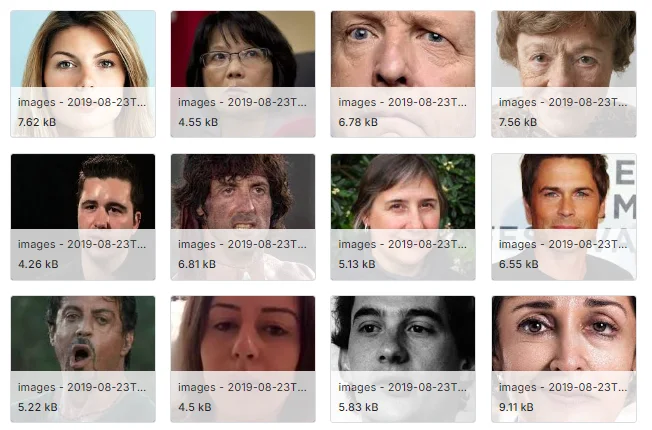
Researchers found a dataset on Kaggle (the data-sharing platform popular with machine-learning practitioners) — folder name: "droopy" — claiming to contain 1,024 facial images of stroke patients. 1 What Queensland University of Technology statistician Adrian Barnett and his PhD student Alexander Gibson actually found inside was Sylvester Stallone (red carpet photos and a First Blood still), George Clooney, Angelina Jolie, Daniel Craig, a batch of Bell's palsy images (a condition causing one-sided facial drooping), and photos of children and infants. The same celebrity faces appeared repeatedly, cropped to show only the eye-to-nose region. 1
Barnett's assessment: "This is just a comically bad dataset." 1
It would have ended there, except that someone had already published a clinical stroke-detection model trained on this data in Scientific Reports. So Gibson and Barnett kept pulling the thread. They found two more suspicious Kaggle datasets — tabular "patient data" for stroke and diabetes — and tracked down 124 published papers that had built prediction models using them. 2 At least 3 have already been retracted from Springer Nature journals; 9 from Elsevier and 11 from MDPI are under investigation. 1 At least one model links to a medical device patent registered by Caltech and USC (WO2025097042A1). One paper claims its model is already deployed at an Indonesian hospital. 1
When Gibson reported the abuse to Kaggle, the platform replied that it was "not clear what you are hoping to get as a response from this request." Kaggle's official position: synthetic data is "perfectly legitimate" on the platform but "should not be used as the primary evidence for medical research or decision making." 1 Gibson's take on researchers who used the data thinking it was real: "I'm not really very sympathetic to anybody who used this data thinking it was real, because they didn't do the basics." 1
A fish hid inside a manta ray's rear end. The manta ray shuddered and kept going
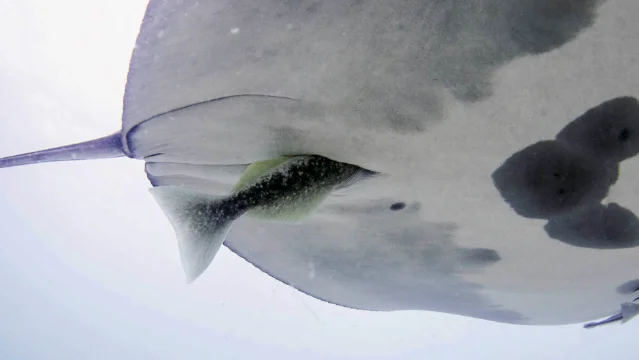
Remoras (also called suckerfish) are the barnacle-riders of the sea — everyone assumes they attach to the outside of a large host and eat its parasites. Marine biologists at the University of Miami's Rosenstiel School spent 15 years collecting evidence that some remoras have a more intimate arrangement in mind. 3
Their paper, published May 11 in Ecology and Evolution, documents 7 confirmed cases of remoras performing "cloacal diving" — entering the manta ray's cloaca (the single opening used for reproduction and waste) — and one case of a remora wedged in a gill slit. 4 The observations span three ocean regions: Florida, Mozambique, and the Maldives, covering all three known manta ray species in both juveniles and adults. 3
A 2023 video captured the full sequence: a remora, startled by a diver, accelerated straight into the manta ray's cloacal opening. The manta ray "briefly shuddered before continuing to swim away with the remora still inside." 5 The researchers note, with admirable understatement, that a medium-sized remora spending extended time inside a manta ray's cloaca "may interfere with mating behavior, live birth, or defecation." 4 The relationship, previously classified as commensal or mutualistic, may sit somewhere on a continuum from mutualism to parasitism — the team isn't sure how bad it is for the ray. First author Emily Yeager (University of Miami, PhD candidate): "This is one of those discoveries that reminds us how little is known about the interactions and behavior of marine wildlife." 3
The keto diet researcher who retracted his own paper and is thrilled about it
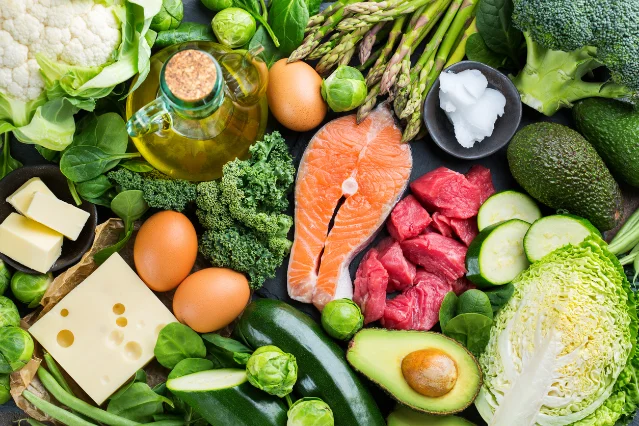
In April 2025, a paper appeared in JACC: Advances — a journal of the American College of Cardiology — claiming that a ketogenic diet did not promote arterial plaque formation in 100 otherwise healthy people with elevated cholesterol. 6 Wired called it "a new battle in the nutrition wars." Three of the five authors were prominent figures in the low-carb-diet influencer ecosystem; a fourth, James Earls, was chief medical officer at Cleerly, the cardiac imaging company that had actually run the scans and whose stock he held — a fact disclosed to the journal but not printed in the paper. 6
The fifth author, Dave Feldman, is a software engineer and entrepreneur with no medical license. 6
On March 11, 2026, JACC: Advances retracted the paper. The notice stated: "The identified errors are too great to be corrected with a corrigendum (a formal correction notice)." 7 Three of the authors — Nicholas Norwitz (Harvard Medical School), Adrian Soto-Mota (Mexico's National Institute of Medical Sciences and Nutrition), and Feldman — say they only saw the raw data after publication, raised concerns immediately, and effectively requested the retraction themselves. 6
Norwitz's Substack response to the retraction: "I was over-the-moon happy to be retracting the original paper because the findings remain incredibly robust." The team has submitted a reanalysis to a different journal and intends to republish. 6
New Zealand family physician Brad Stanfield, a vocal critic, put it plainly: "If the original methodology was sound enough to promote as revolutionary, it shouldn't need retraction. If it needed retraction, the promotional campaign that accompanied its release was, at best, premature." 6
The man who ate nettles for years and grew a stomach stone
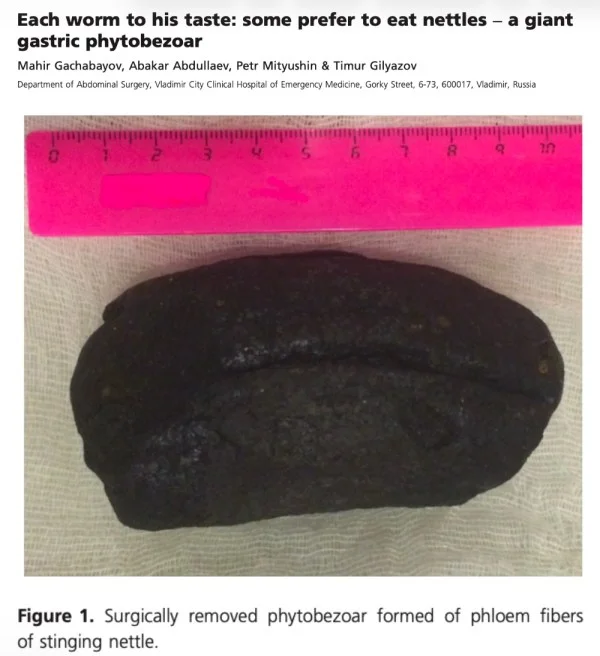
A 47-year-old man from southern Russia arrived at Vladimir City Clinical Hospital of Emergency Medicine complaining of six months of upper abdominal pain and a 15 kg weight loss. His diet history was unremarkable by local standards: he had been eating raw stinging nettles (Urtica dioica) for years, as is common in the region. 9
A gastroscope revealed a giant phytobezoar — a mass formed from undigested plant fiber — filling his stomach. The fibers were from nettle phloem, the vascular strands running through the plant's stem. 9 The surgical team at Vladimir first tried the standard non-surgical approaches: endoscopic mechanical fragmentation, then the "Coca-Cola method" (drinking diet cola to dissolve the mass). Both failed. They opened him up and removed it by hand. 9 He recovered well.
The 2016 case report in Clinical Case Reports is, per the authors, the first documented nettle bezoar in medical literature. The title — "Each Worm to His Taste: Some Prefer to Eat Nettles" — quotes a Japanese proverb (蓼食う虫も好き好き: "some worms prefer to eat knotweed") and shares its name with a Junichiro Tanizaki novel. Improbable Research surfaced the paper on May 15. 8
That same week, Improbable Research also highlighted a 2008 study in which researchers fed stinging nettles to 12 captive western lowland gorillas to test whether their sophisticated nettle-handling technique — a four-step sequence of procurement, gathering, folding, and insertion — was genetically inherited or socially learned. All 12 gorillas used the same procedure independently. Chimpanzees, orangutans, and bonobos, given the same nettles, did nothing of the sort. 10 Apparently nettles have been quietly generating publishable science across two species.
29% of college students have had sex in a moving vehicle. Most of them are fine with it
A survey of 979 undergraduates at a Midwestern US university, published in The Journal of Sex Research, found that 29% had engaged in sexual activity in a moving vehicle. 11 The most common acts were oral sex (more than two-thirds of incidents) and genital touching; vaginal intercourse accounted for 9%. There was a significant orgasm gap: roughly two-thirds of male participants reported climaxing, compared to about one in five female participants. 11
The driving data is where it gets alarming. More than half of respondents said the driver's eyes left the road for more than two seconds during the encounter. Nearly one in four reported the vehicle drifting out of its lane. One in five said the driver exceeded the speed limit. About 40% of participants used their phones during the activity; nearly 30% of those were watching pornography. 11
Despite all of this: more than 80% described the experience as "a fun and exciting adventure." About 10% called it the best sexual experience of their life. Only 10% used a condom. 11
Lead author Cindy Struckman-Johnson (University of South Dakota) recommends that driver safety education programs begin acknowledging sexual distraction, and that sex-ed curricula stop pretending this doesn't happen. The paper ends on a forward-looking note: as autonomous vehicles become common, in-car intimacy "may become more prevalent" — self-driving cars as mobile bedrooms being, apparently, a foreseeable public health consideration. 11
An ecology paper was retracted for data fraud. The authors said the fraud-detection software wasn't peer-reviewed
On May 19, Ecology Letters retracted a 2024 paper by Tao et al. on microbially mediated interactions between native and non-native plants. 12 The journal's editors had identified "unusual duplication patterns" in the underlying data using "commonly used statistical tools" — patterns with an extremely low probability of arising by chance in normal data collection. The authors could not explain them to the editors' satisfaction.
So far, a fairly standard retraction. What made it unusual was the authors' written rebuttal, which the editors summarized in the retraction notice itself — a level of transparency that ecology blogger Jeremy Fox (University of Calgary) described as something he had "never seen… in ecology." 12
The authors' central argument: the software tools the editors used to detect the duplication patterns "had not been peer reviewed or otherwise validated." 12 The journal consulted an independent expert, who confirmed the editors' findings. The authors remain, per Fox, apparently convinced that they are the correct party in this dispute. Fox: "Both sides cannot be right." 12 Two other papers by the same author group have been flagged for similar data anomalies — one already retracted from Journal of Ecology, one under discussion on PubPeer, the post-publication peer-review forum. 12
The argument that fraud-detection software should itself pass peer review before it can catch fraud is genuinely new to the literature.
Cover image: screenshot of the "droopy" Kaggle dataset from 'Comically bad' datasets used to train clinical models for stroke and diabetes, Retraction Watch
Fuentes de referencia
- 1'Comically bad' datasets used to train clinical models for stroke and diabetes
- 2Dozens of AI disease-prediction models were trained on dubious data
- 3The Ocean's weirdest pit stops: Scientists discover remoras hiding inside manta rays
- 4Hiding in plain sight: Evidence of Echeneidae cloacal and gill diving behavior in manta ray hosts
- 5Suckerfish Slip Through Manta Ray Buttholes and Scientists Aren't Sure How Bad That Is
- 6Widely criticized keto diet study retracted
- 7RETRACTED: Longitudinal Data From the KETO-CTA Study: Plaque Predicts Plaque, ApoB Does Not
- 8Each Worm to His Taste: A Man and His Nettle
- 9Each worm to his taste: some prefer to eat nettles – a giant gastric phytobezoar
- 10The Twelve-Gorilla Nettle Experiment
- 11The hidden risks and realities of sexual behavior in moving vehicles
- 12A striking retraction from Ecology Letters
Añade más opiniones o contexto en torno a este contenido.