25/6/2026 · 8:24
The first Grand Prix was a 769-mile death race on public roads — and two-thirds of the cars didn't finish
On June 26, 1906, thirty-two automobiles set off at 90-second intervals onto public roads outside Le Mans — no barriers, no seatbelts, temperatures at 49°C — for the world's first Grand Prix. Two-thirds of them never finished. Hungarian mechanic-turned-driver Ferenc Szisz won in a Renault, aided by a Michelin tire trick that cut pit stops from 15 minutes to four. The race that launched Formula One was this strange.

On June 26, 1906, at six in the morning, thirty-two automobiles launched at 90-second intervals onto the public roads outside Le Mans, France. There were no safety barriers. No rollcages. No seatbelts. Spectators crowded to the edge of the dirt track behind a few kilometers of wooden palisade fencing. The road surface was sealed with tar — and it was going to be a very hot day.
What followed was the world's first Grand Prix. Not a race with "Grand Prix" in the name, but the first international motor racing event to officially carry the title. By the time it finished on the afternoon of June 27, 21 of the 32 starters had retired — from burst engines, melting eyeballs, wheel collapses, and sheer mechanical catastrophe. A locksmith from Hungary who had taught himself to drive won it by over half an hour. And the entire sport of Formula One traces back to this one sweltering weekend on French country roads. 1
Why France invented the Grand Prix — and who they invented it against
The 1906 Grand Prix was born from a bureaucratic grievance. The dominant international motor racing format of the era was the Gordon Bennett Cup, run since 1900, with one elegant problem: every competing nation was limited to three entries. France had Europe's largest automobile industry. In 1904, 29 French cars competed for just 3 spots. The other 26 didn't make the cut. 2
When French driver Léon Théry won the 1905 Gordon Bennett Cup — giving France the right to host the 1906 edition — the Automobile Club de France (ACF) did something characteristically French: it killed the host event and replaced it with its own. The Grand Prix de l'Automobile Club de France would have no limit on national entries. France could run as many cars as it wanted. The format was open. The field would be massive. 1
Le Mans was chosen partly because the local city council and hoteliers put up money. The Automobile Club de la Sarthe designed a 103.18 km triangular circuit linking Le Mans, Saint-Calais, and La Ferté-Bernard — all on ordinary closed public roads. Twelve laps over two days, six each day. Total distance: 1,238 km (769 miles). For comparison, the distance from Paris to Madrid is roughly 1,300 km. They were essentially racing Paris-to-Madrid and back, on a loop. 2
The field that assembled was dominated by French manufacturers — ten of them, including Renault, Brasier, Clément-Bayard, Darracq, Panhard, and Hotchkiss. Italy sent FIAT and Itala. Germany entered Mercedes. No British or American manufacturers entered. 34 cars were registered; two didn't start (a Vulpes over the weight limit, a Grégoire that failed to start). 32 took the flag. 1

Melting roads, blinded drivers, and a horse named for engine tolerance
The cars dispatched at 90-second intervals starting at 6:00 AM on June 26. Each one carried a riding mechanic alongside the driver — not a navigational assistant but a working crew member, there to help with tire changes, radiator refills, and roadside repairs during the race. No outside help was permitted; only the driver and mechanic could touch the car. 1
By midday the temperature reached 49°C (120°F). The tar-sealed road surface, already pulverized by the passing cars, began to liquefy. Chunks of hot tar mixed with road debris were kicked backward by tires directly into the faces of following drivers. Goggles offered imperfect protection. One Renault driver, listed in contemporary accounts as "Edmond," retired after tar and glass fragments got into his eye — officials turned down his request to replace his goggles because equipment substitution was not allowed mid-race. He drove with one eye until he couldn't continue. 2
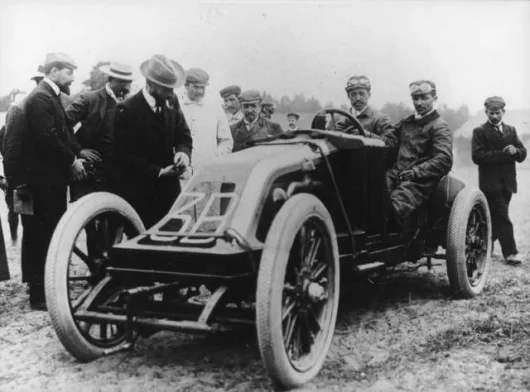
Despite 65 km (40 miles) of palisade fencing — built specifically because spectator deaths from earlier road races had become a political problem — crowds pressed up close to the track. The roads had no runoff areas. At race speeds approaching 154 km/h on the straights, there was essentially nothing between a spectator and a 1,000 kg automobile except a wooden plank and hope. 1
On day two, a horse was employed to tow each car from parc fermé (the overnight storage compound) to the start line. The horse had been trained to tolerate the sound of engines. Day two departures were staggered based on first-day positions — Szisz, leading the race, left at 5:45 AM. 2
The tire war that decided everything before it started
The race might have been decided in the equipment lists filed days earlier, not on the roads at all.
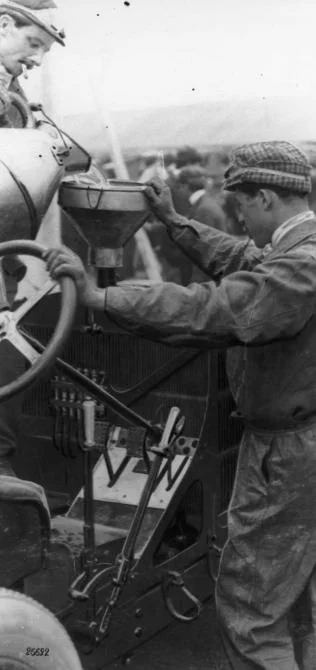
Michelin had developed something called the jante amovible — a detachable rim. Instead of a tire being fixed directly to the wheel (the standard approach, which required mechanics to cut the old tire off and physically force a new one on), the Michelin system pre-mounted the tire and inner tube onto a separate rim. That rim could be bolted to the wheel with eight bolts, changed as a unit, and a fresh pre-mounted rim dropped straight on. 1
The time difference was enormous. A conventional tire change took around 15 minutes. The Michelin detachable rim took under 4 minutes. Motor Sport Magazine summarized the pit stop advantage in three words: "four minutes per corner." 3
There was a catch: each detachable rim weighed 9 kg more than a conventional wire-spoked wheel. The race had a 1,000 kg weight limit per car. So only the teams with enough engineering margin could carry them. Renault ran the system on rear wheels only, combined with lighter conventional artillery wheels at the front. FIAT used a full set. Only two Clément-Bayard cars could run them on the rear. Teams like Itala and Panhard were too heavy to use the system at all. 2
Albert Clément, who finished third, ran one of his Clément-Bayard entries without the detachable rims — a decision the ACF later believed may have cost him victory. Afterward, the ACF actually complained that the race outcome had been too dependent on the Michelin tire advantage. Having created an open technical formula specifically to benefit French industry, they had generated a result that looked too much like a product demonstration. 1
The mechanic from Hungary who became the first champion
Ferenc Szisz was born on September 20, 1873, in Szeghalom, then part of the Austro-Hungarian Empire, the sixth of seven children of a chief stableman. He trained as a locksmith and coppersmith, studied engineering in his twenties, and arrived in Paris in 1900 — at which point he walked into a job at Renault, which had been founded the previous year. He became head of their testing department and served as riding mechanic to Louis Renault himself in the 1902 Paris-Vienna race. 4
He transitioned to driving after Marcel Renault's death in the 1903 Paris-Madrid race — an event that killed at least eight people and was stopped by the French government after the Le Mans stage. By 1906 he had finished fifth in the Gordon Bennett elimination race and fifth in the 1905 Vanderbilt Cup in the United States. He was experienced. He was calm. And F1 journalist David Tremayne, writing on Formula1.com, described him as "a genial fellow by all accounts," known for mechanical sensitivity — the ability to read a car's condition and nurse it through conditions that destroyed less attentive drivers. 5
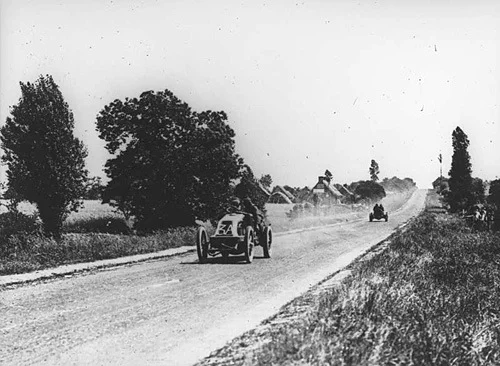
His car, the Renault AK 90CV, was a 12,985 cc four-cylinder monster producing around 95 horsepower at 1,200 rpm. It ran a three-speed gearbox, shaft drive (no differential, to save weight), and hydraulic dampers invented by Louis Renault — the first ever fitted to a racing car. On the straights near Le Mans, Szisz was clocked at 154 km/h (96 mph). 1
He led from early on and never truly relinquished the lead. After day one he had a margin of roughly 26 minutes over FIAT's Felice Nazzaro. The heat on day two was, according to 8W Forix historian Leif Snellman, "as bad as the day before making the race into a 'race of tyres'." 2
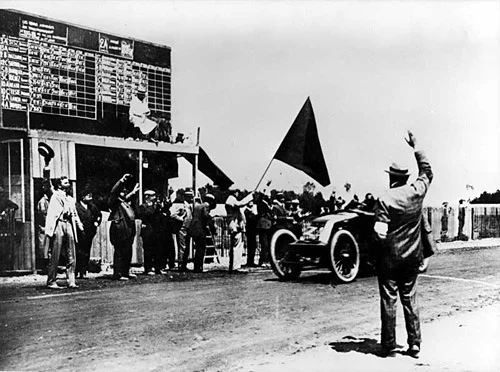
Szisz crossed the finish line after 12 hours 14 minutes 7.0 seconds of racing across two days. Nazzaro finished second, 32 minutes 19 seconds behind. Albert Clément was third, nearly 36 minutes back. The last finisher, a Mercedes driver listed as "Mariaux," crossed over four and a half hours after Szisz. Of the 32 cars that started, 21 did not finish. 1
The winners' prize: 45,000 French francs — the equivalent of roughly 13 kg of gold.
After his post-race interview, Szisz told reporters he had feared some small mechanical failure would strip the victory from him in the final moments. (This is a paraphrase of his reported remarks — the original appeared in contemporary French sports press.) He left Renault in 1909, opened a garage in Neuilly-sur-Seine, and returned for one final Grand Prix in 1914, where he broke his arm after being hit by a stray Opel while changing a tire. He served in the French army during WWI, survived typhoid fever, worked for an aircraft company after the war, and died in Auffargis, France, on February 21, 1944. 4
A statue of him stands at the main entrance to the Hungaroring in Hungary today.
What came next: Formula One is 120 years old this weekend
The 1906 race established the Grand Prix as the prestige format for international motor racing — a Grande Épreuve, in the French term that would define top-tier events for decades. Renault's victory helped push sales from around 1,600 cars in 1906 to over 3,000 in 1907 and 4,600 in 1908, which goes some way to explaining why manufacturers kept entering these races. 1
Germany responded with the Kaiserpreis in 1907. The first Grand Prix outside France was the 1908 American Grand Prize at Savannah, Georgia. The organizing body convened during the 1904 conference that had catalyzed the French proposal — the AIACR (Association Internationale des Automobile Clubs Reconnus) — eventually became the FIA (Fédération Internationale de l'Automobile) in 1947. Every Formula One world championship race is still called a Grand Prix. 6
One enduring quirk: the ACF later attempted to retroactively number earlier French road races as Grands Prix, designating the 1906 event as the "9th Grand Prix de l'Automobile Club de France." Some members of the ACF itself objected, with one dismissing the renumbering as reflecting "a childish desire to establish their Grand Prix as the oldest race in the world." The move never stuck. The 1906 French Grand Prix remains, by the consensus of motorsport historians, the first. 6 2
And the Le Mans of 1906 has nothing to do with the famous 24 Hours of Le Mans — same city, same organizing club (Automobile Club de l'Ouest), entirely different circuit. The 24 Hours first ran in 1923. The two race events share the same geography and the same organizing body, and almost nothing else.
Cover image: Ferenc Szisz driving his Renault AK 90CV during the 1906 Grand Prix, public domain via Wikimedia Commons.
Añade más opiniones o contexto en torno a este contenido.