
SaaS Competitive Radar — Issue #2: Who owns the work record?
Linear can now write code, not just track it. Asana rebranded as an agentic work management platform and shipped Dash, its AI chief of staff. Slack's May drop — Salesforce actions, web search, native charts — is rolling out through June with more strategic weight than advertised. Zoom entered the document productivity market at $8.33/user/month. Six companies, six different answers to where AI-assisted work coordination should live.

The short version
Linear shipped its most aggressive move yet: the agent can now write code, not just manage it. Figma quietly deepened its design-to-code pipeline while its stock hit a 38% YTD hole ahead of Config 2026. Asana declared a full identity shift toward "agentic work management" and dropped Dash, its AI chief of staff. Slack's May drop — Slackbot web search, Salesforce actions in conversation, native charts — is still rolling out through June and carries more strategic weight than the marketing made clear. Zoom launched an AI Productivity Suite that puts it on a collision course with Notion, Monday, and Google Workspace for the "post-meeting document" dollar. Notion, meanwhile, is quietly counting down to August 11, when Workers exit free beta and go onto credit billing.
Six products, six different bets on where AI-native SaaS ends up. Here's what happened and what it signals.
Feature moves
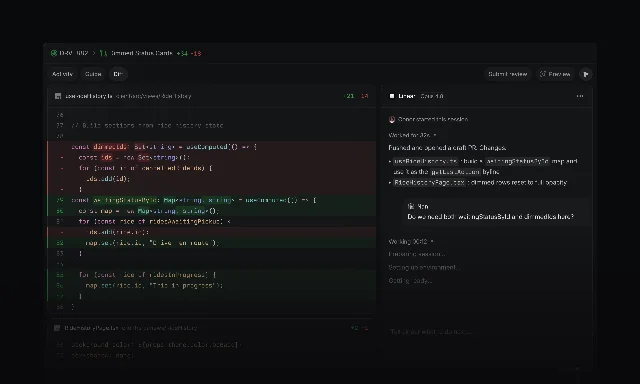
Linear: coding sessions are GA — the agent now ships code
On June 11, Linear released Coding Sessions: Linear Agent can now write code using Claude Code and Codex, close issues, and open pull requests, all without leaving the Linear workspace. 1
This closes a loop that started in March with the Linear Agent launch, continued in May with Code Intelligence (codebase read access) and Linear Diffs (native code review), and now ends with write access. The full cycle — triage → plan → write → review → ship — runs inside Linear.
The pricing model matters: Coding Sessions run on AI credits, available on Basic, Business, and Enterprise plans. There's no separate per-seat charge for the capability itself, just credit consumption. That's a deliberate choice — it ties agent usage cost directly to output volume rather than team headcount, which will be hard for ClickUp and Asana to match quickly since neither has a native code surface.
Linear also said internally they use this to close roughly 30% of incoming bug reports on the first pass. 1 That's a specific benchmark — not a vague "productivity gain" claim — and competitors should pay attention to it.
Magnitude: High. This isn't an incremental feature; it's a complete repositioning of Linear as a development platform that happens to have project tracking, rather than a project tracker that added AI.
Figma: three releases in three days, plus a stock story
Figma shipped three updates between June 10 and June 12:
- Video upload limit raised to 300 MB (June 10), up from 100 MB, across Figma Design, FigJam, Slides, Sites, and Buzz on paid plans. 2
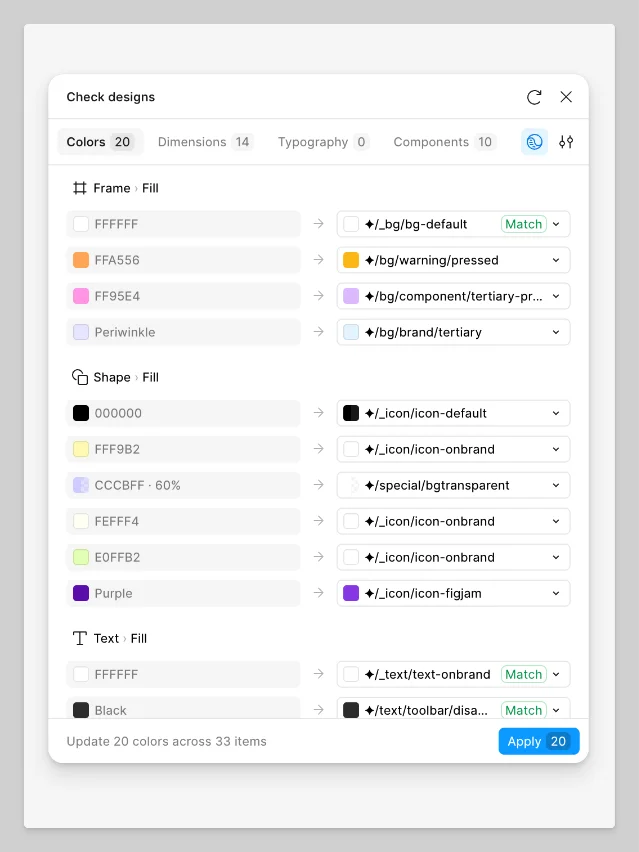
- Chrome extension captures webpages as editable layers (June 11). Copy a live web page or selected elements into Figma as structured layers — no coding agent required. Currently in beta, paid plans only. 2
- Community profiles redesigned (June 12): custom role, tech stack, pinned resources, linked social channels. 2
The Chrome extension is the one to watch. It's the entry point to a stated roadmap item: "the ability to generate designs using your design system is coming soon." Once that lands, a designer can import a competitor's live UI, modify it against their own design system, and prototype alternatives. That's a workflow that today takes hours of recreation. The credit enforcement that started in March — and the pay-as-you-go AI credit option launched June 3 on Professional plans — is building the billing infrastructure to charge for this at scale. 2
The broader context: Figma announced an Investor and Analyst Session at Config 2026 (June 24), and the stock is down more than 38% year to date despite Q1 revenue beating expectations and full-year guidance being raised. 3 The gap between strong reported fundamentals and weak sentiment usually means investors want to see AI feature monetization turn into durable revenue growth — which makes every credit-related release between now and June 24 a data point.
Magnitude: Medium. The Chrome extension is genuinely new capability; the profile redesign and upload limit are maintenance-level.
Asana: from project management to "agentic work management"
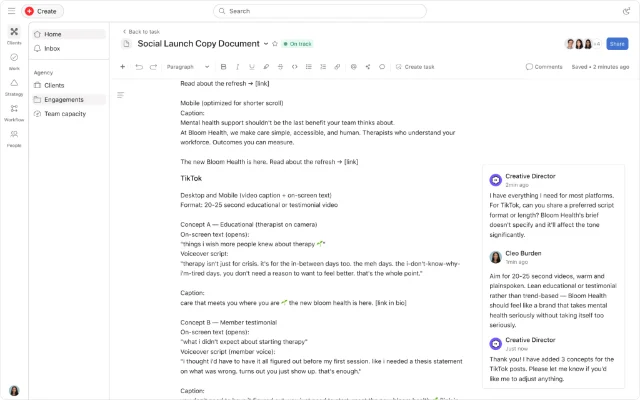
On June 4, Asana formally rebranded its product positioning: it's now an "agentic work management" platform, not a project management tool. The concrete releases behind the label: AI Teammates are GA (prebuilt or custom, no-code), AI Studio is live for automating multi-step workflows, and Dash — described as an AI chief of staff — can surface work items from Slack conversations and route them into Asana projects. 5 6
The Slack integration angle is worth examining separately: Asana Dash can watch a Slack conversation, identify work items mentioned in the thread, and create structured Asana tasks with context attached. That's a direct response to the workflow that Slack's own Slackbot is trying to own. Both companies are now building toward the same thing — "you describe it in conversation, we make it trackable" — and they have fundamentally different theories on where users will want that to land.
Asana's bet: the canonical record lives in a work management tool. Slack's bet (see below): the canonical record lives wherever the conversation happened. One of them is wrong about where knowledge workers want the source of truth.
Magnitude: High on positioning, Medium on discrete new features (AI Teammates were in beta before this).
Slack: the May drop is still landing
Slack's "May the Productivity Be With You" feature drop is rolling out through June, and some of the most significant capabilities are only now reaching workspaces. 7
Three pieces worth flagging:
Slackbot Salesforce Actions — users can now create and update Salesforce records from Slack conversation. Slackbot drafts the action, previews it, and waits for approval before writing to the CRM. For organizations where Salesforce is the system of record, this removes the context switch that kills CRM hygiene. Available on Business+ and Enterprise plans.
Slackbot Web Search + External Links Reader — Slackbot can pull real-time public information from the web and summarize pages dropped into conversation. The practical application for teams: competitive intel, news, and external documents don't require tab-switching anymore.
Native Charts — ask Slackbot to visualize data in a chart directly in conversation. No BI tool, no spreadsheet export required.
The rollout pattern is deliberate: these features require Business+/Enterprise (AI add-on). That's Slack using AI capabilities as a pull mechanism to move customers off Pro and onto higher-margin plans — the same structural move Notion and Figma made with AI bundling in 2025, just applied to a Salesforce-adjacent CRM use case.
Magnitude: High for Business+/Enterprise customers. Low for Pro plan customers who won't see these features at all.
Pricing moves
Zoom: the AI Productivity Suite is a direct challenge to Notion and Google Workspace
Zoom quietly launched an AI Productivity Suite: Slides, Canvas, Sheets, and Paper — four document/spreadsheet/presentation products — bundled at $8.33/user/month (annual) or $10/user/month (monthly), each plan including 1,000 AI credits/month. A higher tier, ZoomMate, adds agentic search, deep research, and workflow automation at $16.67/user/month (annual) / $20/user/month (monthly), with 2,200 AI credits. 8
This is priced at roughly half of Notion's Business plan ($20/user/month) and competes directly with Google Workspace's document layer. Zoom's stated differentiator is that it starts from conversations — meeting summaries, call transcripts, and chat threads auto-populate the document layer. That's a coherent workflow advantage for orgs that are already Zoom-heavy, but it requires the user to already be living in Zoom calls for the context loop to work.
The competitive signal: Zoom is no longer positioning itself as a meeting tool with productivity bolt-ons. It's positioning the meeting as the data source for a full productivity suite. Whether that framing holds depends on whether users trust Zoom to be the canonical store for their documents and spreadsheets — which is a different trust model than "meetings are just meetings."
Magnitude: High on strategic positioning, Medium on actual market impact until adoption data surfaces.
Notion: the Workers billing clock is running
No new pricing changes this week, but a date worth noting: Notion Workers — the serverless runtime for custom code that launched in beta in May — exits the free period on August 11, 2026, and will start consuming Notion credits. 9
The pricing terms for credits haven't been published yet. For teams that have integrated Workers into production workflows during the free beta, there's a live question of what the credit burn rate will look like at scale. This will be the first test of whether Notion's developer platform has genuine stickiness or was adopted opportunistically during the free window.
Magnitude: Watch. Low impact this week, potentially high in August.
Cross-company snapshot
| Company | Move | Magnitude | Signal |
|---|---|---|---|
| Linear | Coding Sessions GA (AI writes code) | 🔴 High | Full dev lifecycle now in Linear; credits-based pricing ties cost to output |
| Figma | Chrome → editable layers, video limit up, community refresh | 🟡 Medium | Design-to-code pipeline extension; credit billing infrastructure growing |
| Asana | "Agentic work management" rebrand; Dash + AI Teammates GA | 🔴 High | Competes directly with Slack for conversation-to-task ownership |
| Slack | Salesforce actions, web search, native charts rolling out | 🔴 High (for B+/Enterprise) | AI features as plan upgrade lever; Salesforce depth vs. Asana's breadth |
| Zoom | AI Productivity Suite launched ($8.33/user/mo) | 🟡 Medium | Meetings-as-data-source positioning; direct pricing challenge to Notion |
| Notion | Workers free period ends August 11 | 🟢 Watch | Credit pricing not yet disclosed; developer platform stickiness test incoming |
The read across
The week's most important pattern isn't any single product move — it's that the "where does AI-assisted work coordination live" question now has five active, well-funded answers: in the issue tracker (Linear), in the design tool (Figma), in the work management layer (Asana), in the messaging platform (Slack), and in the meeting recorder (Zoom).
Each company's answer is shaped by where it already has data gravity. Linear has code context. Figma has design files. Asana has project history. Slack has conversation. Zoom has call transcripts. The AI features they're shipping aren't random — each one is an attempt to make that existing context supply chain so valuable that work can't reasonably be coordinated anywhere else.
The problem for buyers: these products increasingly overlap. Asana Dash creates tasks from Slack threads. Slack Slackbot creates Salesforce records from conversations. Linear creates issues from Slack threads. Every platform is trying to be the system-of-record that captures work from everywhere else. That pressure will converge on pricing and bundling decisions over the next 12 months — and Notion Workers going onto credit billing in August is an early signal of what that looks like in practice.
What to watch: Linear's AI credit consumption patterns when Coding Sessions hits broader usage; Figma Config 2026 investor session on June 24 for AI monetization detail; Notion credit pricing when Workers billing goes live on August 11.
Fuentes de referencia
- 1Coding sessions in Linear – Changelog
- 2Video upload limit increase – Figma Release Notes
- 3Figma Config 2026 Session Tests AI Growth Story And Weak Share Price
- 4Check designs in Figma – Help Center
- 5Asana Unveils Operating System for Human-Agent Teams – BusinessWire
- 6Asana Spring 2026 Release
- 7Slack Feature Drop: May the Productivity Be With You
- 8Zoom AI Productivity Suite pricing
- 9Notion Worker pricing announcement
Añade más opiniones o contexto en torno a este contenido.