
Oil hits a 3-month low as gold rallies — the Iran deal's split verdict
Iran's MoU signed Sunday, but Hormuz stayed shut Monday: WTI CLN6 tumbled to a 3-month low (~$80.75, −4.2%), while gold surged +2.66% to $4,351.60 as cheaper oil repriced the Fed's rate-hike path. Corn and soybeans edged up on short covering. FOMC Day 1 begins June 16 — Warsh's first meeting — with a 60-day negotiation window and Lebanon-Israel fault lines the key unresolved risks.

On Sunday evening, Trump and Iranian Parliament Speaker Mohammad Bagher Ghalibaf electronically signed a framework memorandum of understanding ending the conflict. On Monday the commodity markets rendered their own verdict: oil is done pricing the war premium, and gold is just starting to price the rate-cut that follows. Both moves make sense. Neither is finished.
Settlement snapshot — June 15, 2026
| Contract | Settlement | Change | Change % | Jun 12 close |
|---|---|---|---|---|
| WTI Crude CLN6 (Jul) | ~$80.75/bbl | −$3.54 | −4.20% | $84.29 |
| Brent Crude BZN6 (Aug) | $83.36/bbl | −$3.44 | −3.96% | $86.80 |
| COMEX Gold GCQ6 (Aug) | $4,351.60/oz | +$112.80 | +2.66% | $4,238.80 |
| COMEX Copper HGN6 (Jul) | ~$6.49/lb | ~+$0.02 | ~+0.30% | $6.4740 |
| CBOT Corn ZCN6 (Jul) | 415.50¢/bu | +2.75¢ | +0.67% | 412.75¢ |
| CBOT Soybeans ZSN6 (Jul) | 1,118.75¢/bu | +5.25¢ | +0.47% | 1,113.50¢ |
Note: WTI and copper settled after MarketWatch's primary data feed failed to update; prices drawn from CNBC backup quotes. 1 2
Oil: the war premium evaporated, the physical reopening has not
WTI CLN6 settled near $80.75, its lowest print since the first week of March 2026 — just days after the conflict began. 3 4 Brent closed at $83.36. Together the benchmarks have shed roughly $13 from the June 11 Kharg Island-threat peak of ~$93.64 WTI — a 13% round-trip in four sessions. 5
The sell-off is logically consistent with the deal's terms. Trump posted on Truth Social: "Ships of the World, start your engines. Let the oil flow!" and announced he was authorizing the "immediate removal of the United States Naval blockade." 6 In theory, roughly 600 trapped vessels inside the Persian Gulf — including ~250 tankers — now have a clear exit date. 7
In practice, the Strait remained physically shut on Monday.

Iran state television reported "zero passage through the Strait" and that it remains "closed until further notice." 9 The Joint Maritime Information Center (JMIC) issued an advisory that the US blockade "remains in effect pending execution of a U.S.-Iran ceasefire agreement scheduled for 19 June 2026," telling mariners: "Do not attempt to cross until explicit direction is given." Maritime threat level: SEVERE. 10 Only one vessel — the LNG tanker Disha, operated by India's Petronet — appears to have crossed the strait Monday via AIS data.
The mine problem is what makes traders skeptical of a quick physical reopening. Secretary of State Rubio told the Senate on June 2 that Iran had "mined large segments of Hormuz." German naval vessels reported mines at four separate locations on June 11. Five Western maritime security sources put the clearance timeline at 40–50 days. 11 Dryad Global CEO noted that if a confirmed minefield is found, removal "could potentially take weeks or months."
BIMCO's Jakob Larsen said directly: "The next step is for shipowners to be reassured that transiting the Strait of Hormuz is not only permitted, but also safe." 7 Kpler analyst Dimitris Ampatzidis put a timeframe on normalization: "A return to normal shipping patterns would likely take months." ICIS analyst David Jorbenaze went further: "Returning to full pre-conflict volumes is realistically a 2027 story." 10
Trump's "Southern Highway" — an Omani coastal corridor handling roughly 15 vessels per day — does not move the needle when pre-war throughput was 120–140 vessels per day. 12
NBC's market analysis captured the situation cleanly: "The only moderate moves lower in oil speak to skepticism in markets about how fast oil can really get flowing again from the Middle East." 9 YTD, WTI is still up ~42%, reflecting how much of the war premium remains in the physical supply chain even after Monday's decline.
Gold: the rate-hike repricing drove the rally, not safe-haven demand
The intuitive read — peace deal signed, safe-haven bid collapses, gold falls — did not happen. GCQ6 settled at $4,351.60, up $112.80 (+2.66%), with an intraday high of $4,391.50 and volume of 128,420 contracts (312% of the 65-day average of 41,190). 13 14
The mechanism runs through oil, not geopolitics. When WTI breaks below $81, energy-driven inflation pressure softens, the probability of a Fed rate hike falls, the dollar weakens, and real yields decline — all four tailwinds simultaneously hit gold. Kitco's AM Report framed it precisely: "Hormuz risk shifts from oil shock to rate relief." 15
The data bore this out Monday. DXY fell 0.3% to 99.496, touching a 10-day low of 99.384. 16 The 10-year Treasury yield dropped to 4.473% (from 4.483% Friday), touching a one-month intraday low of 4.420%. The 2-year yield fell to 4.064%. VIX dropped 8.37% to 16.20. 16
Jefferies economist Mohit Kumar was explicit about the Fed link: "If oil falls below $80 in the near term, it would remove any reason for the Federal Reserve to raise interest rates." 16

David Woo, formerly head of global rates and currency research at Bank of America, offered a structural explanation for why gold's spring selloff was more violent than the macro backdrop warranted. His argument: Gulf oil producers, unable to export crude during the conflict and constrained from selling US Treasuries under Washington's scrutiny, "could only sell gold" to raise cash — a forced liquidation unrelated to gold's fundamentals. As that pressure unwinds, gold recovers. 18
The central bank buyer base remained intact through the selloff. The People's Bank of China added 9.95 tonnes in May — the 19th consecutive month of accumulation — bringing total reserves to 2,331 tonnes. Poland was the largest single buyer in April at 14 tonnes, and leads all countries in 2026 YTD at 45 tonnes. 19
On technicals, gold remains well below key resistance. The 200-day moving average sits near $4,450; the 50-day SMA is at $4,581. Nick Cawley of Solomon Global said a "decisive break" above the 50-day SMA "would open the door to a more sustained move higher," with the May 12 lower high at $4,773 as the next level of consequence. The near-term risk, per Trade Nation's David Morrison: if something delays the formal Geneva signing on June 19, "$4,000 could get tested once again." 17
Silver outperformed, rising 4.18% to $70.88/oz — notably holding its 50-week moving average while gold broke below it during the June 9–11 selloff. 19
FOMC: Warsh opens his first meeting into a changed rate picture
The June 16–17 FOMC meeting is Kevin Warsh's first as Federal Reserve Chair, confirmed 54–45 by the Senate on May 22. A hold at 3.50–3.75% is the near-universal expectation, and this was true before the Iran deal. 20
What the deal changes is the tone going into Wednesday's press conference — the first under Warsh at 2:30 PM ET. Markets had been pricing roughly 60% probability of at least one hike by December 9, per Heraeus. That calculus looks different with WTI sub-$81. Jefferies' Kumar had already flagged oil as the dominant variable. 19
The macro data released Monday didn't simplify the picture. The New York Fed Empire State Manufacturing Index collapsed 14 points to 5.7 in June (May: 19.6; consensus: 13.2). 21 New orders fell to 3.5, shipments to 8.6. Prices paid stayed elevated at 61.0 — confirming the stagflation read. Supply availability slumped to -13.9, a four-year low. NY Fed's Richard Deitz noted that employment grew for the fifth straight month even as "price increases remained elevated and supply availability worsened." 21
US industrial production was flat in May (0.0% vs. +0.2% consensus). Non-durable goods fell 0.9%, and petroleum/coal output dropped 0.7% — both consistent with the war's supply-chain drag. Semiconductors +2.4% month-over-month and +14.4% year-over-year were the outliers, driven by AI data-center buildout. 22 Capacity utilization ticked up to 76.2%, still 3.2 percentage points below the long-run average.
Michael Landsberg of Landsberg Bennett Private Wealth Management put the market's focus where it belongs: "We will be paying particular attention to Warsh's first press conference as we try to understand what type of communicator he will be and what level of detail he will go into during the press conference." 23
One dissenting scenario worth tracking: a TradingView commentator noted that if Warsh surprises with a dovish signal, Treasury yields could rise — because investors would start to worry the Fed is losing its independence rather than reacting to data. 24
Equities priced a clean positive: the Dow rose 468.77 points (+0.92%) to a record close of 51,671.03, the Nasdaq added 3.07% — its best session since March 31. 25 Energy stocks moved inversely: Chevron −2.5%, Exxon Mobil −2.5%, Devon Energy −3.5%. Airlines, cruise stocks, and DoorDash surged on lower fuel-cost expectations.
Grains: short covering off contract lows; bearish structure intact
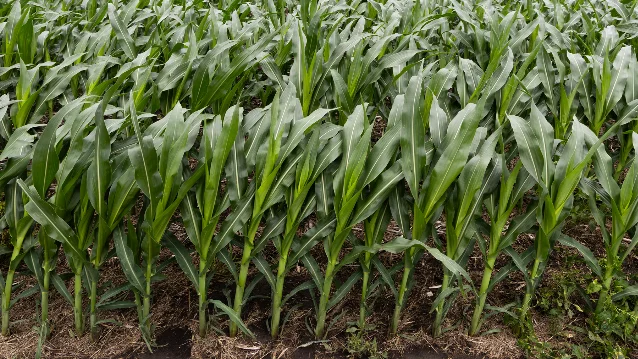
CBOT July corn (ZCN6) settled at 415.50¢, up 2.75¢ (+0.67%), after hitting a contract low early in the session and recovering to close in the upper range. 27 July soybeans (ZSN6) settled at 1,118.75¢, up 5.25¢ (+0.47%). 28 Pro Farmer's editors called it "short covering and perceived bargain buying," and noted the high-range corn close "does begin to hint the bears may now be exhausted" — though they maintained that bears still hold a "solid overall near-term technical advantage" with the next downside target at 400¢. 29
The USDA Crop Progress report released Monday showed conditions improving, if modestly. 30
- Corn: 68% good-to-excellent (G/E) for the week ending June 14, up 1 point from 67%. Still 4 points below last year's 72%. State divergences are significant: Iowa 79% G/E vs. Illinois 66% G/E.
- Soybeans: 66% G/E (up 1 point from 65%), matching last year's 66%. Iowa 77%, Minnesota 80%, Illinois 61%.
- Winter wheat: 27% G/E, harvest 25% complete vs. 9% a year ago. Kansas only 15% G/E, Nebraska 5% G/E.
DTN meteorologist John Baranick said temperatures "will be much cooler this week than they were last week, easing some stress for those drier areas," but added a major severe weather event is likely Wednesday from Missouri to Indiana. 26 A tropical low-pressure system over northeastern Mexico could bring 5–10 inches of rain to the Gulf Coast, raising flood risk. World Weather Inc. sees corn yield potential as "very high" for the next two weeks; the concern is flooding rather than drought.
NOAA formally declared El Niño has arrived, with AccuWeather projecting El Niño-driven rainfall to support above-average Corn Belt yields this summer. 31
Weekly export inspections (week ending June 11): corn 1.637 MMT (within the 1.5–2.0 MMT range), soybeans 522,687 MT (within range), wheat 334,292 MT (below the 350,000–550,000 MT expected range). 29
China's US soybean buying absence extends to 126 days as of June 15. 32 DTN lead analyst Rhett Montgomery noted new-crop US soybean sales to China are at their slowest start since 2003, with traders "clearly frustrated by the lack of concrete sales to China following Trump's visit to Beijing in mid-May." Brazil filled the gap: the country exported 3.14 million tonnes in just the first five days of June (SECEX data), with July Brazilian cargoes trading around +200–204 over CBOT. 31 USDA's June WASDE left its US soybean export forecast unchanged.
In Europe, France faces temperatures above 35°C with DTN's Baranick warning the extended heat "could have some impact on wheat, but will have a more unfavorable effect on corn and other summer crops." COCERAL has cut its 2026 EU grain crop forecast to 295.5 million tonnes, though it noted the heatwave has not yet caused significant yield damage. 26
New World Screwworm (NWS) cases in the US have risen to 12 confirmed cases, up from 7 on June 12, now across Tom Green, Zavala, Edwards, and Sutton counties in Texas (cattle, goats, and one sheep). No wildlife infections or adult fly-trap detections have been logged, which USDA Undersecretary Dudley Hoskins called encouraging. Canada's CFIA maintains its Texas livestock import ban; all US southern ports of entry remain closed to livestock trade. 33 34
The 60-day cliff: what the deal still does not answer
The MoU framework is roughly 1.5 pages long — VP Vance called it "a very general document" — and leaves the most consequential issues to a 60-day negotiation window. 8
Three fault lines bear watching for commodity positioning:
Sanctions and frozen assets: Iran holds ~$24 billion in frozen funds abroad and has pushed for their release before talks begin. A US official stated flatly: "This is a pay-for-performance deal and no frozen funds will be released without the Iranians implementing their commitments." 5 Iranian FM Abbas Araghchi said negotiations will proceed "on the basis of mistrust." If the sanctions timeline slips, Iranian crude volumes return to market later, sustaining the current oil price floor.
Lebanon and Israel: Netanyahu called the deal "Trump's decision" and said "Israel's struggle has not ended." An Israeli drone strike in Kfar Tebnit, Lebanon, killed one person Monday — the first lethal Israeli strike since the deal was announced. 9 Iran says Lebanon ceasefire is "an inseparable part of the agreement"; the US says Israeli withdrawal from Lebanon is not a condition. That discrepancy has already drawn a warning from EU Commission President Ursula von der Leyen: "There can be no peace in the Middle East while Lebanon is in flames." 35
OPEC+ supply response: No official OPEC+ statement has been issued on the deal. Pre-existing production increases of +188,000 bpd are already in place for June, with similar increments expected for July. If Iranian sanctions are lifted and production recovers, the supply picture for H2 2026 shifts materially. Former US JCPOA negotiator Robert Malley called the MoU "an important achievement" but also "a clear indictment of the war that preceded it, chiefly because its main accomplishment is to reopen a waterway that was only closed due to that war." 36
The 60-day window expires in August — one month before midterm elections. Reuters analysts noted that 70% of Americans currently disapprove of Trump's handling of cost-of-living, giving the White House strong political incentive to see gas prices fall quickly. 37
Copper: data quality caveat
COMEX Copper HGN6 showed a range of $6.486–$6.4935 on CNBC's quote page at 6:00 PM ET with reported volume of 4 contracts — effectively a stale data feed. The MarketWatch continuous copper contract showed $6.4905, up ~0.71%, suggesting normal market activity. CME Group's overview page separately showed HGN6 at $6.5460 (+1.57%). The divergence between these sources likely reflects different snapshot times. A confirmed official settlement cannot be reported; the prior close of $6.4740 serves as the reference. 38
Structurally, Grasberg (Indonesia) supply disruption is expected to push the refined copper market into deficit in 2026, per Benchmark Mineral Intelligence. HSBC revised its long-term copper forecasts to an average of $6.12/lb in 2026, $5.81/lb in 2027, and $5.30/lb in 2028 — a more optimistic medium-term trajectory than prior consensus.
Cover image: Drone view of vessels anchored at the Strait of Hormuz at sunrise, June 15, 2026. Photo from The New York Times. 8
Fuentes de referencia
- 1CNBC @CL.1 WTI Jul 2026
- 2CNBC @LCO.1 Brent Aug 2026
- 3WSJ: Oil futures settle at lowest since March 4
- 4MarketWatch CLN26 overview
- 5CNN June 14 Iran deal live
- 6NPR: US-Iran deal updates
- 7gCaptain: Shipping industry welcomes Iran deal
- 8NYT: Iran war live updates
- 9NBC News live: Iran deal
- 10Reuters: Global shippers cautious on Hormuz
- 11gCaptain: Scouring Hormuz for mines could take weeks
- 12gCaptain: Trump Southern Highway
- 13MarketWatch GCQ26 overview
- 14CNBC @GC.1 Gold Aug 2026
- 15Kitco AM Report: Hormuz risk shifts to rate relief
- 16Barron's: Dollar, Treasury yields fall after Iran deal
- 17Kitco: Gold rallies above $4,350, oil tumbles
- 18Kitco: David Woo — AI bubble, not Iran, is the real dollar threat
- 19Kitco/Heraeus: Gold silver rally after Iran deal
- 20FXStreet: Warsh opens first Fed meeting
- 21Kitco: Gold holds near session highs as Empire State falls to 5.7
- 22Reuters: US factory production flat in May
- 23CNBC: Treasury yields and Iran deal
- 24Kitco: What if Warsh turned dovish?
- 25CNBC: Stock market news June 15 2026
- 26DTN: Frequent storms, tropical low heavy rain
- 27MarketWatch corn continuous
- 28MarketWatch soybeans continuous
- 29Pro Farmer: Crops analysis June 15
- 30DTN: USDA Crop Progress June 15
- 31WSJ: USDA projects larger South American crops
- 32DTN: After price plunge, USDA latest take
- 33USDA APHIS: Current status NWS
- 34Ag Proud: Screwworm arrives in US
- 35CNBC: Europe Japan welcome US-Iran deal
- 36Al Jazeera: Trump allies cheer, Democrats seek clarity
- 37Reuters: Trump Iran accord fresh political risks
- 38CNBC @HG.1 copper
Añade más opiniones o contexto en torno a este contenido.