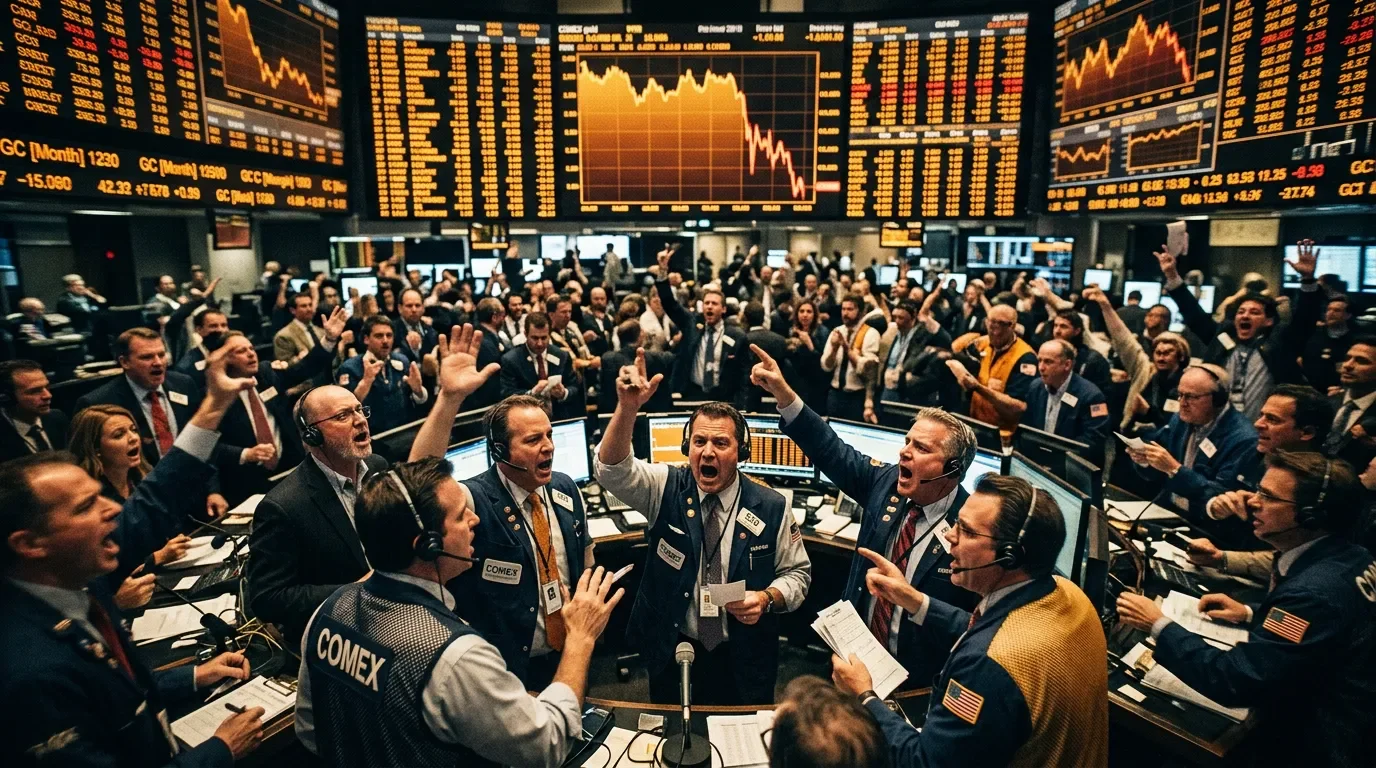
Warsh snap: gold loses $77 as dot plot shifts hawkish
Gold −1.78% to $4,276 as Warsh's first dot plot (9/18 hawk) snaps 4-day rally; WTI $75.61; Corn +1.75%; USDA 372K MT soybean flash sale — likely China

Gold's four-day rally died at 2:00 PM ET Wednesday. The FOMC held rates unanimously at 3.50–3.75%, but Kevin Warsh's first dot plot had 9 of 18 officials penciling in at least one hike by year-end — and that single number was enough to wipe $77.60 off gold in the final two hours of the session. Oil, grains, and copper each traced a different path through the same Fed shock. 1
Settlement snapshot — June 17, 2026
| Contract | Settlement | Day change | Change % | Jun 16 close |
|---|---|---|---|---|
| COMEX Gold GCQ6 (Aug) | $4,276.60/oz | −$77.60 | −1.78% | $4,354.20 |
| NYMEX WTI CLN6 (Jul) | $75.61/bbl | −$0.95 | −1.24% | $76.56 |
| ICE Brent BZN6 (Aug) | $78.66/bbl | −$0.68 | −0.86% | $79.34 |
| COMEX Copper HGN6 (Jul) | $6.376/lb | −$0.124 | −1.91% | ~$6.50* |
| CBOT Corn ZCN6 (Jul) | 421.00¢/bu | +7.25¢ | +1.75% | 413.75¢ |
| CBOT Soybeans ZSN6 (Jul) | 1,132.00¢/bu | +2.00¢ | +0.18% | ~1,130¢† |
Copper Jun 16 baseline is estimated; CNBC @HG.1 feed was offline two consecutive days and came back online June 17. 2
† Soybean Jun 16 baseline is approximate; MarketWatch S00 dedicated page failed a second straight session. 3
Gold: the oil-to-rates trade snaps
Gold entered Wednesday on a four-session winning streak — up roughly $240 since June 12 — running entirely through the oil-to-rates channel: oil falls, disinflation expectations improve, hike odds drop, dollar softens, gold lifts. The mechanism worked without any help from safe-haven demand that has been absent since the Iran MoU was signed.
Then the dot plot arrived.
GCQ6 settled at $4,276.60, down $77.60 (−1.78%). 4 The intraday arc was severe: Kitco's 24-hour chart shows gold opened around $4,331, ran up to about $4,383 in the pre-FOMC session, then plunged to $4,218 before partially recovering to settle near $4,276. 5 Silver fell harder — $67.975, down $2.792 (−3.95%).
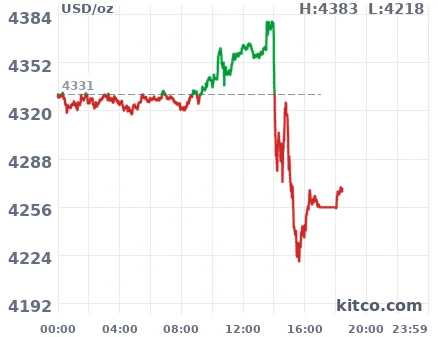
The key driver was the dot plot's revised median: end-2026 federal funds rate projection climbed to 3.8% (from 3.4% in March), implying at least one 25bp hike from the current 3.50–3.75% range. 6 Nine of 18 officials project a hike; only one still projects a cut (down from 12 in March). 6 The 2-year Treasury yield surged 11–17 basis points to 4.16–4.22%, its highest since February 2025. 7 The DXY rose 0.82–0.9% to approximately 100.47. 7 Real yields rising while gold holds zero yield is the arithmetic that drove the selloff.
Mark Hackett of Nationwide Investment Management noted the asymmetry: "It's interesting that gold is having the most significant reaction to what should not have been a surprise." 8 SocGen attributed the snap to persistent inflation and "higher-for-longer rates" capping gold's medium-term upside. 5
CME FedWatch repriced sharply post-announcement: the probability of rates holding through December collapsed to 22.9% (from 40.3% Tuesday), while the odds of a hike by October jumped to 60.7% (from 38.6%). 9 The probability of at least a half-point in hikes by year-end nearly doubled, to 27.1% from 14.8%. 9
The Warsh reset: 341 words → 130 words
The rate decision itself was unanimous (12-0), the fourth consecutive hold. The statement was the news. Warsh cut it from ~341 words in April to ~130 — a 62% reduction — stripping out all forward guidance, the easing-bias language, and even individual voting details. 10 The new core message: "The Committee will deliver price stability." 1
Warsh at his first press conference as Fed Chair, June 17, 2026. 7
Warsh announced five task forces to review Fed communications, balance sheet policy, data sources, productivity/jobs, and inflation methodology. He declined to submit a dot: "I did not submit a dot for me. It's not helpful in the conduct of policy." 1 He called forward guidance "not well suited for the current policy conjuncture" 10 and acknowledged the dot plot's limited credibility: submissions come with "pencils that have big erasers." 7
The SEP raised headline PCE inflation for 2026 to 3.6% (from 2.7% in March) and core PCE to 3.3% (from 2.7%). 7 GDP growth was trimmed to 2.2% (from 2.4%).
Ian Lyngen of BMO described the first impression bluntly: "The statement was significantly shortened and gave only a cursory characterization of the economy." 7 David Zervos of Jefferies gave the equity response a single sentence: "The market doesn't like regime change." 11 The Dow fell 507 points (−0.98%) to 51,492 after hitting an all-time intraday high earlier in the session. 11 The S&P 500 fell 1.21% to 7,420 and the Nasdaq dropped 1.34% to 26,022. 6 The VIX surged 12.37% to 18.44. 11
Warsh, when asked about the market reaction, said the Fed has given markets "a new chapter for the central bank — some fresh thinking." 8
Neil Dutta of Renaissance Macro captured the underlying concern: "A hawked-up Fed puts me in a more defensive mood; monetary policy is tightening and fiscal policy is poised to tighten." 7 Brian Jacobsen of Annex Wealth Management offered a counterintuitive read on the stripped-down statement: "By doing this radical simplification, Warsh is actually inviting more Fed-speak, not less — every Fed President will fill the gap." 7
May retail sales released at 8:30 AM provided the day's one economic bright spot: +0.9% month-over-month, beating the +0.5% consensus. 12 Total sales hit $763.7 billion, though the headline was gas-station-driven (+3.4% in May, +21% year-to-date from Iran-conflict fuel prices). 12 Excluding gas and autos, retail sales rose a more modest 0.5%. Restaurant and bar sales declined for the 4th time in 8 months, with 12-month growth of just 2.7% — down nearly two-thirds from a year ago. 12
Oil: stable near 3-month lows, inventory story clarifies
WTI CLN6 settled at $75.61 (−$0.95, −1.24%), 13 with Brent BZN6 at $78.66 (−$0.68, −0.86%). 14 Both settled near three-month lows, continuing the post-MoU de-risking. The session saw a $5.22 intraday swing in Brent ($77.75 low to $82.97 high) as Trump's remarks at the G7 briefly boosted oil: he said the deal was "not final" and bombing could resume if Iran proved unsatisfactory. 15 Brent's lower final settlement reflects the more complete picture that prevailed by close.
The physical reality at Hormuz remains a slow unwind. Only 7 ships have transited the strait since the deal was announced Sunday, with 550+ vessels still stranded on either side. 16 Three Iranian tankers carrying a combined ~4.8 million barrels crossed the US blockade line — Iran's first crude exports in two months — with the Sonia I (1 million barrels) crossing at 01:11 GMT. 17 Mine clearance is expected to take roughly two months (Jyske Bank estimate). 16
US officials read the 14-point MoU text to journalists on Wednesday, with formal signing still scheduled for Friday in Geneva. The framework includes: toll-free Hormuz passage for 60 days; immediate US sanctions waivers on Iranian fossil fuel exports; minimum uranium dilution standards; a $300 billion reconstruction fund; and a Lebanon ceasefire on all fronts. 18 Iran parliament speaker Ghalibaf announced Hormuz will not stay toll-free after the initial 60 days: "We will charge for the services." 19
The JMIC (Joint Maritime Information Center) downgraded Hormuz threat from Severe to Substantial, noting IRGC behavior "has become less volatile." 20 The advisory still warns "an attack is still a strong possibility" and mine clearance routes have not been established. 20 Bimco said it needs "credible assurances" before recommending commercial transit. 20
The EIA's weekly petroleum status report (data through June 12) showed US crude inventories fell for the 10th consecutive week, with commercial stockpiles at their lowest level since 1985. 15 The Strategic Petroleum Reserve stood at 340,251 thousand barrels as of June 12, down 8,941 thousand barrels from the prior week. 21 The IEA's first 2027 supply/demand outlook presented a contrasting long-term picture: global supply is projected to rise 8 million barrels per day versus demand growth of only 2 million bpd, pointing to a sizable surplus if Hormuz normalizes fully. 15
The Lebanon-Israel fault line remains the most credible threat to the deal. Fresh Israeli air strikes and artillery fire hit several towns in southern Lebanon on Wednesday despite the ceasefire; Hezbollah launched two drone attacks on Israeli forces, injuring five IDF soldiers, one seriously. 22 Iran accused Israel of 84 ceasefire violations since the deal was struck. 22 Iran FM Araghchi stated any final agreement must include "the withdrawal of Israeli forces from the territories they occupied during this war." 23 Doug Bandow of the Cato Institute: "If Trump does not apply real pressure … it's going to turn out to be theatrics. It could blow up the agreement." 22
War risk insurance premiums have fallen from a peak of roughly 5% of hull value during active hostilities to the 1–3% range, still six to twelve times the pre-war rate of ~0.25%. 24 VLCC war risk per transit now runs approximately $1.1 million (pre-war: $110,000–$165,000). 24
At the G7 summit in Evian, Trump also said he may reimpose sanctions on Russian oil that were eased during the Iran war, telling reporters he could do so "soon" now that Hormuz reopening looks likely — an additional potential supply-side variable for oil markets if implemented. 25
Grains: China breaks the silence — or almost
CBOT Corn ZCN6 settled at 421.00¢, up 7.25¢ (+1.75%). 3 Soybeans ZSN6 settled at 1,132.00¢, up 2.00¢ (+0.18%). 26 The catalyst was a USDA daily export flash sale: 372,000 metric tons of soybeans to "unknown destinations" — 60,000 MT old-crop (2025-26) and 312,000 MT new-crop (2026-27), approximately 13.2 million bushels. 27
The market almost universally suspects China (Sinograin, the state grain reserves arm) behind the purchase. Yesterday's 126-day zero-buy streak had produced a soybean inquiry rumor that moved the market +11¢ before dissipating without a confirmed sale; Wednesday's flash sale is the first USDA-confirmed purchase. Randy Martinson of Martinson Ag: "With the size of the purchase, you almost think it has to be [China]. And the timing of it is very coincidental for the rumors that came out yesterday." 29 The "unknown" designation, however, means the 127-day China zero-buy streak is not officially broken — buyers registered as "unknown" can include non-Chinese state enterprises.
The structural constraint: a 10% tariff on US soybeans remains in place for commercial Chinese crushers. 29 Sinograin (state reserves) can buy tariff-free, but Martinson noted its storage capacity can't absorb the full 920 million bushels under China's trade-framework commitment: "Sinograin and the other companies with China that buys for the reserves, they really don't have 920 million bushels of room to put soybeans in storage." 29 Jim Wiesemeyer of Ag Bull: "China has already committed to substantially increase purchases of U.S. agricultural commodities under the trade framework announced earlier this year." 26 Market chatter suggests tariffs may not be lifted until August. If so, commercial Chinese crushers remain on the sidelines even as the state-reserve buying opens the door.
Corn's 1.75% gain reflected spillover from soybean momentum, short covering by managed-money funds that had gone net short the contract, and Trump's Iran deal uncertainty comments (which boosted crude, lifting corn by correlation). 30 Jack Scoville of The Price Futures Group: "I think funds were heavy sellers in the grains before. They seem to have run out of selling pressure and we're seeing some short cover." 30 The September corn contract rose 1.7% to $4.29½/bu. 26 Corn's current level is near two-year lows; Martinson noted China "should also be buying corn" at these prices if the trade-framework commitments are to be met.
Wheat drove the grain complex higher, surging +25.50¢ (+4.28%) in the same session. 3 Soybean oil fell 1.71%; soybean meal held flat at $304.90/ton.
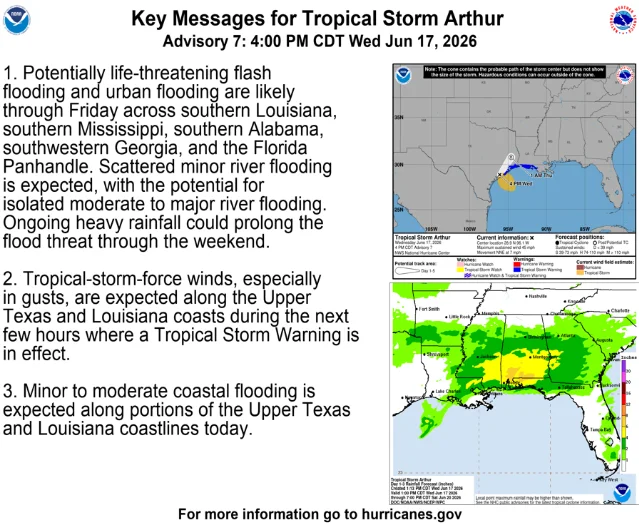
On weather: Tropical Storm Arthur (Advisory #7) was moving NNE at 7 mph with 45 mph maximum sustained winds over Matagorda County, Texas. 28 The NHC forecast 5-10 inches of rain (isolated 20 inches) across Louisiana, Mississippi, Alabama, western Georgia, and the Florida Panhandle, with life-threatening flash flooding expected through early Friday. 28 The storm is not tracking toward the Corn Belt; the NHC expects it to weaken to a remnant low overnight. The Corn Belt did face its own hazard Wednesday: the Storm Prediction Center issued a moderate severe weather risk for Missouri to Indiana, with two rounds of storms including the potential for long-track tornadoes and derecho-class winds. 31 DTN meteorologist John Baranick's 6-10 day forecast for the Corn Belt: "The combination of continued showers and milder air should be mostly favorable east of the Rockies." 32 Crop Progress through June 14 had corn at 68% good-to-excellent (+1 point) and soybeans at 66% G/E (+1 point). 26
USDA weekly export sales (due June 18 at 8:30 AM ET) should clarify whether Chinese buying activity extends beyond Wednesday's flash sale. Analyst forecasts collected by the WSJ range from 400K–850K MT for soybeans. 26 Note: USDA and CBOT are closed Friday June 19 for Juneteenth; the next crop progress report is Monday June 22. The USDA FAS export sales page (apps.fas.usda.gov/export-sales/esrd1.html) has returned a 404 error since at least June 12. 33
Copper: feed restored, contract falls
COMEX Copper HGN6 settled at $6.376/lb (−$0.124, −1.91%), 2 confirmed by MarketWatch's continuous contract at $6.3665 (−1.96%). 34 The CNBC @HG.1 feed came back online Wednesday after two consecutive days of outage, with a live 6:00 PM EDT timestamp showing the narrow intraday range of $6.3725–$6.3775. Copper's decline aligned with the broader metals selloff triggered by the hawkish Fed: higher real yields and a stronger dollar reduce both the investment and speculative cases for copper. Silver's 3.95% drop confirmed the pattern is metals-wide rather than copper-specific.
What to watch Thursday
- USDA weekly export sales, 8:30 AM ET — the first post-flash-sale data point on China buying volume 27
- Cattle on Feed report, noon ET 32
- Iran MoU formal signing — Friday June 19, Geneva — Trump at G7 said it could happen Thursday, "maybe the next day," but "you never know with deals" 19
- NYMEX WTI CLN6 expiry — June 22; traders watching roll activity into CLQ6 (August) 13
- Lebanon-Israel situation — any escalation that triggers ceasefire collapse would likely pull Iran back from Geneva and reset oil higher
Cover image: AI-generated commodity trading floor illustration.
Fuentes de referencia
- 1CNBC: Fed holds rates steady, June 2026
- 2CNBC: Copper HGN6 @HG.1 quote
- 3MarketWatch C00 corn continuous (soybean sidebar)
- 4CNBC: Gold GCQ6 quote @GC.1
- 5Kitco: Live gold prices
- 6WSJ: Fed holds rates, signals hike more likely than cut
- 7Reuters: Instant view — Fed holds steady in Warsh's debut
- 8MarketWatch: The Fed threw investors a curveball
- 9Barron's: Traders price in rate hike as soon as October
- 10CNBC: June Fed meeting — what changed in the new statement
- 11CNBC: Stock market today, live updates
- 12MarketWatch: High gas prices soak up retail sales dollars
- 13CNBC: WTI crude @CL.1 quote
- 14CNBC: Brent crude @LCO.1 quote
- 15CNBC: Oil stabilizes as investors weigh Iran war end
- 16Al Jazeera: Strait of Hormuz reopens — can ships' safety be assured?
- 17gCaptain/Bloomberg: Oil tankers U-turn, rush to Middle East
- 18AP/Swoknews: US officials read MoU with Iran to journalists
- 19Al Jazeera: Trump — world will find out if Iran MoU signing will happen
- 20CNBC: Hormuz threat downgraded after Iran deal
- 21EIA: Weekly Petroleum Status Report, week ending June 12
- 22Al Jazeera: Iran war day 110 — Lebanon attacks threaten US deal
- 23Al Jazeera: Iran war live — June 17 liveblog
- 24gCaptain: Hormuz reopening — shipping's old playbook isn't
- 25PBS NewsHour: Trump signals reimposed Russia oil sanctions
- 26Morningstar/Dow Jones: Grains close higher on Chinese demand hopes
- 27Pro Farmer: Ahead of the open — grains surged on Trump comments
- 28NHC: Tropical Storm Arthur advisory #7
- 29AgWeb: Grains rally as soybean export business confirmed
- 30Manitoba Co-operator: CBOT weekly — Iran peace deal, US weather
- 31DTN: Another severe weather event Wednesday for the Midwest
- 32DTN: Ag weather brief, June 17
- 33USDA FAS export sales page (404)
- 34MarketWatch: Gold GCQ26 overview (copper sidebar)
Añade más opiniones o contexto en torno a este contenido.