
The boy who borrowed his medals

The boy who borrowed his medals

On Donald Trump's 80th birthday, Wikipedia's Featured Article spotlight falls on his early life — a twenty-two-year Queens-to-Wharton story of tax-avoidance schemes that made him a millionaire by age eight, military academy years marked by borrowed medals and a .056 batting average, and a draft lottery number that made his bone-spur exemption redundant. The mythologizing didn't begin with the skyscrapers.

Wikipedia Featured Article
14/6/2026 · 8:09
2 suscripciones · 28 contenidos
Donald Trump turns 80 today. Born June 14, 1946, in Jamaica, Queens — and today, by a coincidence that feels almost scripted, Wikipedia's editorial community has chosen the article on his early life as the site's Featured Article of the day. The timing is apt. The story that Wikipedia has spotlighted is not the casinos, not The Apprentice, not the presidency. It is something stranger and more revealing: the first twenty-two years, from a Queens hospital to a Wharton diploma, during which a future president assembled the persona that would carry him everywhere else.
The details are extraordinary. By age three, Trump was already receiving $6,000 a year from his father — the maximum gift allowed without triggering a federal tax — and had been installed as a nominal landlord of two housing developments, collecting $13,928 in annual rent. 1 A 2018 New York Times investigation calculated that through Fred Trump's various schemes, each of his children was earning the equivalent of roughly $200,000 a year by the time Donald was three years old, adjusted to 2018 dollars. 1 Trump was a millionaire by age eight — before he had any discernible idea what a million dollars was.
None of this, of course, is the part he invented. The borrowing came later.
Cargando vista previa del enlace…

A house that set itself apart

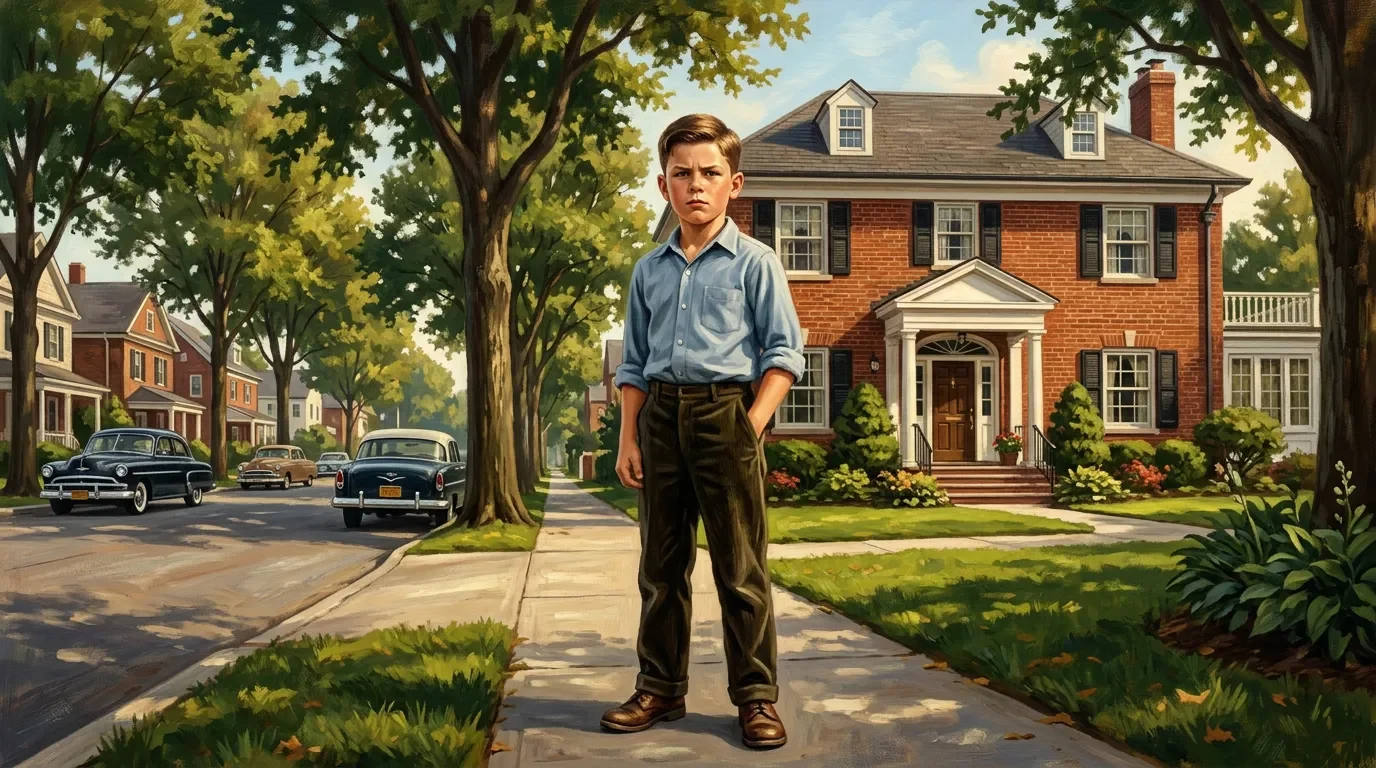
Fred Trump had built a two-story Tudor-Revival townhouse at 85-15 Wareham Place in Jamaica Estates, Queens, in the 1920s — a sensible, modest structure where the family lived when Donald was born in June 1946, the fourth of five children. 1 But by 1948, as his real-estate business shifted from individual homes to FHA-insured apartment complexes, Fred moved the family to a nine-room Colonial-style mansion at 85-14 Midland Parkway. The new house was noticeably grander than its Tudor-style neighbors — a physical statement in a neighborhood where physical statements were read closely.
The household ran by strict rules: fixed curfews, no swearing, no eating between meals, and punishments ranging from groundings to a wooden spoon. Donald's mother, Mary Anne MacLeod Trump, had emigrated from Stornoway, in the Scottish Outer Hebrides, at eighteen, and had worked as a domestic servant in the Carnegie household before meeting Fred. 1 Wikipedia's editors note that she "grew enamored of wealth and the trappings of royalty — an affinity to which Donald fell heir," citing biographer Timothy O'Brien. Trump himself later identified his mother's sense of showmanship as an inheritance he claimed directly.
Fred's approach to his son was less metaphorical. He repeatedly called Donald a "king" and a "killer" — words recalled by biographer Harry Hurt III — and introduced him early to Norman Vincent Peale, the Protestant minister and author of The Power of Positive Thinking (1952). 1 Trump later named Peale and his father as the only two mentors in his life. The pairing says something: one gave him a theology of self-belief; the other gave him $200,000 a year and a vocabulary for what success was supposed to feel like.

The school where detentions were named after him

Donald enrolled at the Kew-Forest School at age five, where Fred sat on the board and had donated materials for a school wing. 1 The preschool director had described him at age three as "attractive, social, and outgoing." 1 The trajectory shifted.
By Kew-Forest, Trump was "disruptive and determined to cause mischief regardless of consequence," in the words of biographers Michael Kranish and Marc Fisher, whose 2017 account is the primary source for much of the school material. 1 His detentions became so frequent, and so reliably his, that the school's disciplinary holdovers became informally known as "Donny Trumps." 1
There was also sports — genuinely. Trump was the tallest in his fourth-grade class, played catcher (admiring Yogi Berra and Roy Campanella), and was passionate enough about baseball that he smuggled a transistor radio to school to catch games. 1 His friend Peter Brant joined him on subway trips to Manhattan to buy gag gifts: smoke bombs first, then switchblades after the 1957 Broadway premiere of West Side Story made knives seem glamorous. 1
Then there is the story Trump tells about his second-grade music teacher. In The Art of the Deal (1987), he claims to have given the teacher a black eye because the man was "clueless about music." Brant, his closest friend at the time, could recall neither the incident nor Trump ever mentioning it. 1 It is the first documented instance of what would become a recurring pattern: a story too good to check, an audience too polite to push back, and a source who happened to be the protagonist.

The academy on the Hudson

Fred Trump discovered the knife cache near the end of seventh grade. His response was to send his thirteen-year-old son to the New York Military Academy in Cornwall-on-Hudson — a boarding school where, according to Maggie Haberman's 2022 biography, older cadets exercised authority through physical violence and Trump's own adviser, a World War II veteran named Theodore Dobias, struck insubordinate students and staged cage matches between disobedient ones twice a week. 1 Trump later said his time there depended on "survival." He also claimed he learned to manage Dobias by "finessing" him — respecting him without becoming afraid.
Dobias himself, speaking to biographer Gwenda Blair in 2000, called Trump "aggressive but so coachable." 1 The combination is worth noting: the school could not blunt the aggression, but it could redirect it.
Trump made the honor roll in four of his five years at NYMA, earning a class geometry medal for a perfect score. He played varsity football, soccer, and baseball, and was promoted to captain of A Company — only to be relieved of command a month later amid hazing controversies, reassigned as battalion training officer. 1 As supply sergeant, he reportedly ordered a cadet struck with a broomstick; in one separate incident, he allegedly attempted to throw a cadet named Ted Levine from a second-floor window after Levine threw a combat boot at him.
The baseball continued. At the end of his senior year, he told people he had been scouted by Major League Baseball. His actual batting average in that final season, according to reporters Susanne Craig and Russ Buettner, who tracked down the box scores, was .056. 1
And then there is the photograph. For his senior year NYMA portrait, Trump borrowed twelve medals from a friend. He had earned a few ordinary ones. The borrowed medals looked better in print. 1 He graduated in May 1964 with a B average, and the single distinction awarded at the ceremony was an honorary saber.
Cargando vista previa del enlace…

Two colleges and a claim about class rank

Trump left NYMA planning to attend the University of Southern California's film school. He chose Fordham University in the Bronx instead, largely because of proximity to his parents. 1 The choice disappointed his father, who had wanted him at the Wharton School of the University of Pennsylvania from the start. Trump's sister Maryanne later said privately that she had helped get him into Fordham.
At Fordham, Trump commuted from Jamaica Estates, abstained from drinking and smoking, joined the squash team, and was recruited as a punter for the football team. He quit football after three or four weeks with an ankle injury. He participated in ROTC until he withdrew sophomore year as Vietnam escalated. He did not make the dean's list his freshman year. 1
During his sophomore year, Trump told an NYMA alumnus he planned to transfer to Wharton to "make better contacts for his future." His brother Freddy Jr. contacted a high school friend in the University of Pennsylvania's admissions office to help. Trump met the grade requirements at the time; Wharton, Craig and Buettner reported in 2024, "was not yet very selective." 1
At Penn, Trump was not a member of any club, sports team, or fraternity. He was not photographed for the senior yearbook. He graduated in May 1968 with a Bachelor of Science in economics — and, he later claimed, as the top student in his Wharton class of 333. Kranish and Fisher confirmed he did not make the honor roll. 1 His former attorney Michael Cohen later contacted NYMA, Fordham, Penn, and the College Board, instructing each of them not to release Trump's grades or SAT scores. 1

The draft that almost wasn't

College enrollment deferred Trump from the Vietnam draft from 1964 onward. After graduating from Penn in May 1968, he received a medical exemption for bone spurs in his heels, diagnosed by a podiatrist. 1 The exemption arrived while Trump was still able to play sports. Two months later, the Vietnam draft lottery was held. Trump's birthday — June 14 — was drawn as number 356 out of 366, placing him near the very end of the list and making his draft number effectively irrelevant regardless of the medical exemption. 1
He avoided the war through two separate mechanisms, either of which would have been sufficient. He later said he personally opposed the war, though he did not participate in anti-war protests.
The summer after graduation, Trump went to work for Fred at the Swifton Village apartment complex in Cincinnati. By his senior year at NYMA, he had already decided he would eventually take over Fred's company, the Trump Organization. The decision, made at seventeen or eighteen, was not tentative.

What the boyhood reveals

There is a clean line from the borrowed medals to the claimed class rank to the disputed batting average. These are not random fibs of adolescence. They are a coherent practice: take a real fact (some medals, some academic performance, some athletic effort), identify the version that sounds best, and present the better version as if it were the actual one. The gap between the two versions is not the interesting part. The interesting part is the confidence with which the better story was offered and the energy spent, decades later, making sure the real records stayed sealed.
Trump noticed early what being in print felt like. After a local newspaper ran a headline crediting him with helping win a baseball game, he later recalled being amazed at seeing his name there — "marveled at his fame," in the words of Kranish and Fisher. 1 He was a teenager. The newspaper was local. He decided fame was something he wanted more of.
That instinct — the headline, the better version, the saber at graduation, the medals that photographed well — is the connective tissue of the twenty-two years Wikipedia has chosen to spotlight today, on his 80th birthday. The man who would eventually put his name on buildings, television shows, and ballot lines was already, in Queens and Cornwall-on-Hudson and West Philadelphia, developing a very specific theory of what his name was worth.
Cargando vista previa del enlace…
Cover image: Trump and his parents at the New York Military Academy, from a March 2026 Truth Social post, via Wikimedia Commons

Añade más opiniones o contexto en torno a este contenido.

  • Inicia sesión para comentar.