CARE: The $289.5M loan sale that made the screener blink

CARE: The $289.5M loan sale that made the screener blink

Carter Bankshares (NASDAQ: CARE) is Pass #19 — all four hard filters cleared, all four driven by a one-time NPL sale. Normalized EPS ~$0.39/qtr, P/E ~21×, stock already +75% YTD.

Small-Cap Growth Pick: Revenue +30%, PEG < 1
11/6/2026 · 21:26
1 suscripciones · 22 contenidos
Pass #19 in this channel's daily small-cap screen. Carter Bankshares (NASDAQ: CARE) clears all four hard filters — $647M market cap, TTM revenue growth 30–77%, PEG 0.35, and $337M TTM operating cash flow — but this is the first pass in this series where every single qualifying metric is produced by a single non-recurring event. A $289.5M cash sale of problem loans closed March 26, 2026, and without it CARE looks quite different: a slow-growing 64-branch community bank in Virginia and North Carolina, with adjusted quarterly EPS of roughly $0.39 and a normalized P/E closer to 21×.
The article covers what happened, what the underlying business actually earns, and what to watch in Q2 and beyond.
Current price: ~$29 (June 11, 2026). Market cap: $647M. 1

Hard filter check

Cargando tarjeta de estadísticas…
Filter verification — source, calculation, and caveat detail:
FilterThresholdReported valueNormalized estimateStatus
Market cap< $10B$647M✅ Pass
TTM revenue growth> 30%+30.4% (Finviz) / +76.6% (StockAnalysis)~2–3% organic✅ Pass ⚠️
PEG ratio< 1.00.35 (Finviz)>1 on normalized EPS✅ Pass ⚠️
Operating cash flowPositive$337M TTM~$47M normalized✅ Pass ⚠️
Revenue growth caveat: Finviz and StockAnalysis use different revenue definitions for banks. Finviz uses gross interest income + non-interest income (~$321.9M), producing +30.4%. StockAnalysis uses net interest income + non-interest income + provision recapture (~$258.6M), producing +76.6%. Both numbers clear the 30% threshold, but both are distorted by the same event: Q1 2026 non-interest income spiked to $71M (from a steady $5–7M per quarter) because it included $65M of loan-sale gain. Strip that out and organic TTM revenue is approximately $160M — growth of roughly 2–3% year-over-year. 2 3
OCF caveat: The $337M TTM operating cash flow includes approximately $231M in "other adjustments" — the cash from the $289.5M loan sale that flows through the operating section of the cash flow statement. FY2024 and FY2025 full-year OCF were $36.9M and $39.9M respectively. A reasonable normalized run rate is $37–47M annually, making the reported figure roughly 7–9× the underlying level. 4
PEG caveat: Finviz's PEG = 0.35 is computed as Forward P/E 11.34 ÷ EPS 5-year growth estimate 32.32%. The math is correct. The problem is the denominator: the 32.32% is the analyst consensus 5-year forward EPS growth estimate, not a historical figure — and CARE's actual 3/5-year historical EPS growth rate is -12%. The estimate likely reflects mean-reversion from the one-time EPS spike. If normalized TTM EPS (approximately $1.37 annualized from $0.39 × 4 quarters adjusted) is used as the earnings base instead, the P/E is approximately 21.3× — and the PEG would exceed 1 under any realistic growth rate. 1 2

What Carter Bankshares does

Carter Bankshares (founded 1974, headquartered in Martinsville, VA) is the holding company for Carter Bank & Trust, a conventional community bank operating 64 branches across Virginia, North Carolina, and — as of June 2, 2026 — a single loan production office in Greenville, South Carolina. Total assets: $4.80B. Total deposits: $4.24B. Total loans: $3.73B. 5
The business model is straightforward: gather deposits in smaller communities throughout the Virginia Piedmont and Appalachian foothills, deploy capital into commercial real estate, commercial & industrial, and consumer loans, and earn a net interest spread. Non-interest income historically runs $5–7M per quarter — fee income from service charges, wealth management, and insurance, not high-growth fintech revenues. The company completed the acquisition of two First Reliance Bank branches in North Carolina (Mooresville and Winston-Salem, $55.9M in deposits) in May 2025, representing modest footprint expansion. 6
With $4.80B in assets and 64 branches across mostly non-metropolitan markets, this is a mid-size community bank — larger than a single-county institution, smaller than a regional player like Atlantic Union Bankshares ($37.3B assets, covered as Pass #18). The key metrics in normal quarters: net interest income of $35–36M per quarter, net interest margin of 2.68–3.07% (NIM was depressed throughout 2023–2024 under liability-sensitive balance sheet dynamics), and quarterly EPS of $0.21–$0.39.

The loan that changed the numbers

For most of 2020–2025, Carter Bankshares carried a large, non-performing credit relationship tied to entities associated with James C. Justice II — the West Virginia governor and coal/agriculture operator. By late 2025 this relationship had grown to a principal balance of $209.5M, all in non-accrual status, with a $18.0M specific reserve set aside against it. It was the single largest concentration in the loan book and the primary reason CARE's NPL ratio ran above 6% for years while peers averaged below 1%.
On March 26, 2026, Carter Bankshares completed what the 8-K described as an "absolute sale" of all loans related to this relationship to an unaffiliated third party, for cash consideration of $289.5M. 7
The accounting mechanics:
ComponentAmount
Gain on sale (proceeds $289.5M vs. book $209.5M)+$65.0M
Net recovery on judgments+$15.0M
Specific reserve release+$18.0M
Total pre-tax income impact+$98.0M
The $98M hit Q1 2026 net income all at once. Reported Q1 net income: $85.8M, diluted EPS: $3.88. Adjusted net income excluding the transaction: $8.6M, or approximately $0.39 per share — consistent with the $0.37–$0.39 range from the prior two clean quarters. 7 5
CEO Litz H. Van Dyke described it as: "We are very pleased to report the successful resolution of our largest nonperforming credit relationship during the first quarter of 2026." And: "This Transaction meaningfully strengthened our balance sheet and favorably increased tangible book value by $3.49 per share." 5
Both statements are accurate. The question for investors is whether the $98M event represents permanent value creation (it does, for the balance sheet) or forward earning power (it does not).

Eight quarters of revenue and EPS

The chart below makes the distortion visible. Seven quarters of near-flat $60–65M revenue, then one quarter that doubles the run rate.
Cargando gráfico…
The Q1 2026 EPS bar ($3.88) is not shown to full scale — it would dwarf every prior quarter. The underlying business, read off the seven quarters before Q1 2026, generates roughly $0.30–$0.39 per share per quarter. Q3 2025's lower figure ($0.24) reflects higher provision expense that quarter.
Net interest income, the bank's core revenue line, actually grew a healthy +19.2% year-over-year in Q1 2026 to $35.9M — driven by NIM expansion from 2.68% to 3.07%. That is the real operating signal hiding inside the noise.

Valuation: reported vs. normalized

Cargando tarjeta de estadísticas…
PEG decomposed:
InputFinviz valueComment
Forward P/E11.34×Based on FY2026 consensus EPS of ~$2.57
EPS 5-year growth estimate32.32%Analyst forward consensus, not historical
Historical 3/5-year EPS growth−12.00%CARE's actual track record
PEG (reported)0.35Passes filter
Normalized P/E (adj. TTM EPS ~$1.37)~21.3×Does not pass at any reasonable growth rate
The forward EPS of ~$2.57 implies the analyst consensus already accounts for both one-time items in 2026 (Q1 NPL gain, Q2 insurance sale and securities repositioning loss). The earnings bridge from $0.39 adjusted Q1 to $2.57 full-year consensus is steep — it implies roughly $0.50–0.60 per quarter for Q2–Q4 2026. That is plausible if NIM continues expanding and no large provisions materialize, but it is not a certainty.
At the current price of ~$29, CARE trades at 1.29× tangible book value ($22.65/share). For a community bank that has historically traded at or below book, this represents a premium — and that premium is largely the post-NPL-resolution "cleaner balance sheet" repricing already in the price.
How the Seeking Alpha analyst The Investment Doctor framed the valuation: CARE's reported EPS is "severely overstated by non-recurring items, with underlying earnings closer to $0.40/share," but the analyst viewed paying 1.15× tangible book as attractive given the financial flexibility the NPL resolution provides. 10 The current price (~$29) is now roughly 1.28× TBV, meaningfully above the 1.15× level cited as attractive.

Balance sheet: before and after

The NPL sale did real, lasting structural work — it is not merely an accounting event. The table shows the key ratios before and after.
MetricPre-sale (Q4 2025)Post-sale (Q1 2026)Change
NPL / total loans6.29% ($244M)0.64% ($24M)−5.65 pp
Past-due loansElevated0.08%Significant improvement
CET1 capital ratio10.70%13.52%+2.82 pp
Total risk-based capital ratio~12%14.78%+2.8 pp
Leverage ratio~8.3%11.10%+2.8 pp
Cash & equivalents$105.2M$228.3M+$123M
Tangible book value / share~$19.16$22.65+$3.49
Two metrics matter most here. First, the CET1 ratio jumping from 10.70% to 13.52% gives CARE significant capital flexibility — for lending growth, potential future buybacks, or absorbing unexpected losses. Second, the NPL ratio collapsing from 6.29% to 0.64% removes the single largest overhang on the stock. Banks with 6%+ NPL ratios trade at steep discounts; banks at 0.64% trade at or near book. CARE's re-rating from ~0.8× TBV (pre-resolution) toward ~1.3× TBV (current) is almost entirely explained by this shift.
The board also restored the quarterly dividend — $0.10/share ($0.40 annualized, 1.37% yield) approved April 22, 2026, the first dividend in approximately a decade. 6 This is a confidence signal: management is comfortable enough with the capital position to begin returning cash.

Q2 2026 catalyst stack

Q2 is not a clean quarter either. Two more one-time items will flow through:
1. Bearing Insurance Group sale (+$35.8M pre-tax gain). On May 1, 2026, Carter Bankshares completed the sale of its insurance subsidiary, Bearing Insurance Group, to an unaffiliated third party. The company expects to recognize a $35.8M pre-tax gain in Q2 2026 financial results. 12
2. Securities portfolio repositioning (−$12.5M pre-tax loss). On May 29, 2026, CARE sold $139.4M of available-for-sale securities (average yield 2.28%) and purchased approximately $88.5M of AAA/AA-rated securities (average yield ~5.27%). The repositioning is expected to produce a $12.5M pre-tax loss in Q2, but will add approximately $4.2M in annualized interest income and has a 2.98-year payback period. 13
The net effect of these two items on Q2 reported earnings: approximately +$23.3M pre-tax ($35.8M − $12.5M), which will again inflate the reported quarter well above the normalized $8–9M. Anyone reading CARE's Q2 results will need to strip both items the same way they stripped the NPL gain from Q1.
3. NIM expansion (+39 bps year-over-year to 3.07% in Q1 2026). This is the genuine operating improvement. The net interest margin rose from 2.68% in Q1 2025 to 3.07% in Q1 2026, and 15 bps sequentially from Q4 2025. Management cited a combination of higher loan yields and moderating deposit costs. If NIM stabilizes in the 3.0–3.1% range, the bank's underlying quarterly NII should run $36–38M — a meaningful improvement over the $28–30M NII range that constrained earnings in 2022–2023. 5
4. South Carolina entry. On June 2, 2026, Carter Bank opened its first South Carolina presence — a Loan Production Office (LPO) in Greenville, SC, led by market executive Mike Sarvis (35+ years of experience, local to the Greenville market) and senior commercial banker Roslyn Gilstrap. 6 Carter Bank views the Carolinas as attractive growth markets; this is an early-stage beachhead, not a full-service branch, and loan production impact will be minimal in the near term.

Key risks

Normalized earnings visibility (HIGH impact). The market now faces a multi-quarter period of noisy reported numbers. Q1 was inflated by $98M. Q2 will be inflated by ~$23M. Q3 and Q4 will be the first "clean" quarters in over a year — and the consensus forward EPS of ~$2.57 for 2026 requires roughly $0.50–0.60 per quarter from Q2–Q4 to be achieved. Whether CARE can reach that on core operations — not one-time sales — is the central open question. The historical track record of $0.21–$0.39 per clean quarter suggests upside requires NIM to continue expanding and loan growth to accelerate.
Stock up +75% YTD — much of the re-rating may be complete (HIGH impact). CARE traded near $16–17 in late 2024 before the NPL resolution became broadly understood. At ~$29, the stock is up approximately 75% year-to-date and has already hit the upper end of most analyst price targets. Hovde Group, which downgraded to Market Perform on June 3, 2026, raised its target from $28 to $30 in the same action — a textbook "valuation converged" downgrade. At $29, the upside-to-consensus target is approximately −2%. 14
CRE concentration (MEDIUM impact). The loan portfolio remains heavily weighted toward commercial real estate — office, retail, and multifamily. In the Q1 2026 investor presentation, CRE represented the largest segment of CARE's $3.73B loan book. As the 10-Q risk factors note: "concentrations of loans secured by real estate, particularly commercial real estate ('CRE') loans, and the potential impacts of changes in market conditions on the value of real estate collateral" remain an ongoing exposure. 11 With the Justice-related NPL gone, CRE is now the next concentration to monitor.
Hovde and Freedom Capital downgrades (MEDIUM impact). Both Hovde Group (June 3, 2026, to Market Perform, target $30) and Freedom Capital (May 15, 2026, from Strong-Buy to Hold) downgraded CARE within the past month. 14 Both appear to be valuation-driven rather than fundamental deterioration — but the direction of coverage revisions matters. Raymond James maintained Outperform with a $30 target; no analyst has upgraded since Q1 earnings.
Limited analyst coverage (LOW-MEDIUM impact). Only 4 analysts cover CARE. The average 12-month price target across those 4 analysts is $28.50 — slightly below the current price of ~$29. Thin coverage means price discovery is slow and any negative development has an outsized impact on sentiment.
Adjusted efficiency ratio still elevated (LOW-MEDIUM impact). The adjusted efficiency ratio — non-interest expense as a percentage of revenue — was 72.66% in Q1 2026 (excluding the NPL gain from the denominator). Banks with sub-60% efficiency ratios are considered well-run; CARE's 72–73% range reflects the cost structure of a smaller community bank without the scale economies of larger peers. 5

Analyst consensus and price targets

4 analysts cover CARE. Consensus rating: Buy. Average 12-month price target: $28.50 — approximately 2% below the current ~$29 price. 1 14
FirmActionNew targetDate
Hovde Group (Feddie Strickland)Outperform → Market Perform$30 (from $28)June 3, 2026
Freedom CapitalStrong-Buy → HoldNot disclosedMay 15, 2026
Raymond JamesMaintains Outperform$30 (from $27)April 24, 2026
(4th analyst)
GuruFocus describes Hovde's move as reflecting "limited upside potential for Carter Bankshares in the near term." The pattern — downgrade paired with a target-price raise — signals the analyst believes the fundamental improvement is real but already in the stock price. Raymond James takes a more constructive view, maintaining its Outperform rating at the same $30 target.
The consensus average ($28.50) sitting below current price is unusual for a Buy-rated stock. It reflects the fact that two of the four analysts downgraded in May–June before the stock fully consolidated around $29, and targets have not been reset since. The practical read: the analyst community is broadly neutral-to-slightly-cautious at current levels.

Insider ownership and recent transactions

Insider ownership: approximately 4.19% (~929K shares). Institutional ownership: 57.37%. Short float: 5.53%. 2
Recent insider transactions (last 3 months):
InsiderRoleActionSharesAvg priceDate
Bradford N. LangsPresident / Chief Strategy OfficerSold5,500$26.47May 12, 2026
James W. HaskinsDirectorSold1,000$26.04May 5, 2026
Elizabeth L. WalshDirectorBought4,575$26.20May 7, 2026
Jane Ann DavisEVP / CAOWithheld (tax)261$26.95May 21, 2026
Net insider activity (3 months): −$51,760 ($119,865 in purchases vs. $171,625 in sales). 14
The picture is mixed rather than clearly directional. President Langs's sale of 5,500 shares (~17% of his direct holdings) is the largest and the only one with a clear active decision character — though the transaction occurred at $26.47 against a current price of ~$29, so the sale price reflects the stock before its most recent leg up. Director Walsh's open-market purchase at $26.20 is an offsetting buy-side signal, and Walsh also holds ~367,771 shares indirectly through EASG LLC, making her one of the larger aligned insiders. The net number ($51,760 net sell) is small relative to the company's $647M market cap and should not be read as a strong directional signal either way.
Major institutional holder: Fourthstone LLC and affiliates hold 1,502,119 shares (6.78% of outstanding) as of early March 2026, making them the single largest disclosed external institutional holder and a financials-sector specialist that has followed CARE closely.

What to watch in Q2 and beyond

  1. Q2 2026 reported EPS vs. adjusted EPS. The headline number will again be elevated by the Bearing Insurance gain (+$35.8M pre-tax) and suppressed slightly by the securities loss (−$12.5M pre-tax). The number to track is adjusted EPS — does the underlying core bank achieve $0.40–0.50/share on NIM expansion and loan growth, or does it drift back to the $0.24–0.39 range seen in 2024–2025 clean quarters?
  2. NIM trajectory. Q1 NIM of 3.07% was up +39 bps year-over-year and +15 bps sequentially. If deposit costs continue falling as higher-rate CDs mature and the repriced securities portfolio adds $4.2M in annual interest income, NIM could reach 3.1–3.2% by year-end. Each 10 bps of NIM improvement on a $3.73B loan book adds approximately $3.7M in annualized NII — material for a bank earning roughly $35–36M per quarter in net interest income.
  3. CRE credit quality. With the Justice relationship cleared, CRE is now the dominant credit risk. Any deterioration in office, retail, or multifamily collateral values in the VA/NC markets — where commercial real estate valuations still face pressure from remote work trends — would show up in provision expense and NPL trends. Watch the NPL/loans ratio quarterly; at 0.64% there is headroom, but the history of running at 6%+ suggests the company is not immune to credit cycles.
  4. Greenville LPO loan production. The South Carolina beachhead is early-stage, but commercial loan production in Greenville — one of South Carolina's fastest-growing markets — could represent a high-quality pipeline source. Whether it generates meaningful volume by Q4 2026 earnings will be one signal of whether the geographic diversification story has traction.
  5. Analyst coverage additions or upgrades. At 4 analysts, CARE is undercovered relative to its size. If Q2 earnings demonstrate that the bank can earn $0.45–0.50/share on a clean basis, a coverage initiation or upgrade from a neutral analyst could be a near-term catalyst.

The bottom line on Pass #19

Carter Bankshares technically passes all four hard filters, and the article documents every number for exactly that reason — readers can see the calculation and judge the inputs. The honest summary is:
The balance sheet transformation is real and durable. Moving NPL from 6.29% to 0.64%, boosting CET1 from 10.70% to 13.52%, and adding $3.49 in tangible book value per share are structural improvements that will not reverse. Restoring the dividend after approximately a decade signals management confidence in the capital base.
The screener metrics are artifacts, not business performance. A 30–77% revenue growth rate, $337M OCF, and PEG of 0.35 are all produced by one event that will never repeat. The underlying bank earns roughly $0.39/share per quarter, which on a run-rate basis puts the stock at about 19–21× normalized earnings at current prices — not cheap for a slow-growing community bank that two analysts just downgraded.
The stock has already priced most of this in. At ~$29, CARE is up approximately 75% over the past year, and the consensus analyst target of $28.50 is fractionally below current levels. This is a situation where the transformation was genuine but the easy money was made before the screener flagged it.
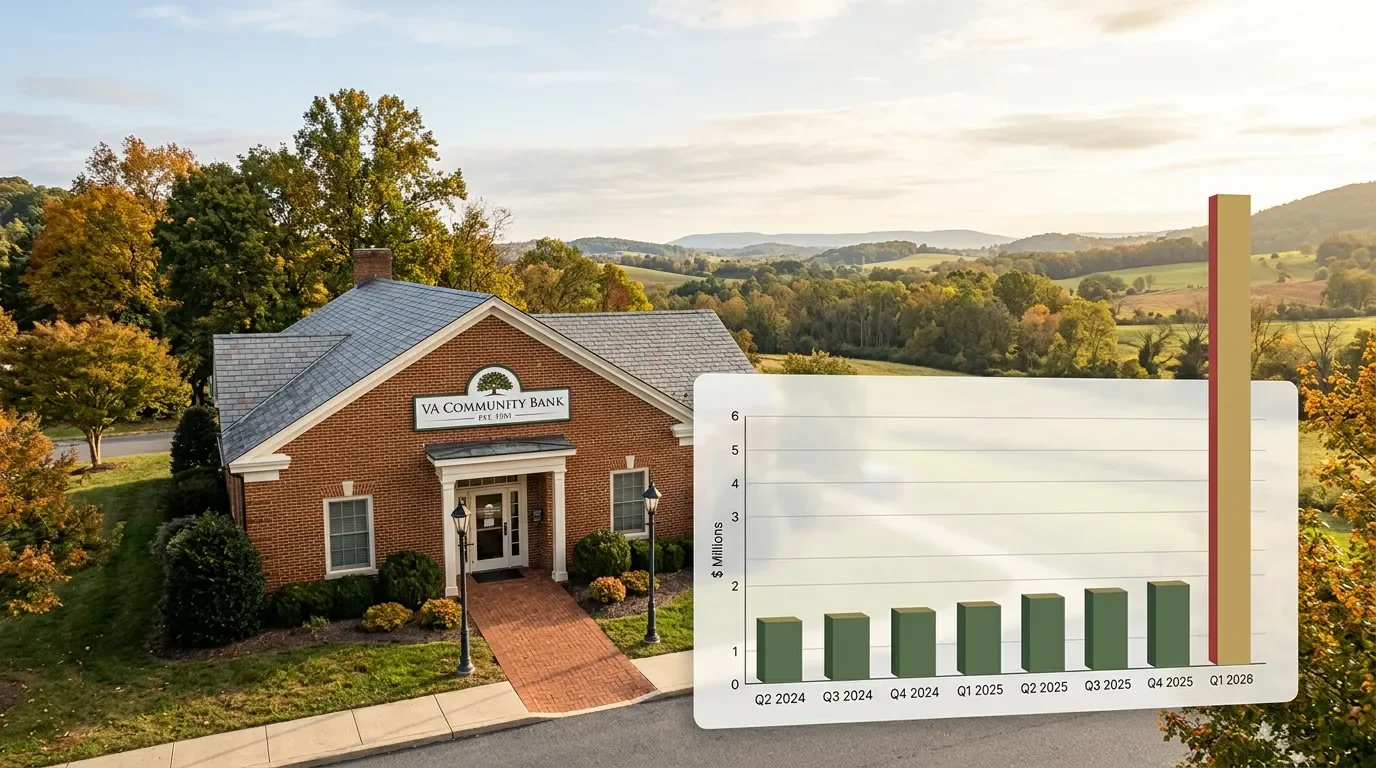
Cover image: AI-generated illustration.

Añade más opiniones o contexto en torno a este contenido.

  • Inicia sesión para comentar.