practical.engineering
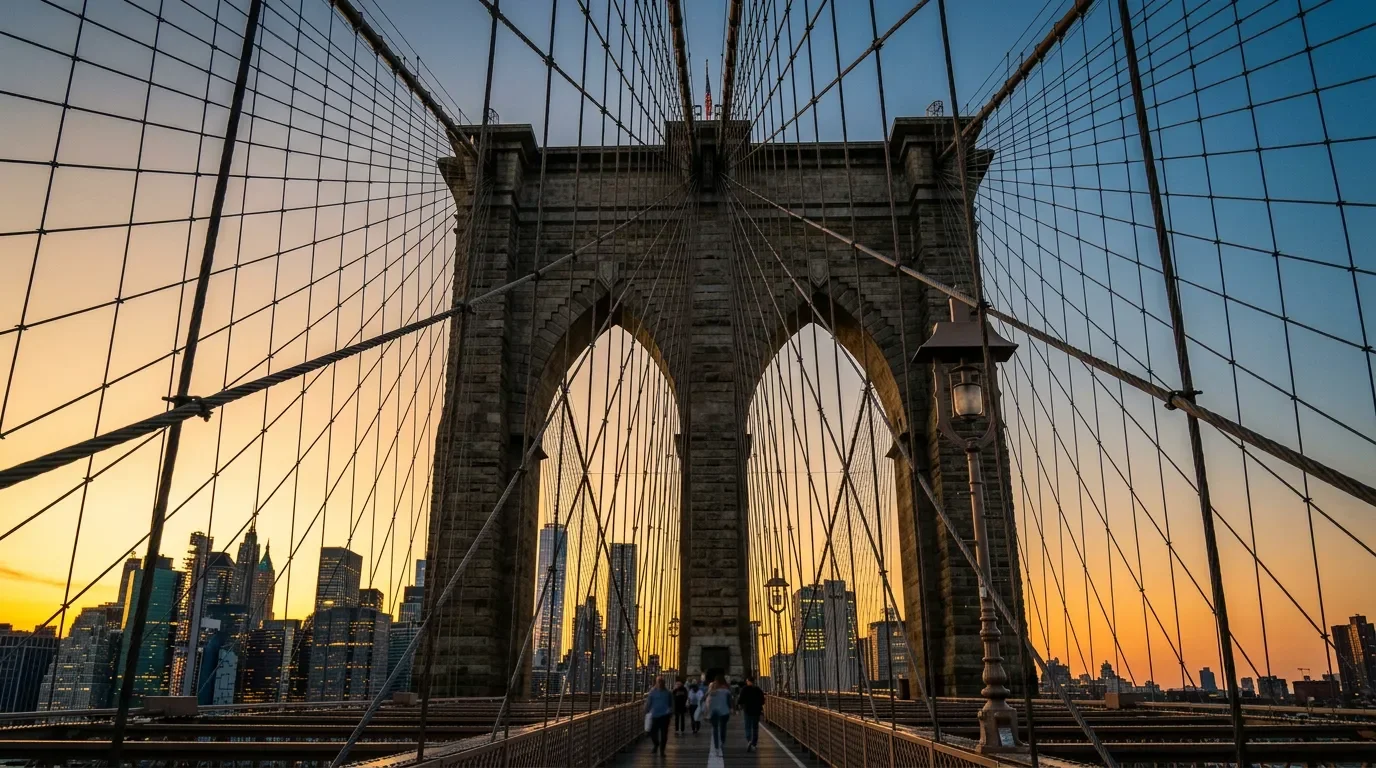
Brooklyn Bridge: the wire, the fraud, and the woman who finished it
The Brooklyn Bridge opened in 1883 as the world's longest suspension bridge — and as a structure that had already survived the death of its designer, the paralysis of its chief engineer, and a contractor's $300,000 wire fraud. This teardown traces the full constraint→solution→cost chain: how pneumatic caissons at 35 psi killed workers and incapacitated Washington Roebling; how Emily Warren Roebling ran the project for eleven years without a title; how J. Lloyd Haigh's substituted wire forced engineers to quantify a safety margin they had assumed but never measured; and why John Roebling's triple-redundant structural logic — cables, diagonal stays, and stiffening truss — is the template every major suspension bridge built since has followed.

On the morning of June 28, 1869, John Augustus Roebling stood on a timber dock at the Fulton Ferry slip in Brooklyn, sighting through a surveying instrument to fix the precise location of one of his bridge's towers. A ferry came in without warning. The boat crushed his foot against the dock piling. His toes were amputated on site. He refused hospital treatment, insisted on hydrotherapy, developed tetanus, and was dead twenty-four days later. 1
He never saw a single cable wire go up.
The man who had spent more than a decade designing the world's longest suspension bridge — who had invented the wire rope it would depend on, who had crossed the Ohio River at Cincinnati and crossed Niagara Falls in steel wire before any of his contemporaries thought steel wire could span a river — died before his biggest project began. His 32-year-old son Washington took over. Washington would be paralyzed by the same construction process within two years, directing the final eleven years of work through a telescope from his bedroom window while his wife delivered his orders to the site. The cables, when they were finally spun, turned out to contain wire that a corrupt contractor had fraudulently substituted — and nobody went to prison for it.
The Brooklyn Bridge that opened on May 24, 1883, was, in a precise engineering sense, a harder bridge than the one John Roebling had designed. Every crisis it passed through had forced the engineers to calculate what they actually had, patch what was missing, and add margin where margin had been stolen. That is its real structural legacy.
The East River problem
For roughly thirty years before the bridge opened, the only way to cross the East River between Brooklyn and Manhattan was the Fulton Ferry. 2 In winter, when ice filled the river, service stopped entirely and hundreds of thousands of people were stranded. Brooklyn's population had grown from 96,000 in 1845 to 396,000 in 1870 — the third-largest city in the United States — and it was functionally an island. The ferry fleet could not keep pace. Proposals to bridge the East River went back to 1804, but no one had a serious plan for doing it because no prior bridge technology could span the 1,600-foot width at navigable height.
John Roebling first proposed a suspension bridge over the East River in 1857. The New York State Legislature passed enabling legislation in February 1867, and the New York and Brooklyn Bridge Company was incorporated in April with authorization to raise $5 million. By September, Roebling had submitted a 48-page master plan. 3
The design Roebling proposed was not a conventional suspension bridge. It was a hybrid: four main cables carrying the deck by vertical suspenders, as in an ordinary suspension bridge, but supplemented by 400 diagonal cable stays radiating outward from each tower face. In a pure suspension bridge, the deck is entirely passive — it hangs from the cables and relies on the stiffening truss to resist horizontal wind loads. In Roebling's design, the diagonal stays turned each tower into an active compression strut and gave the deck direct load paths to the anchor points. If the suspension cables failed entirely, the stays could carry the deck. If the stays failed, the suspension cables could carry the deck. If either failed, the stiffening truss would hold the whole thing in shape long enough for the failure to be detected. This triple-redundancy philosophy was deliberate — Roebling had seen the Angers Suspension Bridge collapse in France in 1850 when marching soldiers synchronously loaded its main span, and he designed the Brooklyn Bridge so that no single failure mode could bring it down. 2
The deck clearance requirement was demanding: the Navy insisted on 135 feet of navigable clearance above mean high water, to allow masted vessels to pass beneath. That constraint set the tower height at 278 ft and determined how far the cable catenary had to rise before dipping to the deck — which in turn determined the cable's horizontal tension at mid-span. The higher the cable sag relative to the span, the lower the tension; but excessive sag would reduce the clearance and defeat the purpose. Roebling chose a sag-to-span ratio that balanced cable weight against horizontal tension, landing on the geometry that defined the bridge's profile.
The other defining choice was material. Roebling had invented the wire rope in 1841 and had built both the Niagara Falls Suspension Bridge (1855, 821 ft span) and the Cincinnati-Covington Bridge (1866, 1,057 ft span) using parallel wire cables. 1 The competing alternative — wrought-iron chain links, the dominant European suspension technology — could not be field-adjusted once assembled; individual links were fixed-length and any error in the catenary geometry had to be corrected at great cost. Parallel wire cable, spun in place, allowed continuous adjustment of each wire's tension as it was laid. The Brooklyn Bridge's 1,595.5 ft main span was 20% longer than any previously built suspension bridge, and Roebling's calculation was that only wire cable could be spun at that scale with the precision the geometry required.
Into the riverbed: pneumatic caissons at extreme pressure
Construction began January 2, 1870. The first challenge was not the cables. It was getting two massive stone towers to stand on the East River bed.
The riverbed under the East River is not bedrock near the surface. Under the Brooklyn side, the geology is sand and gravel sitting on rock that lies roughly 44 feet below mean high water. Under the Manhattan side, the bedrock dips to nearly 80 feet. Conventional open-water foundations — driven timber piles, cofferdam excavations — were impractical at those depths in a tidal river with active boat traffic. Washington Roebling had studied pneumatic caisson technology in Europe, where it was being used for bridge foundations in France and Britain, and he designed two enormous pressurized working chambers — air-locked wooden boxes, open at the bottom, floated out and sunk while workers excavated the riverbed from inside under compressed air.
The principle of the pneumatic caisson is straightforward but physiologically treacherous. Compressed air pumped into the sealed working chamber holds back the water that would otherwise flood in from below. Workers enter through double airlocks, spend their shift excavating silt and boulders from the riverbed by hand and steam-powered tools, and exit back through the locks to surface pressure. As the caisson sinks and the water pressure increases with depth, the required air pressure in the working chamber must increase proportionally. The deeper the caisson goes, the higher the pressure the workers breathe.
The Brooklyn-side caisson was launched March 19, 1870. Its dimensions: 168 × 102 ft (51 × 31 m), walls 8 ft thick, roof built from fifteen layers of timber totaling roughly 15 ft in thickness. Workers entered through cast-iron shafts equipped with double airlocks. Inside, compressed air at 21 psi (140 kPa) — about 1.4 atmospheres above surface pressure — held the river back. The working chamber ceiling was 9.5 ft high. In December 1870, a lamp ignited the timber roof; the fire burned in the wood for days, invisible to workers below, until the structure weakened enough that Washington Roebling noticed the caisson settling unevenly. He personally descended and fought the fire. The Brooklyn caisson reached its final depth of 44.5 ft on March 6, 1871, and was filled with concrete. 2
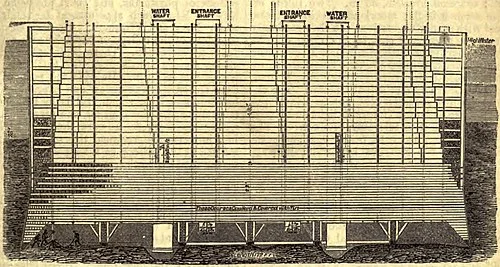
The Manhattan-side caisson was larger: 172 × 102 ft, with 22 layers of timber on its roof and a fireproof iron-boilerplate interior. The Manhattan bedrock was nowhere near as accessible. As the caisson sank past 60 feet, Washington Roebling faced a choice: keep sinking until workers hit bedrock at perhaps 100+ feet, or stop on the sandy subsoil that lay 30 ft above. At 78.5 ft, with air pressure reaching 35 psi (240 kPa) — nearly 2.4 atmospheres above surface — Roebling halted. The sand was dense enough. Going deeper would require pressures that, based on what was already happening to his workers, would be fatal. 2
What was already happening was this: workers would exit the pressurized caisson into normal air and some would collapse. Joint pain. Paralysis. Death. The project's physician, Dr. Andrew Smith, had no name for it; he coined one — "caisson disease" — and between January 25 and May 31, 1872, he treated 110 cases among Manhattan caisson workers. Three died. 4 The disease was not understood to be caused by nitrogen bubble formation during rapid decompression until Paul Bert's 1878 research and John Scott Haldane's 1908 staged-decompression protocols.
One of those 110 cases was Washington Roebling. He worked too long at too great a depth and emerged paralyzed. He could not walk. He could not easily speak. He could not visit the construction site again for the rest of the project — eleven-plus years of construction that still lay ahead. He retreated to his apartment on Columbia Heights in Brooklyn Heights, from which he could see the bridge rising above the river, and he watched through a telescope.
Frank Harris, a 16-year-old Irish immigrant worker who labored in the Manhattan caisson, described the conditions in a memoir: "The six of us were working naked to the waist in the small iron chamber with the temperature of about 80 degrees Fahrenheit: In five minutes the sweat was pouring from us, and all the while we were standing in icy water that was only kept from rising by the terrific pressure. No wonder the headaches were blinding." 2
The caissons were filled with concrete. The towers went up on top of them, their masonry blocks hauled by steam-powered pulley systems using 1.5-inch steel wire rope. The Brooklyn tower's last stone was set in June 1875; the Manhattan tower was completed in July 1876. Both towers stood 278 ft (85 m) above mean high water — taller than every building in New York City except Trinity Church's 279-ft spire, a record they held until 1890. 2
The person who ran the construction
Washington Roebling's instructions traveled from his telescope to the construction site through a single channel: his wife Emily Warren Roebling.
Emily Warren (born September 23, 1843, in Cold Spring, New York) had met Washington at a wartime ball in 1864. She had no formal engineering education. After Washington was incapacitated, she began teaching herself what she needed to know — initially from Washington's dictation, later from his correspondence and engineering texts — working through catenary curve calculations, strength of materials, stress analysis, cable construction, and bridge specifications. She became the technical interface between a bedridden chief engineer and a construction team that needed daily direction. 5
For eleven years, she handled project management, materials procurement, political liaison, and correspondence with engineers and contractors. When a faction of the bridge's trustees moved in 1882 to have Washington removed as chief engineer on the grounds of his extended absence, Emily lobbied the engineers and politicians personally, making the case that Washington still possessed the technical judgment the project required and that she was his reliable conduit. The effort succeeded. 5
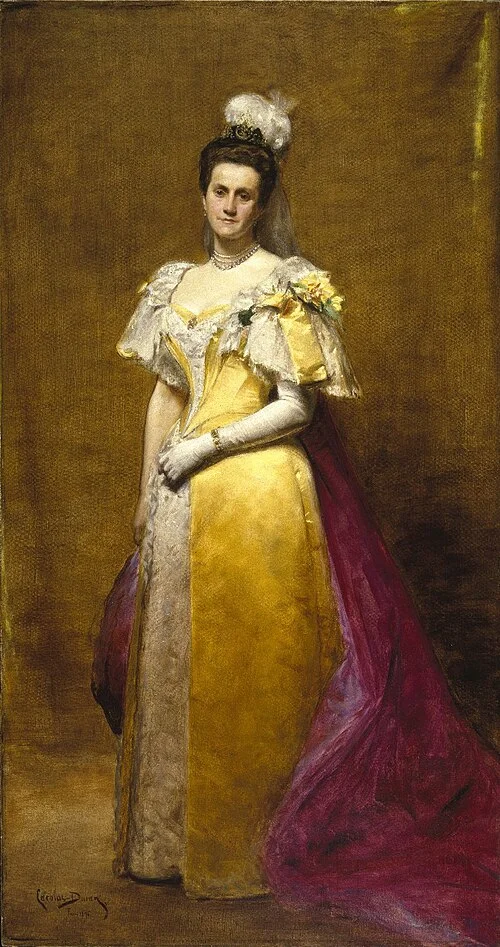
On May 24, 1883 — opening day — Emily Warren Roebling was the first person to cross the completed Brooklyn Bridge, riding a carriage and carrying a rooster as a symbol of victory. At the ceremony, orator Abram Stevens Hewitt addressed her directly: "an everlasting monument to the sacrificing devotion of a woman and of her capacity for that higher education from which she has been too long disbarred." 5
Washington Roebling watched from his apartment window.
After the bridge's completion, Emily Warren Roebling pursued a law certificate from New York University, became active in the Daughters of the American Revolution, and in 1899 published the essay "A Wife's Disabilities" — arguing for greater women's rights — under her husband's initials. She died of stomach cancer in 1903 at age 59. In May 2024, Rensselaer Polytechnic Institute awarded her a posthumous honorary doctorate at its bicentennial commencement. 5
She is one of three people commemorated in a plaque on the bridge's towers. John Roebling, Washington Roebling, and Emily Warren Roebling: the designer who never saw it built, the chief engineer who could not visit his own site, and the woman who actually ran it.
The wire fraud: how the cables survived a $300,000 deception
Wire spinning began in June 1877. The contract for the permanent cable wire had been awarded in January of that year to J. Lloyd Haigh, a Brooklyn wire manufacturer. The contract called for No. 8 Birmingham gauge crucible steel wire — a specified grade that would meet Roebling's strength requirements. 2
Haigh was connected to bridge trustee Abram Hewitt, whom Washington Roebling already distrusted. Washington had preferred to award the contract to John A. Roebling's Sons in Trenton, New Jersey — the family firm — which had submitted a competitive bid. The trustees overruled him and gave it to Haigh.
By May 1878, the main cables were more than two-thirds complete. Washington Roebling's assistant engineers conducted routine wire sampling and discovered the fraud: of 80 rings of wire tested, only 5 met specifications. The rest was inferior steel. Haigh had been accepting the good wire shipments at his factory, inspecting them for certification, then substituting weaker stock and pocketing the cost difference. His estimated profit from the deception: $300,000. 2
The fraudulent wire was already inside the cables. It could not be removed. The question was whether the bridge remained safe.
Washington Roebling ran the numbers. The original design called for a safety factor of 6 to 8 times the maximum expected load — Roebling's standard for the bridge under worst-case conditions of traffic, wind, temperature stress, and the weight of the cables themselves. With the inferior wire included, the revised figure came out at approximately 4 times. Still above the minimum engineering margin, but substantially below the design intent. The bridge would not fall. But it had less spare capacity than its designer had intended, and nobody would be able to add it back later. 2
The mitigation: 150 additional high-quality wires were added to each cable, using wire supplied by John A. Roebling's Sons — the firm that should have had the contract from the beginning. Haigh was not prosecuted. He was not publicly fired. To avoid scandal, contract disruption, and the exposure of how much inferior wire was already embedded in a nearly-complete bridge, the trustees required Haigh to personally pay for the extra wires, quietly shifted the remaining contract to Roebling's Sons, and said nothing publicly. The last wire went over the river on October 5, 1878. 2
The cables that emerged from this process contained 5,282 parallel galvanized steel wires per main cable, bundled in 19 strands of 278 wires each, with a finished cable diameter of 15.75 inches (40 cm). This parallel-wire bundling — wires laid parallel rather than twisted — was Roebling's invention and was being used in a suspension bridge for the first time. Each wire was dipped in linseed oil and coated with red zinc before spinning; 32 drums (8 per cable), each holding 60,000 ft of wire, fed the spinning wheel as it crossed the river on the catenary path. The spinning wheel traveled back and forth between anchorages on the footbridge, laying one wire per trip, while workers on the footbridge kept each new wire positioned within the strand template. Once all wires in a strand were laid, the strand was bound with wire wrapping, then all 19 strands were gathered into the circular cable cross-section and wrapped with a continuous binding wire that gave each cable its characteristic smooth cylindrical profile. 2
The vertical suspenders — between 1,088 and 1,520 of them, ranging from 8 to 130 ft long — were attached after the main cables were in place. The 400 diagonal stays, from 138 to 449 ft long, were added last, completing the hybrid structural system John Roebling had designed a decade earlier from his drafting table in Trenton.
The structural consequence of the fraud was permanent. The safety factor of 4x was baked into the bridge's physical fabric. But in a practical sense, the fraud forced the engineers to do something they had not otherwise been compelled to do: calculate the actual safety margin on the as-built structure and verify that it was still acceptable. Before the discovery, the safety factor was an assumption. After it, it was a measured number. In an indirect way, Haigh's fraud made the bridge's structural accounting more precise.
The towers: Gothic arches as load-transfer machines
The Brooklyn Bridge's two towers are the most visible elements of the structure, and their Gothic Revival pointed arches are widely read as aesthetic choices. They were not. The pointed arch is the most efficient compressive load path available to a masonry structure.
Each tower is built of limestone (from Clark Quarry in Essex County, New York), granite (from Bodwell Granite Company, Vinalhaven Island, Maine), and Rosendale cement — a natural hydraulic cement from the Hudson Valley known for its slow cure and exceptional durability in wet conditions. The tower footprint at the high-water line is 140 × 59 ft (43 × 18 m); the interior consists of four hollow cells separated by granite cross-walls, reducing the mass without reducing the structural capacity. 2
The Gothic pointed arch in each tower opening is 117 ft (36 m) tall and 33.75 ft (10.29 m) wide. In a semicircular Roman arch, the arch geometry generates horizontal thrust at the springing points — the arch pushes outward at its base as well as downward, which requires substantial lateral buttressing. In a pointed arch, the thrust line is steeper, keeping the horizontal force smaller and directing more of the load vertically through the tower's cross-section. For a structure that must carry the enormous vertical cable loads from the main span and transmit them down through masonry to the caisson below, a pointed arch minimizes the lateral force that the tower walls must resist. The arch shape is the load path made visible.
Above the arch openings, the cable saddle plates sit on top of the towers. The main cables drape over the saddles, which allow the cables to move longitudinally as temperature expands and contracts the steel. The bridge's cables lengthen and shorten by 14–16 inches between seasonal extremes; at the center of the main span, the deck height above water fluctuates by more than 9 feet between the heaviest winter traffic loads and the hottest summer days. 2 The saddles slide, and the towers hold.
| Specification | Value |
|---|---|
| Main span | 1,595.5 ft (486.3 m) |
| Side spans | 930 ft (280 m) each |
| Total length (Park Row to Sands St.) | 6,016 ft (1,834 m) |
| Deck width | 85 ft (26 m) |
| Navigational clearance | 127 ft (38.7 m) |
| Tower height (above mean high water) | 278 ft (85 m) |
| Cable diameter | 15.75 in (40 cm) per cable |
| Wires per cable | 5,282 parallel galvanized steel wires |
| Wire strands per cable | 19 strands × 278 wires |
| Anchorage weight | 60,000 short tons each |
| Design load capacity | 18,700 short tons (17,000 metric tons) |
| Construction cost | $15.5 million (1883 dollars; ~$518 million in 2025) |
The anchorages — one in Brooklyn, one in Manhattan — are trapezoidal limestone blocks weighing 60,000 short tons each, with base dimensions of 129 × 119 ft. The cables terminate inside them in eyebar clusters, each eyebar connected to massive anchor plates 46,000 lb apiece. The Manhattan anchorage sits on bedrock; the Brooklyn anchorage sits on clay. Both anchorages have shown no measurable movement in 140 years. 2
The stiffening truss runs along both sides of the roadway for the full main span, originally six trusses each 33 ft (10 m) deep, reduced to four in the 1940s renovation. The truss resists the tendency of the deck to oscillate under asymmetric loads — wind, waves of pedestrian traffic, or trains. The combination of main cables, diagonal stays, and stiffening truss gives the structure exactly the triple redundancy that Roebling designed: remove any one system, and the other two can hold the deck. 2
Opening day and the bridge's early years
President Chester A. Arthur attended the opening ceremony on May 24, 1883. New York Mayor Franklin Edson and Brooklyn Mayor Seth Low were there. An estimated 1,800 vehicles and 150,300 people crossed on the first day. 2
Six days later, on May 30, 1883, a woman slipped on a staircase approach and screamed. The crowd on the bridge — possibly 20,000 people — interpreted the scream as a structural collapse and stampeded. At least 12 people were killed, trampled in the panic. No cable had moved. The bridge was structurally unaffected. The disaster illustrated the gap between engineering safety and public confidence in something entirely new.
The confidence was rebuilt the following year. On May 17, 1884, circus promoter P.T. Barnum drove 21 elephants across the bridge — including his famous Jumbo — in a deliberate demonstration that the structure could bear extraordinary concentrated loads without distress. The load demonstration worked exactly as Barnum intended: it permanently settled public anxiety about the bridge's stability. 2
Washington Roebling received no public recognition at the opening ceremony. His name did not appear in the official program. He was not invited to speak. He watched through his telescope as the president shook hands with the people who had supervised his work.
The template for what came after
When the Brooklyn Bridge opened in 1883, it held the record for the world's longest suspension bridge. That record lasted twenty years — until the Williamsburg Bridge opened in 1903 with a main span of 1,600 ft. But the Williamsburg Bridge, and the Manhattan and Queensboro Bridges that followed in 1909, were all built because the Brooklyn Bridge had proven the concept: the East River could be crossed, steel wire could carry the load, and a city's two halves could be permanently stitched together. 2
The Brooklyn Bridge's most direct structural descendant is the Golden Gate Bridge (1937). John A. Roebling's Sons Company in Trenton — the firm Washington Roebling had tried to award the wire contract to before the trustees overruled him — supplied the cables for the Golden Gate. The parallel-wire spinning technique, the wire specifications, the catenary geometry calculations: all descended from the Brooklyn Bridge program. 2
The 1883 bridge demonstrated that long-span suspension bridges required at least three things the engineering community had not previously systematized: a material science baseline for steel wire tensile strength, a method for calculating catenary geometry at production scale, and a construction management structure that could survive the incapacitation of its chief engineer mid-project. The Brooklyn Bridge is the reason every major suspension bridge built after 1883 specifies wire cable rather than chain links, the reason every long-span bridge design includes multiple redundant load paths, and the reason modern bridge engineering culture takes the chief engineer's irreplaceability seriously as a project risk.
The Akashi Kaikyo Bridge (1998) in Japan — the world's longest suspension bridge at 1,991 m main span — used parallel wire cable spinning on the same principle, with 290 strands of 127 wires each. The Oresund Fixed Link (2000) incorporated cable-stayed elements in a hybrid configuration that echoes Roebling's original insight about multiple redundant load paths. The 1915 Canakkale Bridge (2022) in Turkey — with a main span of 2,023 m — uses prefabricated parallel wire strand bundles built to tensile specifications directly traceable to the wire technology Roebling pioneered. Each generation of long-span bridge engineers has treated the Brooklyn Bridge not as a historical curiosity but as a structural proof-of-concept they are continuing to refine.
Cargando vista previa del enlace…
In 2025, the NYC Department of Transportation completed a five-year, $300 million restoration of the bridge — the most comprehensive since the original construction. The project, led by Parsons Corporation as principal design consultant, covered granite tower rehabilitation, approach arch restoration, foundation reinforcement, replacement of brick infill walls with concrete shear walls, seismic upgrades to the 2,500-year earthquake event standard, and installation of a new LED lighting system. In April 2025, the project won the ACEC New York Diamond Award, the highest honor in the American Council of Engineering Companies' annual competition, in the Structural Systems category — the first time in sixteen years that a NYC DOT project had advanced from state-level to national competition. 6 7
NYC DOT Commissioner Ydanis Rodriguez described the bridge as "America's Eiffel Tower." 6 The comparison is apt in one respect: both structures have outlasted the engineering assumptions under which they were built, and both have required continuous maintenance to remain in service. The difference is that the Eiffel Tower was built to last twenty years before demolition. The Brooklyn Bridge was built to last indefinitely.
In May 2025, a Mexican Navy training ship — the ARM Cuauhtémoc — lost propulsion and struck the underside of the bridge during a departure maneuver, snapping three masts and killing two crew members. NYC DOT inspectors confirmed the bridge sustained no structural damage. The cables, the towers, and the anchorages were all exactly where they were supposed to be. 8
The Brooklyn Bridge was designated a National Historic Landmark on January 29, 1964, added to the National Register of Historic Places on October 15, 1966, made a New York City Landmark on August 24, 1967, and designated a National Historic Civil Engineering Landmark in 1972. It was placed on UNESCO's tentative World Heritage Site list in 2017. 2
The engineering lesson the Brooklyn Bridge teaches is not the obvious one. It is not that good design survives. It is that design which builds in redundancy survives bad luck, bad contractors, and bad timing — and the bad luck, bad contractors, and bad timing are not exceptional. They are the standard conditions under which large infrastructure gets built. John Roebling's 1867 design had three independent structural systems not because he expected one of them to be compromised by a wire fraud. He built in redundancy because he understood, from experience, that something always goes wrong, and that the engineering job is to ensure that when it does, the bridge does not fall.
It didn't.
Cover image: AI-generated architectural rendering.
Fuentes de referencia
- 1Wikipedia — John A. Roebling
- 2Wikipedia — Brooklyn Bridge
- 3STRUCTURE Magazine — Brooklyn Bridge, Part 1
- 4Wikipedia — Decompression sickness
- 5Wikipedia — Emily Warren Roebling
- 6NYC DOT — Historic Restoration of the Brooklyn Bridge
- 7Parsons — Brooklyn Bridge Rehabilitation
- 8Wikipedia — Cuauhtémoc–Brooklyn Bridge collision
Añade más opiniones o contexto en torno a este contenido.