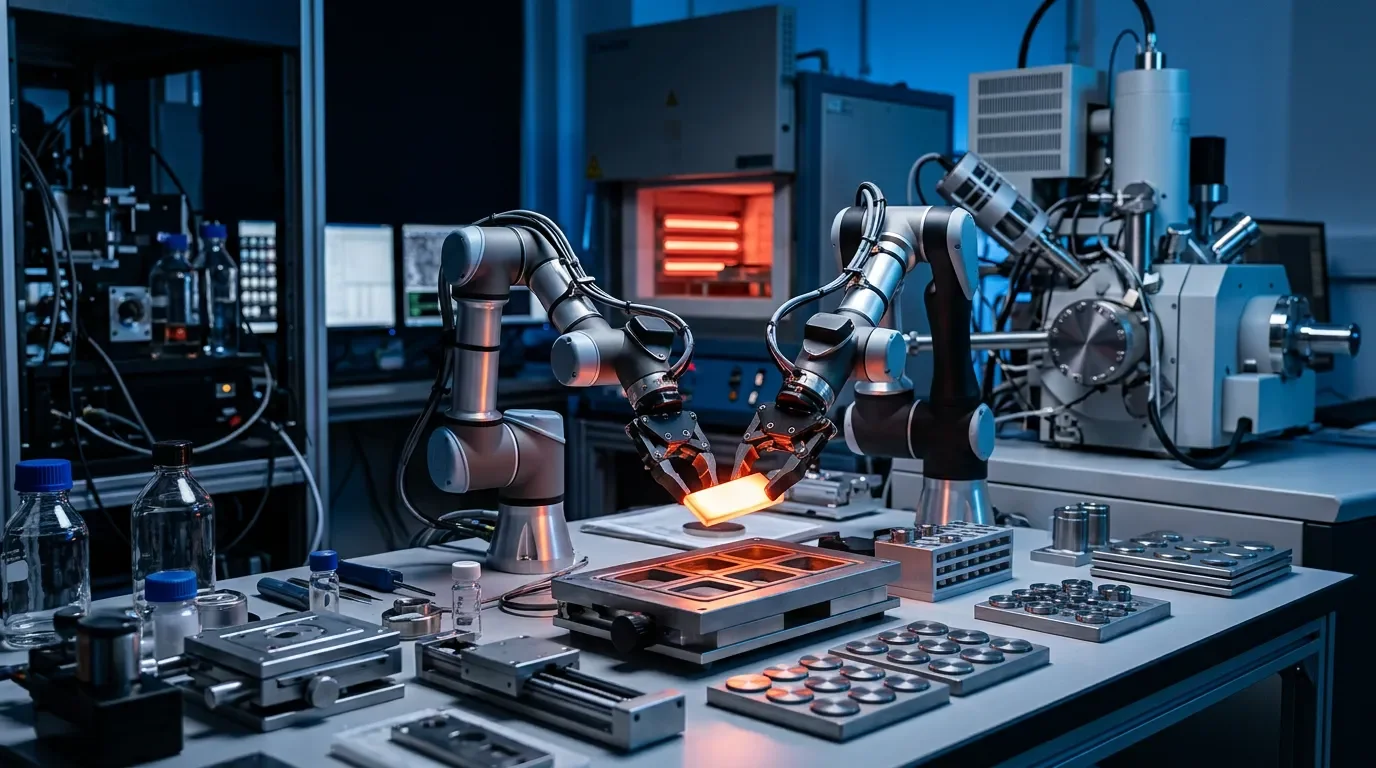
No model can one-shot a material
Joseph Krause argues that AI for materials science cannot be model-only: alloys need physical synthesis, characterization, processing knowledge, and qualification before they become real products. This article distills the Latent Space conversation into the case for self-driving labs as the missing experimental loop.

The most revealing line in Latent Space's new conversation with Radical AI CEO Joseph Krause is also the least flattering to model-first AI science: "There is no one model that can one shot a new material that ends up in your iPhone or that ends up on Starship." Krause's point is not that AI is useless in materials research. It is that materials are physical objects with processing histories, supply-chain constraints, microstructures, costs, and failure modes. An alloy is not just a string. It has to be made, tested, characterized, and eventually manufactured 1.
The June 17, 2026 episode, titled "The Limits of AI in Science - Why We Need Self-Driving Labs," runs 1 hour and 16 minutes and features Krause, founder and CEO of Radical AI, explaining why his company is building a robotic materials lab rather than a pure software discovery engine 1. The thesis is sharper than the usual "AI will accelerate science" claim: in some domains, the model is only as valuable as the experimental loop attached to it.
Cargando tarjeta de contenido…
Why materials are not molecules
Krause starts with a contrast between AI for biological molecules and AI for inorganic materials. In small-molecule and protein work, string representations such as SMILES and SELFIES can capture enough of the object for many modeling tasks: the atoms, bonds, and structure are close to the thing being predicted. Alloys do not behave that way. Krause lists the missing variables: supply chain, cost, microstructure, processing method, additive manufacturing versus casting, and other context that cannot be packed into a simple text string 1.
That difference matters because it changes what "AI discovery" means. If the model proposes a composition that looks good in simulation but cannot be processed, formed, qualified, or scaled, it has not discovered a useful material. It has generated a hypothesis. Krause's repeated phrase is that "the ground truth is the material itself": Radical's loop has to make the material, test it, characterize it, and then feed the result back into what he calls the AI scientist 1.
This is also why he pushes back on the search for an "AlphaFold for materials." Krause agrees that materials science can have AlphaFold-like moments in narrow subproblems, such as using segmentation models on scanning-electron-microscope images. He does not think the field is close to a single model that goes from a hypothesis to a scaled material inside consumer electronics or aerospace hardware 1.
The lab is the moat
Radical AI's bet is that the bottleneck is not ideas. It is experiments. Krause says the traditional materials pipeline is fragmented enough that new materials can take 15 to 30 years to move from discovery to use. Academia handles early discovery. Small companies or government-backed programs do limited testing. Large incumbents then tend to optimize existing material systems for 5% or 10% gains rather than rebuild the stack around a new alloy family. Data gets lost between each stage 1.
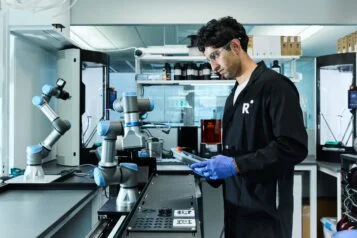
The self-driving lab is Radical's attempt to keep that data in one loop. In the episode, Krause describes an AI system that designs a research campaign, sends it to the lab, receives synthesis and characterization data, and uses those results to update the next campaign. The company is not yet claiming fully automated manufacturing validation. It is already running synthesis, characterization, and early property tests in a closed loop 1.
The numbers are the part of the conversation that make the strategy concrete. Krause says Radical has made about 1,200 alloys in the previous five or six months; about 300 were new compositions not seen in the literature, and roughly 10 had performance promising enough to pursue with industry. He compares that with the public benchmark he knows: DARPA and GE Aerospace's MACH program, which produced 500 alloys in about 12 months. Radical's stated target is 500 alloys in five business days 1.
What the AI changes inside the lab
The most interesting role for AI in Krause's telling is not replacing metallurgists. It is removing the sampling bias that comes from human intuition. Radical's system has gone into elemental and alloy families that published literature had largely ignored. When Krause asked scientists why they had never tried those combinations, the answer was often practical instinct: they assumed a mixture would not cast, would evaporate, would form the wrong microstructure, or would fail to produce the mechanical properties they wanted. The AI scientist tried some of those paths anyway and found workable formations 1.
That does not mean the human disappears. Krause says Radical still has PhD metallurgists running parts of the synthesis mechanism, with some tools expected to become automated later. The productivity claim is different: one PhD in metallurgy can run about 10 campaigns at once, while Krause says his own graduate-school experience looked closer to 10 scientists focused on one research problem 1.
That framing is more believable than the usual "scientist replaced by agent" pitch. The scientist's job shifts toward supervising campaigns, checking the physical plausibility of outputs, deciding when the lab data is sufficient, and connecting materials to applications. In the near term, the machine is widening the search space and compressing experiment cycles. It is not certifying jet engines by itself.
The qualification wall still stands
Krause is careful about where this can matter first. He argues that new alloys could reach some aerospace, defense, and space uses in three to five years, especially in non-manned applications. He also says manned commercial flight remains a roughly 10-year qualification process for good safety reasons 1.
That distinction keeps the episode grounded. AI can accelerate the front end of discovery, but the back end of materials adoption is still regulated, conservative, and failure-intolerant. A material does not become real when it appears in a model output. It becomes real when it survives processing, testing, qualification, and integration into a product that cannot afford surprise behavior.
Krause's background helps explain why Radical is built this way. In a January 2026 Startup Project interview, he described leaving a materials-science PhD track at Rice, working with the Army Research Lab, investing in materials and semiconductors at AlleyCorp, and then founding Radical AI with Jorge Colindres and Gerbrand Ceder. In that same interview, he said Radical's "materials flywheel" combines AI modeling with a fully robotic self-driving lab and targets aerospace, defense, and energy applications 3.
The takeaway from the Latent Space episode is not that models are hitting a wall in science. It is that some scientific domains make the wall visible sooner. For materials, the hard part is not only proposing the next composition. It is building a system that can ask a physical question, run the experiment, remember the failed attempts, and keep moving without losing the thread between lab bench and factory floor.
Añade más opiniones o contexto en torno a este contenido.