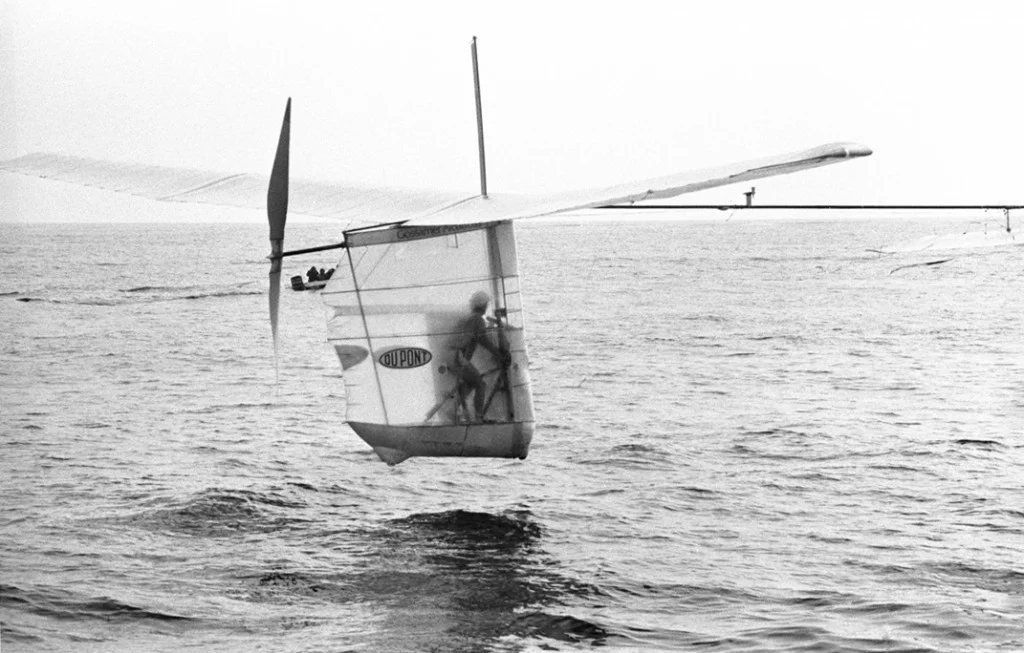
He pedaled a 71-pound plastic plane across the English Channel
On June 12, 1979, amateur cyclist Bryan Allen flew a 71-lb aircraft made of carbon fiber and plastic wrap 22.2 miles across the English Channel — dehydrated, cramping, and nearly rescued — to win the £100,000 Kremer Prize.

11/6/2026 · 21:25
5 suscripciones · 25 contenidos
On June 12, 1979, a 26-year-old amateur cyclist climbed into a transparent coffin-shaped pod, began pedaling, and flew across one of the world's most treacherous waterways at an average altitude of five feet. The aircraft weighed less than he did.
Bryan Allen's crossing of the English Channel in the Gossamer Albatross — 22.2 miles from Folkestone, England to Cap Gris-Nez, France in 2 hours and 49 minutes — remains one of the stranger athletic feats ever recorded. 1 It wasn't just a flight. It was a 169-minute endurance event powered entirely by one man's legs, conducted at wave-skimming altitude over open water, in a machine built mostly of plastic wrap.
What the Albatross actually was
Before getting to the drama, it's worth sitting with the absurdity of the machine itself.
The Gossamer Albatross had a 97-foot, 8-inch wingspan — longer than the width of a regulation basketball court is long — yet weighed only 71 pounds empty. 2 Its frame was carbon fiber tubes. Its ribs were polystyrene foam. Its skin was Mylar polyester film — the same material found in space blankets — stretched to just two-thousandths of an inch thick. DuPont supplied the Kevlar reinforcements and the Mylar; without those materials, the whole enterprise was a non-starter. 3
Allen sat in a small transparent pod, legs churning bicycle pedals at a steady 75 rpm. The pedals drove a chain and gear reduction system that turned a two-bladed propeller. To keep the plane aloft in calm air required roughly 300 watts — about 0.4 horsepower, or roughly what you'd need to power three old-school light bulbs. 1 Any headwind, any turbulence, and that number jumped sharply.
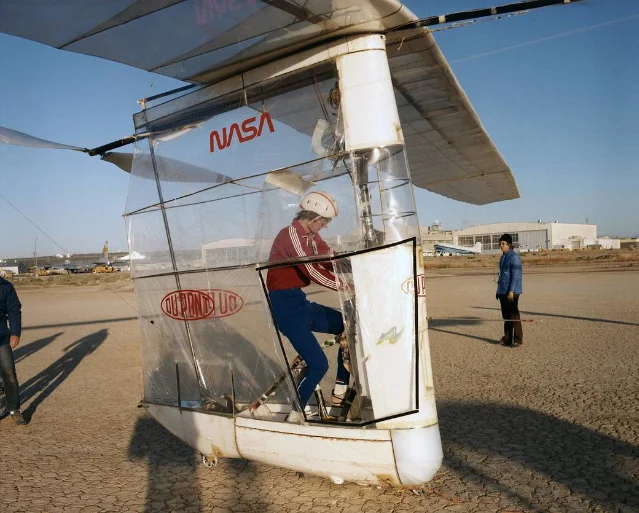
The canard layout — horizontal stabilizer in front, main wing behind — echoed the Wright Flyer. The wing area was 488 square feet, giving a wing loading of just 0.44 pounds per square foot. 1 Put plainly, it flew so slowly and so lightly that the slightest atmospheric disturbance could overwhelm the pilot's output. The English Channel, famously, is not calm.
The man behind the debt
Designer Paul MacCready had a motive most engineers don't bring to the lab: a $100,000 debt. He'd co-signed a business loan for a friend that went sideways, and that exact figure was also the value of the second Kremer Prize — a bounty offered since 1959 by British industrialist Henry Kremer, managed by the Royal Aeronautical Society, for the first human-powered flight across the English Channel. 5
MacCready was not a nobody in aerospace. He held three U.S. national soaring championships (1948, 1949, 1953) and in 1956 became the first American to win the World Gliding Championship. 6 He'd already pocketed the first Kremer Prize in August 1977 when Bryan Allen flew his earlier aircraft, the Gossamer Condor, through a figure-eight course at Minter Field in California — the first controlled sustained human-powered flight in history. 7 That one paid £50,000.
The Channel prize, set at £100,000 (roughly £492,000 in 2025 purchasing power), had gone unclaimed since Kremer first posted it. Two decades of aerospace engineers had looked at the English Channel and passed. MacCready looked at it and saw a way to clear his tab.
Two hours and forty-nine minutes of genuine crisis
Allen launched from the cliffs near Folkestone — a site called The Warrens — just before 6 a.m. on June 12, 1979. Things started going wrong almost immediately.
His two-way radio died shortly after takeoff. With no voice communication, Allen could only signal the escort boat using hand and head movements — a gesturing system improvised on the fly over open water. 1
The flight had been planned for two hours. Allen had packed water accordingly. But a headwind slowed the crossing and pushed the total time past that mark. His water ran out. Dehydration set in. His legs began to cramp.
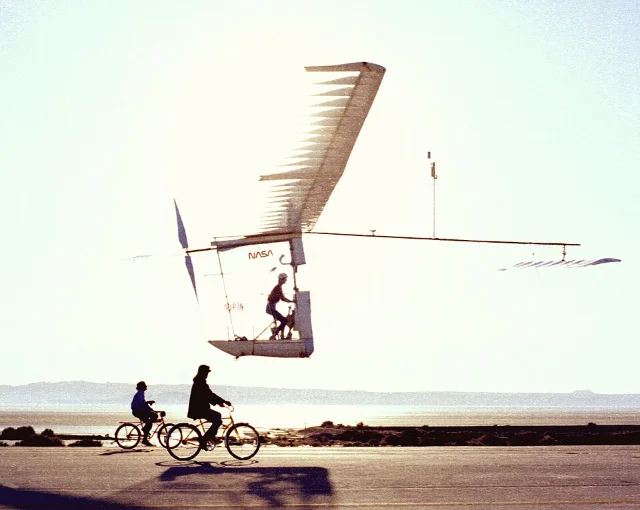
With France still invisible on the horizon and the wind strengthening, Allen touched the water surface multiple times. He appeared exhausted to the crew on the escort boat. DuPont's account of the flight records that "Allen touched the water several times, appeared to be exhausted, and even signaled for help at one point." 3 The boat maneuvered ahead of the Albatross and a crew member readied a hook to snag the aircraft and end the attempt.
Then Allen climbed. Not high — he was still only a few feet above the water — but enough to find smoother air. The turbulence at the slightly higher altitude was less brutal. He kept pedaling.
The French coast appeared. He descended onto the beach at Cap Gris-Nez and landed. The crossing was complete: 35.82 kilometers, two FAI world records (straight-line distance and sustained flight duration for human-powered aircraft). 8
The prize, the trophy, and Alistair Cooke's take
MacCready's team collected the £100,000 Kremer Prize. The Royal Aeronautical Society had been waiting 20 years to hand it out. 5
MacCready also received the 1979 Collier Trophy, American aviation's highest annual honor — previously awarded to the Wright brothers, the Mercury 7 astronauts, and the Apollo 11 crew. The citation read: "For the concept, design and construction of the Gossamer Albatross, which made the first man-powered flight across the English Channel — with special recognition to Bryan Allen, the pilot." 4
BBC broadcaster Alistair Cooke covered the flight in his Letter from America radio program three days later, calling Allen "a peddle-pushing Lindbergh" and the flight "an air mark in the history of flight." He quoted an aerospace engineer who summarized Allen's accomplishment in two words: "He manoeuvred" — something that had never been demonstrated in human-powered flight before. 9 Cooke speculated, apparently in full seriousness: "Who knows? A year or two from now we may see a man with polyester wings flying over Central Park or Hyde Park and youngsters will cry, 'It's a bird! It's Superman! It's not — it's Bryan Allen!'"
That hasn't happened yet. But Allen did write the firsthand account of the flight for the November 1979 issue of National Geographic, which ran it as the cover story: "Winged Victory of Gossamer Albatross." 1
Who was Bryan Allen, anyway?
Not a pilot. Not in any conventional sense. Allen — born in Tulare, California in 1952 — was a self-taught hang-gliding enthusiast and amateur long-distance cyclist. No professional aviation credentials. He'd trained specifically for the power output these aircraft required, working up the aerobic capacity to sustain 300+ watts for extended periods. 10
He later worked as a software engineer at NASA's Jet Propulsion Laboratory on Mars mission ground systems, including the Mars Reconnaissance Orbiter and Mars Exploration Rover programs. In 2025, the Society of Experimental Test Pilots awarded him an honorary fellowship. 10
Flying Magazine once called him "the hardest-working pilot ever." That's an argument worth taking seriously. Every other aircraft pilot just manages the controls. Allen had to generate the thrust himself, mid-Channel, with cramps, no water, and a dead radio.
What came next
The Albatross opened a door. MacCready's team converted the design into the Gossamer Penguin in 1980 — fitting 3,920 solar cells to the wings — and his 13-year-old son Marshall flew it about 150 meters in the first purely solar-powered flight in history. 11 That led to the Solar Challenger, which later crossed the English Channel again — this time on sunlight alone.
MacCready's company, AeroVironment, which he founded in 1971, went on to build the RQ-11 Raven military drone (over 9,000 delivered) and the Switchblade loitering munition. The firm's advanced development group is named MacCready Works. 12
The original Gossamer Albatross sits today at the Smithsonian's Steven F. Udvar-Hazy Center in Virginia. The backup aircraft, Gossamer Albatross II, hangs in the Museum of Flight in Seattle, where it earned a second footnote: the first human-powered aircraft ever flown in a controlled manner indoors, inside the Houston Astrodome. 13
It weighed 71 pounds, flew on bicycle legs, and crossed the English Channel. Forty-seven years later, no one has quite replicated the strangeness of that morning.
Cover photo: Bryan Allen flying the Gossamer Albatross over the English Channel, June 12, 1979. Photo by Don Monroe via This Day in Aviation
Fuentes de referencia
- 1MacCready Gossamer Albatross – Wikipedia
- 2Smithsonian National Air and Space Museum – MacCready "Gossamer Albatross"
- 3DuPont – Gossamer Albatross
- 4NASA – Gossamer Albatross
- 5Kremer Prize – Wikipedia
- 6Paul MacCready – Wikipedia
- 7MacCready Gossamer Condor – Wikipedia
- 8This Day in Aviation – 12 June 1979
- 9BBC Letter from America transcript
- 10Bryan Allen – Wikipedia
- 11Smithsonian – First Public Demonstration of Solar-Powered Gossamer Penguin
- 12AeroVironment – Wikipedia
- 13Museum of Flight – MacCready Gossamer Albatross II
Añade más opiniones o contexto en torno a este contenido.