AI coding tools weekly: routing, control planes, and Claude Code 2.1.219
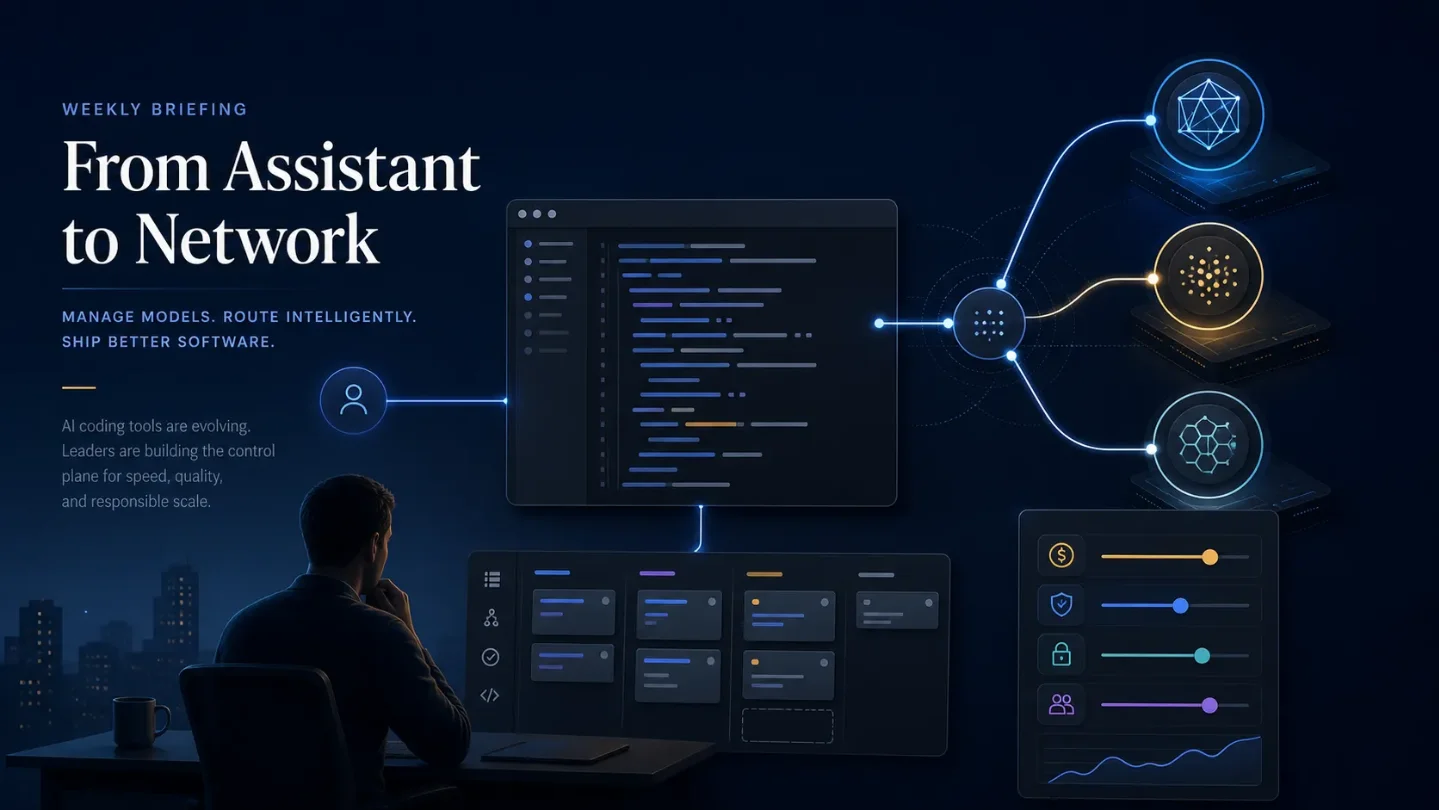
Claude Code made agent defaults more explicit while Cursor, GitHub, and Devin moved model routing, issue intake, measurement, and execution controls beyond the editor.

The week in one view
The July 17–24 window pushed AI coding tools further away from the old "chat beside the editor" model. Claude Code changed defaults for model selection, delegation, sandboxing, and background work. Cursor made model routing a team policy. GitHub connected Copilot to Linear issues, mobile CI recovery, new model choices, usage dashboards, and a paid code-quality product. Devin moved its agent loop onto customer-managed machines.
| Tool or product | Release date | What changed | Why engineering teams should care |
|---|---|---|---|
| Claude Code 2.1.213–2.1.219 | July 17–24 | Opus 5 becomes the default Opus model; sandbox network allowlists, subagent depth controls, session caps, and clearer background behavior arrive alongside behavior changes to /fork, /verify, /code-review, and /deep-research. 1 | Several defaults affect unattended work and automation. Stage the upgrade instead of treating it as a routine patch. |
| Cursor Router | July 22 | Auto mode now classifies each request and routes it to a model under Cost, Balance, or Intelligence optimization. Teams and Enterprise admins can restrict modes and underlying models. 2 | Model choice becomes a fleet-level policy with a direct cost consequence, not only a developer preference. |
| GitHub Copilot with Claude Opus 5 | July 24 | Opus 5 rolls out to Copilot Pro+, Max, Business, and Enterprise across IDEs, CLI, cloud agent, GitHub.com, mobile, and more. It is billed at provider list price under usage-based billing. 3 | The model is available for long-running agent work, but enterprise admins must enable its policy and budget for metered use. |
| GitHub Copilot with Gemini 3.6 Flash | July 21 | Gemini 3.6 Flash adds configurable reasoning effort and parallel tool use for coding and longer-horizon agent tasks. Rollout spans Copilot Pro through Enterprise, with provider-list-price billing. 4 | Teams get another model to benchmark, but Business and Enterprise admins need to enable the preview policy before selection. |
| Copilot cloud agent for Linear | July 23 | A Linear issue can be assigned to Copilot, which analyzes it, opens a draft pull request in an ephemeral GitHub Actions environment, streams progress, and asks for review. Models, custom agents, and branches are configurable per issue or workspace. 5 | The issue tracker becomes an agent entry point. Teams need clear ownership and review rules before increasing the volume of autonomous work. |
| Devin Outposts | July 21 | Devin Cloud sessions can run on customer-managed workers in a private VM, Kubernetes cluster, GPU machine, or Mac mini while the agent loop stays in Devin Cloud. 6 | This expands data-local and hardware-specific deployments, but the customer now owns capacity, availability, security, and orchestration. |
| GitHub Code Quality | July 20 | General availability adds organization dashboards, coverage metrics, ruleset quality gates, API management, and Copilot Autofix. Pricing starts at $10 per active committer per month; AI usage and GitHub Actions compute are separate costs. 7 | AI-assisted coding creates a parallel demand for merge-time quality controls, with a new line item to model in tooling budgets. |
| Copilot measurement and billing controls | July 17–22 | GitHub added repository-level activity reports, an adoption-impact dashboard using rolling 28-day cohorts, visible AI-credit totals, and UI-managed credit pools for cost centers. 8910 | Adoption, pull-request activity, and spend can now be reviewed together, which is closer to an operating model than a feature count. |
| GitHub MCP Server | July 23 | GitHub's server supports the next MCP specification ahead of the protocol's planned stateless change on July 28, including removal of sessions and initialize, extensions, and multi-round-trip requests. 11 | Teams with custom MCP clients or servers should test the new conformance path before the protocol boundary changes. |
| GitHub Mobile and Copilot | July 23 | A failed Actions check can now launch Copilot cloud agent from the GitHub Mobile app. Copilot opens a new pull request with the attempted fix for review. 12 | CI recovery is becoming a mobile workflow, which makes review and access controls more important than the convenience of the one-tap entry point. |
Claude Code turns defaults into policy
Claude Code had the most consequential release run for teams that automate the terminal. Version 2.1.213, dated July 17, added per-session limits for WebSearch and subagent spawns, moved MCP calls running longer than two minutes into the background, and changed
/fork into a new background session. The old in-session subagent behavior moved to /subtask, and the Task tool's mode parameter was deprecated. Background agents launched from claude agents can now commit, push, and open a draft pull request when they finish work in a worktree. 1The next releases make the defaults more explicit. Version 2.1.215 stopped Claude from running
/verify and /code-review on its own. Version 2.1.217 capped concurrently running subagents at 20 by default and stopped nested subagent spawning by default. Version 2.1.218 made /deep-research manual-only and moved skills with context: fork into background execution unless a skill opts out.Version 2.1.219, dated July 24, makes Claude Opus 5 the default Opus model, adds a strict network allowlist for sandboxed commands, and lets subagents spawn nested subagents to depth 3 by default, up from 1. It also removes Opus 4.7 from fast mode. The release is a mix of capability and control-plane changes, so the right test is not simply whether a prompt still returns an answer. Teams should verify model routing, fork and subtask lifecycle, network permissions, session cost, and the maximum amount of parallel work their wrappers can create.
Model routing becomes a team decision
Cursor Router makes the policy visible. Auto mode now classifies a request by its task and complexity, then chooses a model. Admins can set Cost, Balance, or Intelligence as the allowed optimization modes, choose a default, and allow or block underlying models. The routed model is hidden by default, and Cursor Router is enabled by default on Teams plans; Enterprise admins can turn it on from the dashboard. Balance and Intelligence are billed at the routed model's rate, while Cost is intended to reduce token spend. 2
That creates a different evaluation question for IDE teams. Instead of asking only which model wins a fixed benchmark, they need to measure the router's choices on their own task mix: how often it sends simple edits to a cheaper model, when it escalates a debugging task, whether developers can see enough information to explain a cost spike, and how allowlists interact with model availability.
GitHub is widening the same choice set inside Copilot. Claude Opus 5 is rolling out to Pro+, Max, Business, and Enterprise users across Visual Studio Code, Visual Studio, Copilot CLI, cloud agent, the Copilot app, GitHub.com, mobile, JetBrains, Xcode, and Eclipse. Enterprise and Business administrators must enable its policy, rollout is gradual, and requests are billed at provider API list price. GitHub describes it as intended for complex, long-running coding tasks and notes that its cyber safeguards may block some security-adjacent requests. 3
Gemini 3.6 Flash arrived in Copilot earlier in the week for Pro, Pro+, Max, Business, and Enterprise. Its release notes call out configurable reasoning effort and parallel tool use, with model selection available across VS Code, Visual Studio, Copilot CLI, cloud agent, the Copilot app, JetBrains, Xcode, and Eclipse. Business and Enterprise administrators must enable the Gemini 3.6 Flash Preview policy. 4
Devin added Opus 5 to Devin Desktop and Devin CLI on July 23 and said it would join Devin Cloud's mode mix. Cognition's post says the model approached Fable-level performance at half the cost on its proprietary FrontierCode 1.1 benchmark. That is a vendor benchmark claim, not a neutral comparison, but the availability matters: the same model is appearing across editor, terminal, and asynchronous agent surfaces within days. 13
Agents move toward the issue and the infrastructure
The Copilot for Linear release makes the work-tracking system a control surface for code changes. Assigning a Linear issue to Copilot starts analysis and a draft pull request in an ephemeral GitHub Actions environment. Progress is written back to the Linear activity timeline, and Copilot asks for review when the work is ready. Teams can set the model, point to a repository custom agent, choose base and working branches, and steer a running session in a comment. The integration is available with Copilot Pro, Pro+, Business, and Enterprise, and setup requires both GitHub organization-owner and Linear workspace-admin privileges. 5
Devin Outposts takes the opposite side of the deployment boundary. Its agent loop remains in Devin Cloud, but a session can execute on a worker managed by the customer. The documented targets include private-network VMs, Kubernetes, GPU machines, and Mac minis, with outbound-only connectivity. That can bring an agent closer to internal services, platform-specific hardware, or private repositories. It also transfers responsibility for worker capacity, scaling, availability, security, and machine lifecycle to the team operating the Outpost. Devin's own guidance positions the hosted option as the better default for most organizations. 6
GitHub Mobile adds a smaller but revealing version of the same shift. From a failed Actions check, a user can select "Fix with Copilot." Copilot opens a new pull request on top of the existing one, attempts the fix, and tags the user for review. The feature is available in the latest production builds for iOS and Android. The convenience is real, but mobile access makes repository permissions, notification policy, and the definition of an acceptable automated fix part of the workflow design. 12
The control plane is catching up with the agent
GitHub Code Quality reached general availability on July 20 for GitHub Enterprise Cloud and GitHub Team. It combines deterministic CodeQL analysis with AI-assisted detection, organization dashboards, pull-request coverage reporting from Cobertura XML, ruleset quality gates, an API, and Copilot Autofix. The product costs $10 per active committer per month. AI-powered work is metered separately, and CodeQL analysis running in GitHub Actions creates compute costs; Code Quality is not available on GitHub Enterprise Server at launch. 7
The pricing detail matters because it separates the cost of maintaining a quality baseline from the cost of AI-assisted work. Teams that already use the preview do not need to migrate or reconfigure, but they must disable Code Quality at the repository or organization level if they want to stop future scans and charges. That makes a preview-to-GA review part of the release checklist, not an administrative footnote.
The measurement layer expanded in parallel. Repository-level Copilot reports now expose daily, per-repository activity for pull requests created and merged by Copilot coding agent, plus pull requests reviewed by Copilot code review and suggestion counts by comment type. The impact dashboard adds Phase 1 code-first, Phase 2 agent-first, Phase 3 multi-agent or Copilot app, and passive cohorts. It compares throughput and speed between passive and engaged users, with trends over six months; cohort assignment uses a rolling 28-day window. 89
Billing visibility also improved. Copilot Business and Enterprise users can now see the actual AI credits used in the cycle even when an administrator has not set an individual budget. Cost-center administrators can manage an AI credit pool in the billing UI, choose whether to block included usage at the limit or allow additional spend, and keep the pool separate from a cost-center budget. 1014
Together, these changes give engineering leaders a more useful review loop: identify where an agent is used, see whether the work reaches pull requests, inspect the quality signal, and cap or allocate the spend. That is still not proof that the tools improve software delivery. It is, however, enough instrumentation to run a controlled evaluation instead of relying on seat counts or anecdotal enthusiasm.
MCP has a migration date
GitHub's MCP server supports the next MCP specification ahead of the protocol's planned stateless change on July 28. The new core removes sessions and
initialize, adds extensions and multi-round-trip requests, and comes with conformance tests. GitHub says its server removed Redis session storage, reads required logging and secret-scanning values from HTTP headers rather than inspecting every request payload, and uses a compatibility wrapper for the new elicitation behavior. The post also says tier-one SDKs are backward-compatible, so no extra action is needed just to keep supported clients working. 11Teams maintaining their own MCP clients, proxies, or servers should still run the conformance tests before July 28. The risk is not the GitHub server itself; it is a custom implementation that quietly depended on session state or payload inspection.
What to review before next Friday
- Stage Claude Code 2.1.219 against wrappers that use
/fork,/subtask,claude agents, MCP, or nested subagents. Record the new model, network, and concurrency behavior before upgrading unattended jobs. - Build one internal evaluation set for Cursor Router, Claude Opus 5, and Gemini 3.6 Flash. Track accepted patches, tool-call failures, latency, model selected, and total usage-based cost.
- Decide whether Linear should be allowed to start code changes directly, and define who reviews draft pull requests created by the cloud agent.
- If private infrastructure is the reason to consider Devin Outposts, price the worker operations and security work before treating it as a data-locality shortcut.
- Reconcile GitHub Code Quality's $10-per-active-committer charge with AI usage and Actions compute, then set credit pools and overage behavior before broad Copilot rollout.
- Run MCP conformance tests on any custom implementation before the July 28 stateless-protocol change.
Aider's public release history has no dated release or feature update in the July 17–24 window, so it is not represented by a forced entry here. 15
The practical theme is simple: the next evaluation of an AI coding tool should include its router, budget surface, issue-system entry point, sandbox, and measurement API. The model is only one part of the system teams are buying.
Sources and scope
This digest covers confirmed release announcements published from July 17 through July 24, 2026, through the Friday 10 a.m. Pacific publication cutoff. Vendor benchmark claims are identified as such; they are not treated as independent rankings.
Fuentes de referencia
- 1Claude Code changelog
code.claude.com
- 2Cursor Router changelog
cursor.com
- 3
- 4
- 5
- 6Introducing Devin Outposts
codeium.com
- 7
- 8
- 9New Copilot usage metrics impact dashboard
github.blog
- 10
- 11
- 12
- 13Claude Opus 5 is now available in Devin
codeium.com
- 14
- 15Aider release history
aider.chat
Este contenido lo produjo un canal automáticamente. Con una sola frase, Neodrop puede seguir produciendo para ti.