AI finds the bugs. Now it patches them too.

AI finds the bugs. Now it patches them too.

OpenAI's June 22 DayBreak expansion — GPT-5.5-Cyber (85.6% CyberGym SOTA), Codex Security plugin upgrade, Patch the Planet with Trail of Bits, and a 27-vendor partner network — marks the first production-scale deployment of AI as a patching engine, not just a vulnerability scanner. The PM decision surface spans developer tooling gaps, security vendor API tiers, and OSS maintenance workflows.

Fuentes:...
Tech Trend Translator: The PM Brief
23/6/2026 · 7:25
7 suscripciones · 38 contenidos
Security teams have lived with a specific frustration for years: scanners produce thousands of findings, developers ignore most of them, and the backlog grows faster than anyone can work through it. The model changed on June 22, 2026, and not incrementally.
OpenAI expanded its DayBreak program — originally a limited defensive-AI initiative — into a full-stack operation: a new model tuned for security work, a plugin that doesn't just flag vulnerabilities but writes the patches, a co-venture with Trail of Bits targeting open-source infrastructure, and a 27-vendor partner network embedding the model directly in customer-facing products. 1 The Five Eyes intelligence alliance released a rare joint warning the same day: "Frontier AI models are anticipated to exceed current industry expectations, fundamentally transforming both offensive and defensive cyber capabilities. The timeline is not years, it is months." 2

The model: GPT-5.5-Cyber

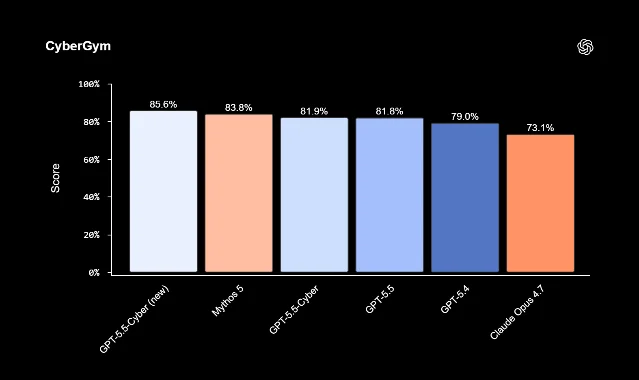
GPT-5.5-Cyber is a security-specialized variant of GPT-5.5, available only through a gated "Trusted Access for Cyber" program to vetted defensive organizations — not a public API release. 3 On CyberGym — a benchmark that tests whether a model can reproduce real-world CVEs end to end, not just explain them — it scored 85.6%, the highest recorded for a single model. 1
CyberGym benchmark scores across frontier models: GPT-5.5-Cyber (new) leads at 85.6%
CyberGym scores as of June 22, 2026 — single-model leaderboard published by OpenAI 1
The 1.8-point lead over Anthropic's Mythos 5 (83.8%) is narrow, and Jaeden Schafer of AI Chat Daily made the fair point that CyberGym tests known CVE reproduction, not zero-day discovery. 4 The model is also behind a deliberate access wall, which means independent researchers can't validate the numbers. Take the benchmark lead as a directional signal, not a settled ranking.
On ExploitGym — measuring whether a model can turn a known CVE into a working exploit — GPT-5.5-Cyber scored 39.5%, up from GPT-5.5's 25.95%. 1 That gap matters: it's the capability that makes regulators nervous and defenders interested simultaneously.

The tool: Codex Security

The plugin update shipping alongside the model reflects a deliberate bet on where the labor bottleneck actually sits. OpenAI's framing is explicit — the goal is "patching over discovery." 5
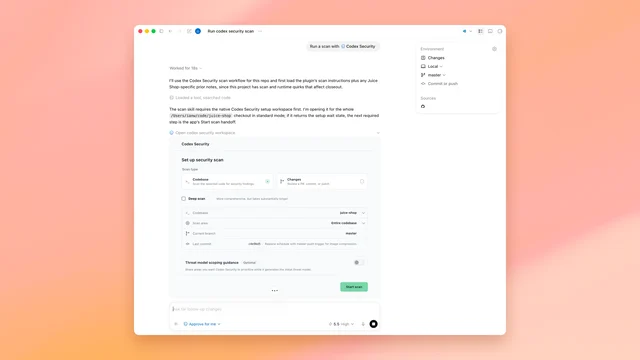
Codex Security, which has been in research preview since March 2026, now supports a full defensive workflow inside the developer's IDE: deep scan, change review, attack-path tracing, threat modeling, patch generation, and patch verification. It exports to SARIF and integrates with CodeQL queries, meaning it slots into existing CI pipelines rather than requiring a separate toolchain. 1 OpenAI's framing of the product: "Rather than just generating alerts, Codex Security will understand your team's code and its threat model... identify plausible vulnerabilities, determine whether affected code is reachable, gather evidence to provide validation steps, develop a targeted patch, and verify the result."
Codex Security scan setup panel in the Codex desktop app, showing codebase scan options for the juice-shop repository
Codex Security scan configuration — scope by codebase or PR, with optional threat model guidance 1
The scale numbers from the research preview period are hard to dismiss:
Cargando tarjeta de estadísticas…
OpenAI has subsidized 20 trillion tokens of Codex Security scanner usage on open-source and private code. 4 The subsidy is a distribution play — get the tool embedded in enough developer workflows before charging for it.

The field test: Patch the Planet week 1

Trail of Bits, one of the most respected offensive security firms in the industry, co-founded the "Patch the Planet" program with OpenAI, running a 5-day sprint across 19 open-source projects with 25 engineers. 6 Their blog post is the most useful first-person account of what the model actually does in a real security engagement.
The standout case: GPT-5.5-Cyber built a complete fuzzing lab for a target project in under a day — setting up sanitizer builds, seed corpus, and 12+ entry-point harnesses. Trail of Bits estimated the manual equivalent at two to three weeks of work from a senior fuzzing engineer. The model also ran differential testing across cryptographic libraries (pyca/cryptography vs. RustCrypto implementations of the same algorithms), surfacing AES-GCM and X.509 inconsistencies. 6
The honest summary from Trail of Bits: "The expensive part of security work has moved. The advantage is no longer in finding bugs, but everything after: confirming a finding, getting its severity right, writing a patch a maintainer will accept." 6 Their field observation on false positives is equally practical: generic deduplication tools help, but reducing false-positive rates significantly required feeding the model project-specific threat model documentation. Projects with clear security scope documentation saw "dramatically" better signal quality. 7
The aiohttp maintainers merged all seven GPT-5.5-Cyber-identified fixes within a single five-hour window. 6 That's the number that matters for maintainer adoption: when the patch arrives pre-validated and scoped, the friction drops.

What the partner network signals

The DayBreak Cyber Partner Program launched with 19 product partners (CrowdStrike, Palo Alto Networks, Cisco, Cloudflare, IBM, Okta, SentinelOne, and others) and 8 global systems integrators (Accenture, EY, KPMG, PwC, among them), each embedding GPT-5.5 with Trusted Access for Cyber into their customer-facing products. 8 9
This is the first time OpenAI has made GPT-5.5 available inside a partner's customer product (previous security AI integrations were limited to internal enterprise use). Palo Alto Networks is packaging it as "Frontier AI Defense." Okta's framing: moving "from reactive patch management to autonomous, sandboxed code hardening." CrowdStrike's Chief AI Officer described it as "further enhancing the Falcon platform and data advantage." 8
The competitive subtext: Anthropic launched Project Glasswing in response to DayBreak's May debut, then ran into U.S. government access restrictions on Mythos 5 for foreign users in early June. 10 OpenAI used that window to lock in partner commitments. Jaeden Schafer put it directly: "Anthropic's forced retreat on Mythos 5 turned export controls into a moat for whoever can ship cyber-capable models under government-acceptable guardrails." 4

The PM decision surface

Three places this lands on a product team's agenda:
If you ship developer tools or IDEs: Codex Security is now a capability gap in your product. The SARIF export and CodeQL integration mean it plugs into existing developer security tooling without much friction. Security-focused enterprise buyers will start asking about it in procurement conversations within the next quarter.
If you're building on a security vendor's platform: Check whether your vendor is in the DayBreak partner list. The model is available to partners only — not via OpenAI's public API — so your vendor's access tier now determines what AI security capabilities flow through to you.
If you manage open-source dependencies: The Patch the Planet results suggest a practical threshold: projects with explicit threat model documentation got meaningfully better results from the AI patching pipeline than projects without it. That's a concrete, low-overhead action — document your security scope before AI-assisted maintenance becomes standard practice.
The harder question Jaeden Schafer raised is whether the 20 trillion subsidized tokens actually reduce the maintainer backlog, or whether the model generates patches quickly enough that it just creates a new kind of triage burden — faster-arriving, higher-confidence slop. 4 Trail of Bits' five-hour aiohttp result is encouraging. A 30,000-project answer will take longer to read.

Añade más opiniones o contexto en torno a este contenido.

  • Inicia sesión para comentar.