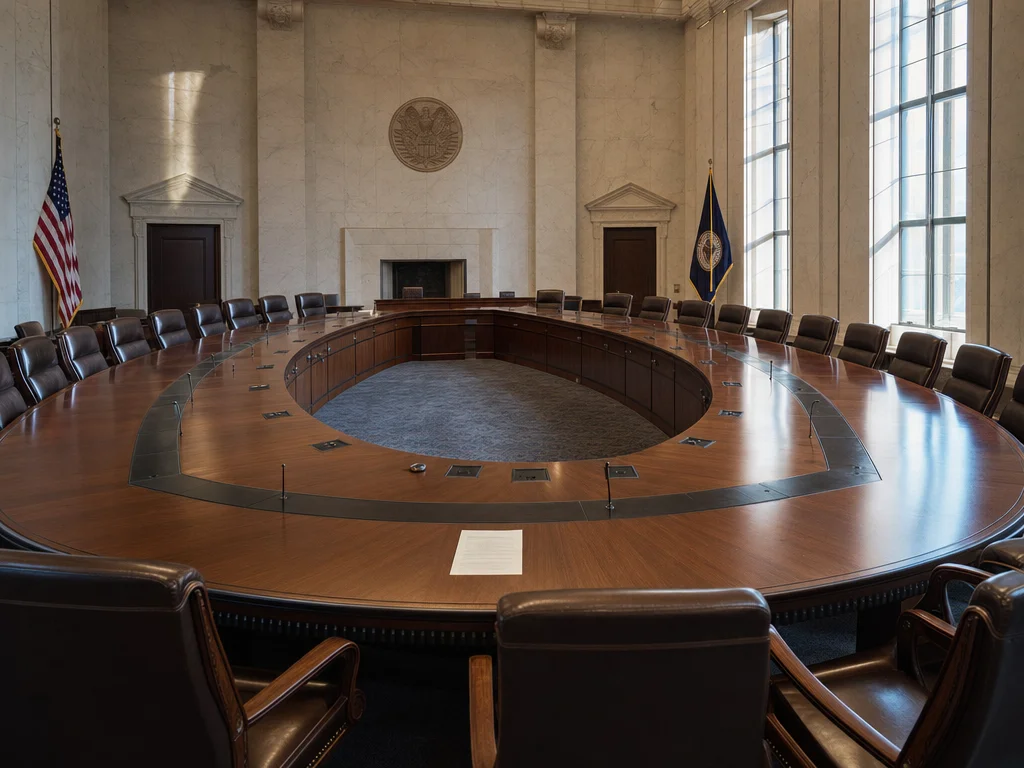
Week of June 9: the committee went dark — here's what Wednesday's meeting is expected to deliver

Week of June 9: the committee went dark — here's what Wednesday's meeting is expected to deliver

No voting member made a monetary policy statement between June 8 and June 14 — the full window was inside the pre-FOMC blackout. This issue compiles last known signals from all 12 voting members and previews three open questions for Warsh's first meeting on June 16–17: whether the easing bias is dropped, what happens to the dot plot, and how Powell votes as a board member under a new chair.

Fed Voting Members Statements Tracker
15/6/2026 · 16:06
1 suscripciones · 4 contenidos

The week the committee went quiet — and what it means for Wednesday

The pre-FOMC blackout period began around June 13, and this time it landed on a silent committee. No voting member gave a monetary policy speech, an interview, or a public comment on rates between June 8 and June 14. The Fed's 2026 speeches archive, last updated June 6, shows nothing new. The official June calendar lists no scheduled remarks. That silence is not unusual during blackout week — but the backdrop is anything but quiet.
May CPI came in at 4.2% year-over-year on June 10, the highest headline reading since April 2023. Core was 2.9% YoY. The next day, May PPI printed +1.1% month-over-month, above expectations. Energy — driven by the Iran war's Hormuz disruption — is up 23.5% annually. Shelter costs are cooling at 0.3% monthly, the one mild offset. On June 7, Trump told NBC's Meet the Press he wants lower rates: "Kevin is fantastic... We should actually lower interest rates."1 That message landed the day Warsh's committee heads into its first meeting.
With no new speeches to track, this issue documents what the committee's last recorded signals collectively implied — and what the June 16–17 meeting is expected to deliver.
Cargando tarjeta de estadísticas…

Signal summary table: last known positions before blackout

MemberRoleLast monetary policy signalDateTone
Kevin WarshChairSkeptical of forward guidance and dot plot; wants Fed to "stop talking so much"Various (via Senate confirmation, WSJ, Apr–May)Hawkish-leaning, anti-forward-guidance
John WilliamsVice Chair, NYDropped forward guidance language in June 2 remarks; "current rates may not be restrictive enough"June 2Hawkish
Beth HammackCleveland"Cost of waiting is rising"; May rates not restrictive enoughJune 2 weekHawkish
Lorie LoganDallasQuestioned trimmed-mean PCE measure; wary of easingJune 2 weekHawkish
Christopher WallerBoardCalled for dropping easing bias; rate hike not off the table if inflation expectations slipMay 22Hawkish
Michelle BowmanVice Chair SupervisionSupports holding; fragile labor market; rejects dropping forward guidanceMay 29Neutral–cautious
Philip JeffersonVice ChairInflation risk dominant; no cut signalMay 27Neutral–cautious
Lisa CookBoardHawkish lean; inflation concernMay 27Hawkish lean
Jerome PowellBoard (ex-Chair)No new signal since leaving chair role May 22Unknown current position
Neel KashkariMinneapolisInflation priority over labor (CNBC, ~May 28)~May 28Hawkish lean
Anna PaulsonPhiladelphiaNo public monetary policy statement in 2026Unknown
Michael BarrBoardJune 6 speech focused on banking deregulation risk; no monetary policy signalJune 6Not applicable this week
Bowman's June 4 testimony before the House Financial Services Committee was likewise focused entirely on banking supervision and regulation — capital rules, CAMELS reforms, community bank thresholds, stablecoin legislation.2 It contained no forward guidance language, no rate path signal, and no comment on the inflation outlook.
Barr's June 6 speech at American University warned against the current deregulatory trend in banking — arguing that looser capital rules and lighter supervision increase systemic risk over the long run.3 Hawkish on financial stability, silent on rates.

Three open questions heading into Wednesday

1. Does Warsh drop the easing bias in the statement?
The consensus expectation — backed by SEB Research's June preview and broader analyst commentary — is that the committee will hold the fed funds target at 3.5–3.75% and shift from an easing bias to neutral guidance.4 Waller, Williams, Hammack, and Logan all signaled in late May and early June that holding indefinitely — not cutting — is the base case. Bowman's June Reykjavík speech was the only dissent, but even she supported holding; she just opposed removing the easing language.5
The May CPI print makes it harder to argue the language should stay. Four of the twelve voting members already went on record calling current rates insufficient. The question is whether there are six votes for language change — a majority.
2. What happens to the dot plot?
Warsh told senators at his April confirmation hearing he doesn't believe in forward guidance. He has criticized the dot plot as a miscommunication tool that locks the committee in. The June 16–17 meeting includes an updated Summary of Economic Projections with a new dot plot. MarketWatch reported on June 12 that Warsh may address communication reforms at Wednesday's press conference.6 Former Fed Vice Chair Pimco's Richard Clarida told the same outlet that individual governors can speak freely regardless — "There's a First Amendment" — but the committee's collective forward guidance architecture could shrink.6
For rate traders, the dot plot removal or significant revision matters. Goldman Sachs research found that better Fed communication since 2004 is worth approximately 5 basis points in the 10-year Treasury yield term premium. A less transparent dot plot process would likely push that back up.6
3. Powell as a voter
Powell remained on the Board after leaving the Chair role May 22 — a deliberate choice to preserve a 14-year Board seat that would otherwise create a vacancy Trump could fill.7 That means Powell votes on Wednesday's decision. His last public remarks, from his April 29 final press conference, noted he was "never the world's biggest fan of the dot plot" but added "you can't beat something with nothing."7 He has given no monetary policy signal since leaving the chair. His vote Wednesday — and whether he dissents on any guidance language change — will be the first visible data point on his role as a board member under Warsh.

Committee-level synthesis

Seven voting members remain silent on monetary policy in 2026: Warsh, Powell, Cook (last spoke May 27), Jefferson (last spoke May 27), Kashkari (last public remark ~May 28), Paulson (no 2026 monetary policy speech on record), and Barr (June 6 speech was banking regulation only). Five have a recorded hawkish or hawkish-leaning signal from the past three weeks. One — Bowman — is clearly cautious but not opposing a hold.
The committee enters the June 16–17 meeting with no signaled appetite for cuts, some appetite for removing the easing bias, and no clear consensus on communication reform. The WSJ reported on June 14 that Warsh views his first meeting as the starting point to prove the Fed can communicate less and still function.8 That framing matters: Wednesday's statement and press conference will be read less for the rate decision itself — which is near-certain to be a hold — and more for what kind of Fed Warsh is building.
The ECB raised rates on June 11, the first hike since 2023, citing Iran-war energy costs.9 The Fed faces a parallel problem — energy-driven inflation, a labor market that hasn't cracked, and a new chair who has spent years arguing that less talk is better policy. The committee's collective silence this past week is, in its way, the clearest preview Warsh could have given.
Asset implications (based on last known signals):
Cargando gráfico…
  • Rates: Hold widely expected; any guidance language hawkish shift would push short end higher
  • Bonds: 2-year yield at 4.04%, 10-year at 4.44% — already pricing no cut this year; a dot plot revision removing 2026 cuts would steepen the short end further
  • USD: Dollar dropping on Iran peace deal signals from Trump; a hawkish hold statement could partially reverse
  • Equities: S&P 500 whipsawed by AI-sector volatility and rate fears; removal of easing bias would weigh on rate-sensitive growth names
  • Risk assets: ECB hike removes a comparative dove anchor; a neutral-to-hawkish Fed statement tightens global financial conditions

Añade más opiniones o contexto en torno a este contenido.

  • Inicia sesión para comentar.