The weekend reset: what you eat Saturday and Sunday programs your Monday brain
Most professionals are disciplined Monday–Friday, then quietly undo their nutrition on the weekend — arriving Monday already depleted. This guide explains the three biological mechanisms that connect weekend eating to Monday cognitive performance (glycogen reserves, neurotransmitter synthesis, gut circadian rhythm), then gives three high-leverage weekend eating moves: anchoring Saturday breakfast timing, front-loading protein both days, and executing a Sunday night glycogen top-off. Two micro-habits make the system structural — no willpower required.

Most professionals are disciplined from Monday through Friday. They eat a real breakfast, keep a snack drawer stocked, avoid the 3pm vending machine run. Then Saturday arrives — and the whole structure quietly collapses.
It's not a character flaw. It's a pattern. Late meals, alcohol, processed food, disrupted sleep timing, skipped breakfasts. By Sunday night, you've undone most of the glycogen, neurotransmitter, and gut-microbiome groundwork you built all week. Monday morning you wake up already behind — before a single meeting starts.
This guide covers the three highest-leverage weekend eating moves that determine whether you walk into Monday sharp or foggy.
Why the weekend "doesn't count" is a myth 🧠
Your brain doesn't take weekends off. The cognitive performance you experience Monday morning is largely a product of what happened in your gut, liver, and neurons over the previous 48 hours.
Three mechanisms connect weekend eating to Monday performance:
Glycogen reserves. Your brain runs almost exclusively on glucose, drawing from liver glycogen overnight. 1 A Saturday-Sunday pattern of late meals and low-quality carbohydrates depletes and destabilizes these stores. You wake up Monday with a shallower reserve than if you'd maintained consistent mealtimes.
Neurotransmitter synthesis. Dopamine and serotonin — the neurotransmitters most directly tied to motivation, focus, and emotional regulation — are synthesized from dietary amino acids (tyrosine and tryptophan). 2 Two days of protein-light eating (the standard American weekend brunch-heavy, dinner-heavy pattern) means lower substrate availability when your brain most needs to rebuild.
Gut-brain axis timing. The gut microbiome has its own circadian rhythm. Research shows that irregular meal timing disrupts the microbial clock, reducing short-chain fatty acid (SCFA) production — SCFAs are the gut's primary output that supports the blood-brain barrier and reduces neuroinflammation. 3 One late Saturday night of processed food doesn't crater you. Two consecutive days of it, back to back with disrupted sleep, reliably does.
The chart below shows the typical cognitive performance pattern across a standard workweek — with the weekend dip that most professionals don't realize they're creating.
Cargando gráfico…
Mon* = the following Monday morning. The gap between the two lines is the cognitive cost of the weekend nutrition drift.
The 3 weekend eating moves that protect Monday focus ⚡
Move 1: Keep your Saturday anchor breakfast window
The most powerful thing you can do for Monday is not skip breakfast on Saturday.
Your body's insulin sensitivity and cortisol awakening response follow a learned schedule built on your weekday pattern. 4 When you sleep in two extra hours and skip breakfast until 11am, you're essentially giving yourself a mild version of the circadian disruption that causes jet lag — and the cognitive effects compound when you do it two days in a row.
You don't need to wake at 6:30am on Saturday. But eating within 90 minutes of waking — whatever time that is — keeps the metabolic clock anchored.
What this looks like in practice:
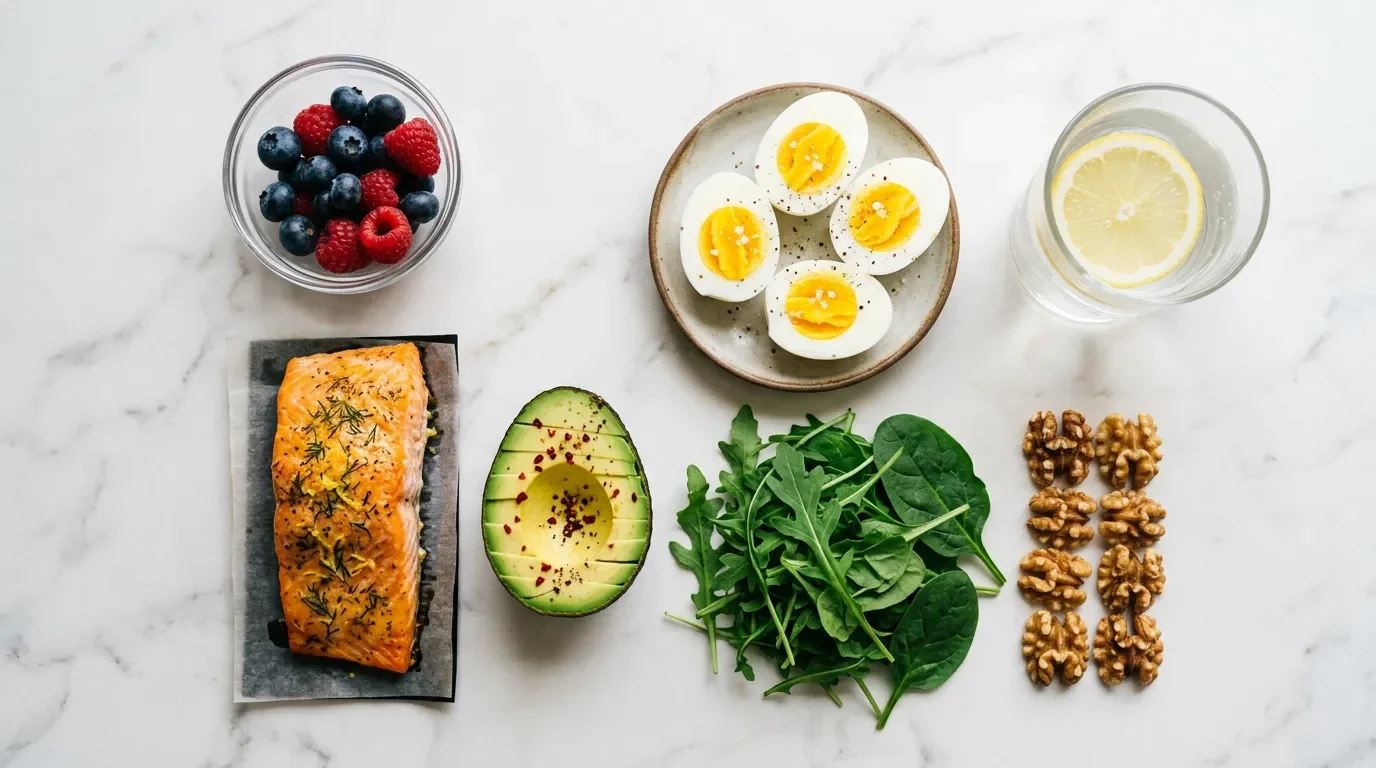
- Wake at 8:30am → eat by 10am. Even if it's small: Greek yogurt + a handful of walnuts + some berries
- Wake at 9am → eat by 10:30am. Two eggs + half an avocado
- No cooking energy? Grab a banana + a string cheese. The goal is glucose + protein within the window, not a perfect meal
The specific food matters less than the timing. Anchor the window.
Move 2: Front-load protein both days 🥚
The weekend default is to eat protein-light during the day (pastries, bagels, coffee) and protein-heavy at dinner (steak, pasta, restaurant portions). This is the exact inversion of what your brain needs.
Protein — specifically tyrosine and tryptophan-rich foods — is the raw material your neurons use to build dopamine, serotonin, and norepinephrine. Your brain synthesizes these neurotransmitters most actively during the day, during waking hours, not overnight. 5 Hitting 25–30g of protein at breakfast and lunch — and then having a lighter dinner — means your brain has the building blocks available when it's actually manufacturing them.
Front-loaded weekend protein targets:
| Meal | Target | Desk-ready options |
|---|---|---|
| Breakfast | 25–30g | 3 eggs (18g) + Greek yogurt (15g); cottage cheese + hemp seeds |
| Lunch | 25–30g | Canned tuna + crackers + string cheese; grilled chicken bowl |
| Dinner | 15–20g | Lighter — your brain's synthesis window is mostly over |
If brunch is your weekend rhythm, make it count: a 2-egg + smoked salmon combo (≈35g protein) carries both breakfast and lunch in one sitting.
Move 3: The Sunday night glycogen top-off 🌙
Sunday night is the single highest-leverage nutrition moment of the entire week. It's your last opportunity to fill liver glycogen before Monday's cognitive sprint.
The top-off isn't a large meal — it's a strategic snack. Eaten 90–120 minutes before sleep, a small combination of complex carbohydrates + a modest amount of tryptophan-rich protein allows your body to do two things simultaneously: restore glycogen stores and use the insulin spike to facilitate tryptophan uptake into the brain, where it gets converted to serotonin (and ultimately melatonin for sleep quality). 6
The Sunday night top-off formula:
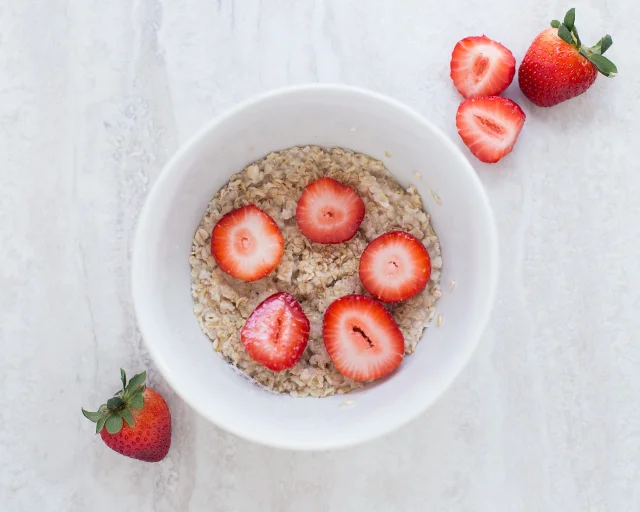
Complex carb (20–30g) + tryptophan-rich protein (10–15g) — eaten 90–120 min before sleep
Examples:
- Oatmeal + 1 tbsp almond butter — oats provide slow glucose release; almond butter adds just enough fat to slow digestion through the night
- Whole grain crackers + a small piece of turkey — turkey is one of the highest dietary sources of tryptophan
- Banana + a small handful of walnuts — natural tryptophan + melatonin precursors in the banana, healthy fats in the walnuts
What not to eat Sunday night: ultra-processed snacks (chips, candy, cookies) spike and drop blood sugar during sleep, disrupting the overnight slow-release pattern your brain depends on for memory consolidation and neurotransmitter rebuild.
Two micro-habits that lock the system in 🔒
These require no meal prep, no planning, and take under two minutes each:
Micro-habit 1 — Set a Saturday "first food" alarm. Pick a time 90 minutes after your typical weekend wake time (say, 10:00am). Set one recurring alarm labeled "eat something." You don't need to plan the food — just eat before it goes off. This single structural cue prevents the accidental breakfast-skip that kicks off the entire weekend drift.
Micro-habit 2 — Stock one Sunday-night snack item. On your next grocery run, buy one item specifically for Sunday night top-off: oatmeal, whole grain crackers, or a bunch of bananas. Put it somewhere visible on Sunday evenings — counter or nightstand. The act of having it there eliminates the decision entirely.
The Monday morning test
If you implement these three moves — anchored Saturday breakfast, front-loaded weekend protein, Sunday night glycogen top-off — you'll notice the difference by 9am Monday.
Not in a dramatic way. You won't feel superhuman. You'll feel like you actually slept, like your first coffee hits cleanly, like your first hour of work has traction instead of fog. That's not a small thing. That's the difference between your Monday being recovery time and being your best cognitive window of the week.
What's your current Sunday night eating habit — and do you notice a connection to how sharp you feel Monday morning? Drop it in the comments. I'm curious whether the "Sunday night reset" is something others have figured out on their own, or whether it's just the thing we all do accidentally wrong.
Fuentes de referencia
- 1Brain energy metabolism, Mergenthaler et al. 2013, Trends in Neurosciences
- 2Diet and mental health: relationship between dietary patterns, depression and anxiety, Adan et al. 2019, Nutrition Bulletin
- 3Gut microbiota features associated with Clostridioides difficile colonization in dairy cattle, Leone et al. 2019 (SCFA and gut circadian research overview)
- 4Cortisol awakening response and metabolic health, Stalder et al. 2016, Psychoneuroendocrinology
- 5Amino acid precursors and monoamine neurotransmitter synthesis, Fernstrom 2013, Journal of Nutrition
- 6Dietary protein, tryptophan, and sleep quality, Shechter & St-Onge 2014, Advances in Nutrition
- 7Pixabay — royalty-free food photography
Añade más opiniones o contexto en torno a este contenido.