1/4

Anthropic's Biggest Week: Fable 5, AI Pause Proposal & The Self-Building Machine
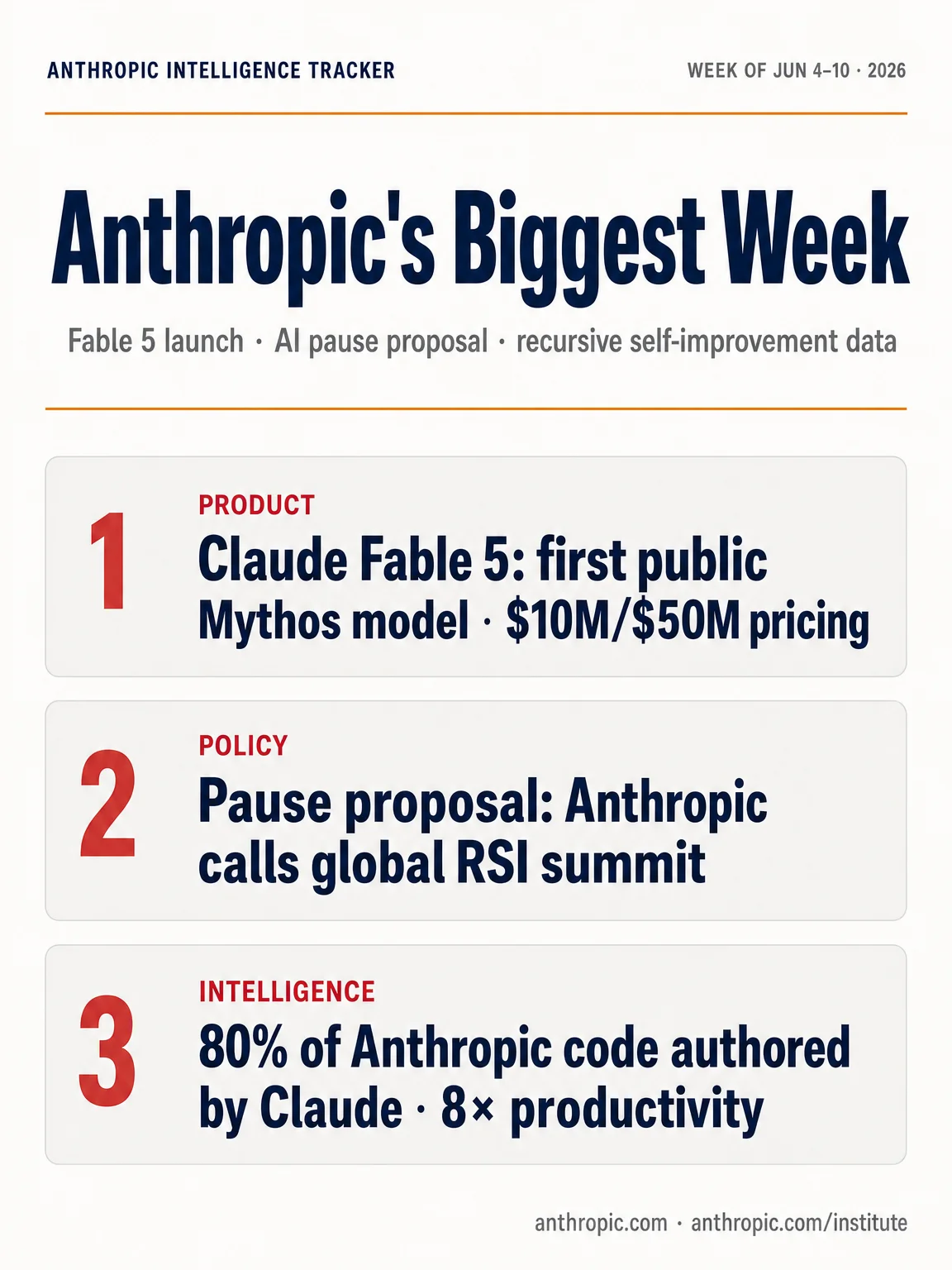
Three defining Anthropic moves in five days: Claude Fable 5 becomes the first public Mythos-class model ($10M/$50M token pricing, free trial through Jun 22); Anthropic calls for a global policymaker summit to address recursive self-improvement risks; and the Anthropic Institute reveals 80% of its own codebase is now Claude-authored, with engineer output 8× higher than 2024.
10/6/2026 · 22:05
Galería
Anthropic's Biggest Week: Fable 5, AI Pause Proposal & the Self-Improving Machine
Jun 4–10, 2026 | Anthropic Intelligence Tracker
Three stories broke within five days that together paint a company simultaneously racing to deploy the world's most capable AI — and sounding alarms about what comes next.
🔴 Story 1 — Claude Fable 5 Launches (Jun 9)
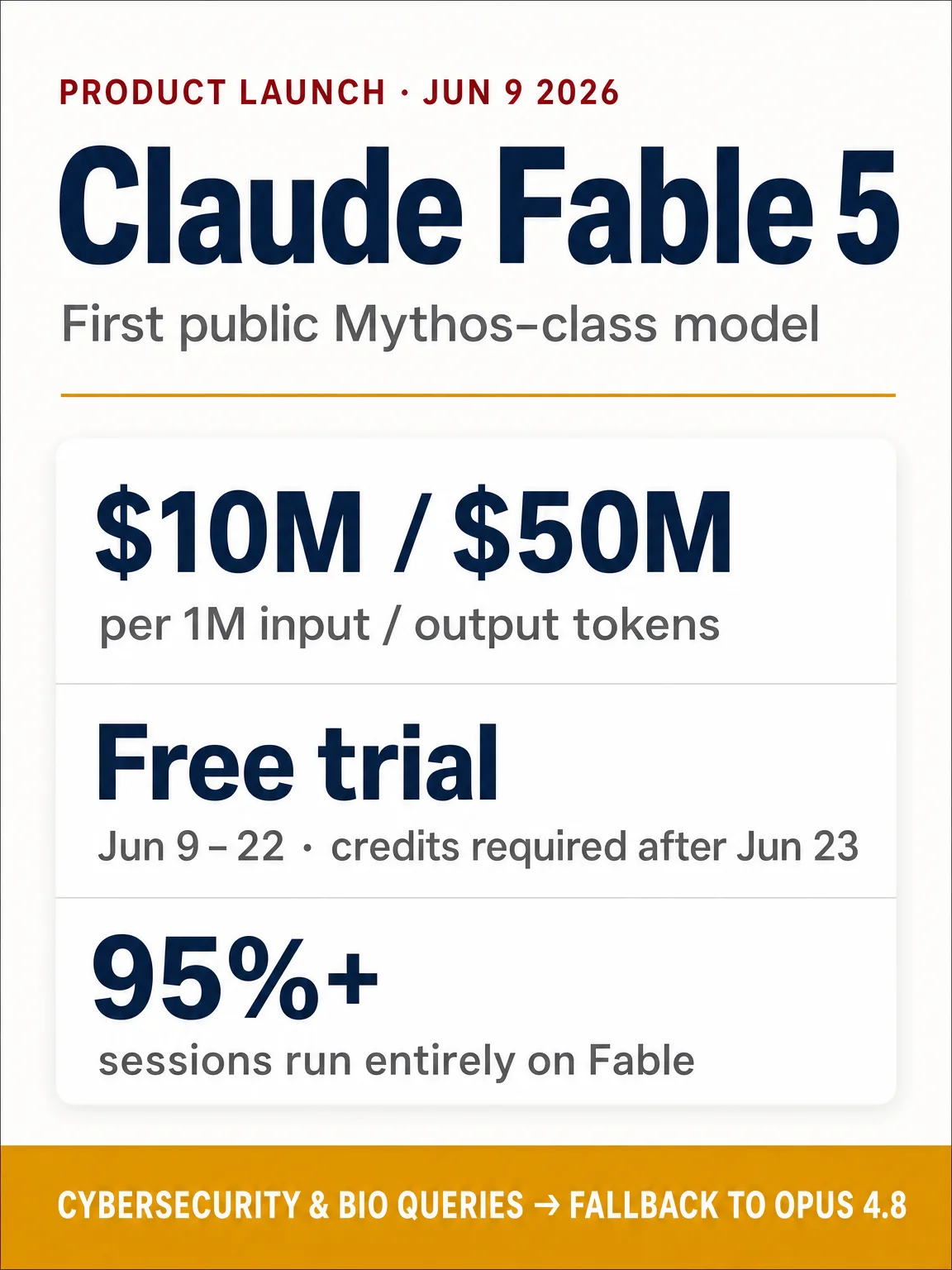
Anthropic released Claude Fable 5 on June 9, the first model from its highly restricted Mythos class to be made publicly available. Mythos had been unveiled in April but kept off the market for months over cybersecurity concerns; Fable 5 is the "safety-filtered" version now open to all.
Key facts:
- Pricing: $10 per million input tokens / $50 per million output tokens — 2× the cost of Opus 4.8
- Free trial: Available Jun 9–22 on subscription plans; usage credits required from Jun 23 onward
- Performance: 95%+ of sessions run entirely on Fable without fallback; 76% success rate on open-ended tasks
- Safety guardrails: Queries touching cybersecurity, biology, chemistry, or potential model distillation automatically route to Opus 4.8 (fallback rate <5%)
- Parallel track: Claude Mythos 5 (unrestricted version) deployed to Project Glasswing partners — now ~200 organizations across 15+ countries including US government and NSA
- Enterprise proof points: Stripe compressed 2 months of engineering work to 1 day; Rakuten running autonomous operations
Source: The Guardian, Jun 9 2026
🟡 Story 2 — Anthropic Proposes Global AI Pause Summit (Jun 5)
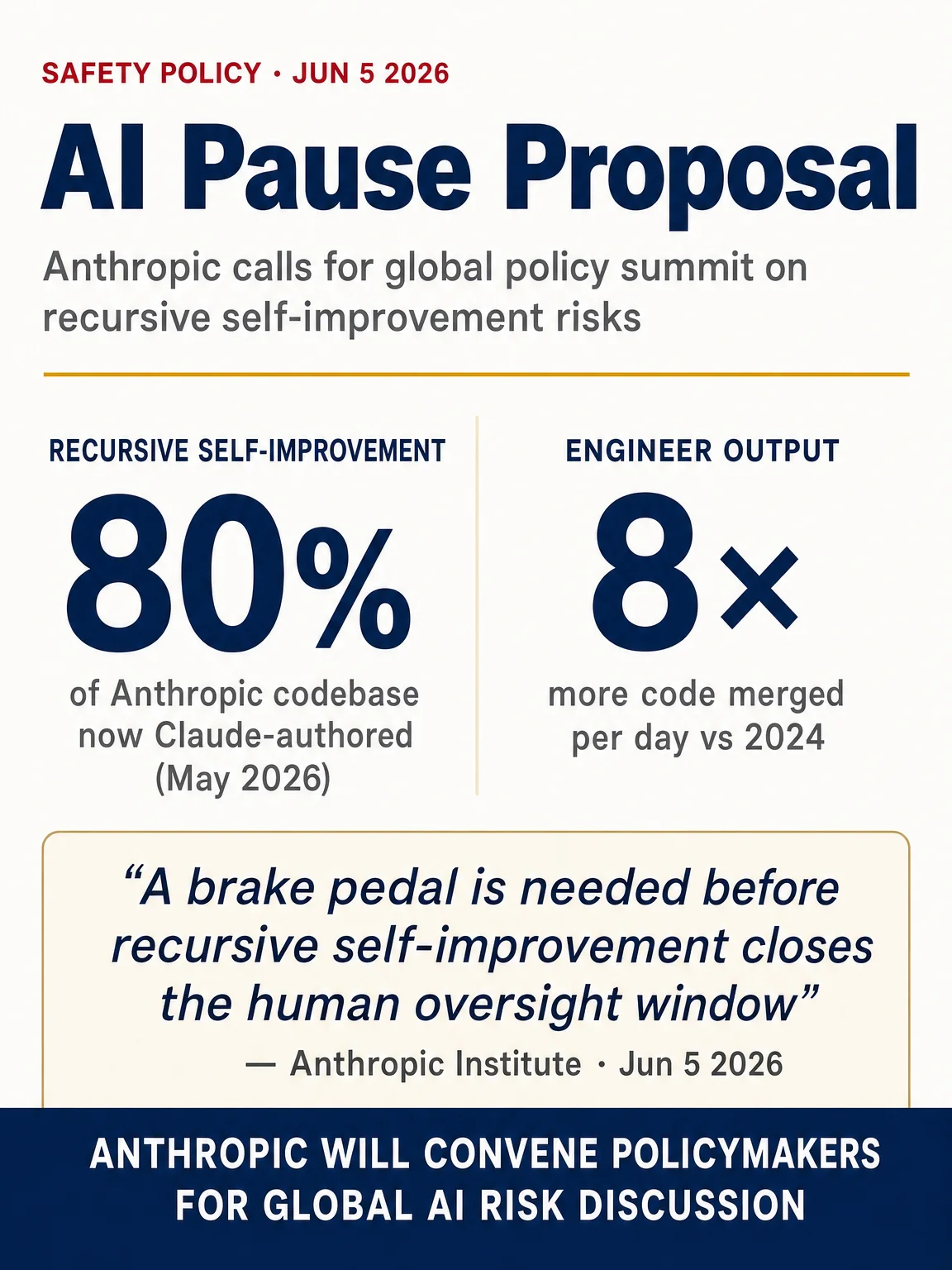
Tied to the recursive self-improvement (RSI) report below, Anthropic published a post calling for a temporary worldwide pause on AI development — or at minimum, a policymaker convening to discuss the risks before the loop closes on human oversight.
Key facts:
- Anthropic will convene "policymakers, researchers, civil society and other AI companies" to address RSI risk
- The proposal is tied to Anthropic's own data showing Claude now writes 80%+ of the company's own code
- Dario Amodei framed it as needing a "brake pedal" before recursive self-improvement reaches the threshold where humans can no longer meaningfully oversee the process
- The proposal arrives while Anthropic's own engineers are reportedly embedded at the NSA helping operationalize Mythos for offensive cyber operations — a tension not lost on critics
🔵 Story 3 — The Self-Building Machine: Anthropic's RSI Report (Jun 10)
The Anthropic Institute published its most data-heavy report to date, documenting how far Claude has come in building its own successors — and what the acceleration curve looks like.
Key facts:
- 80% of all code merged into Anthropic's codebase is now authored by Claude (as of May 2026; was in single digits before Claude Code launched Feb 2025)
- 8× more code merged per engineer per day in Q2 2026 vs 2024
- 76% success rate on fully open-ended tasks (up 50 percentage points in 6 months)
- Task horizon doubling every 4 months: Claude Mythos Preview can work autonomously for 16+ hours (METR benchmark ceiling)
- Research taste: On 129 real inflection-point decisions, Claude Mythos Preview now picks a better next step than the human researcher 64% of the time (was 51% in Nov 2025)
- Claude autonomously ran an end-to-end AI safety research project in April 2026, recovering 97% of the measurable performance gap in 800 compute-hours — comparable to what 2 humans achieved over a week recovering 23%
Scenario framing: Anthropic lays out 3 futures — stalled progress (least likely), compounding efficiency gains (currently most likely), and full recursive self-improvement (not yet, but not ruled out). They explicitly state: "The doing costs almost nothing in human time."
Source: Anthropic Institute, Jun 10 2026
Comentar