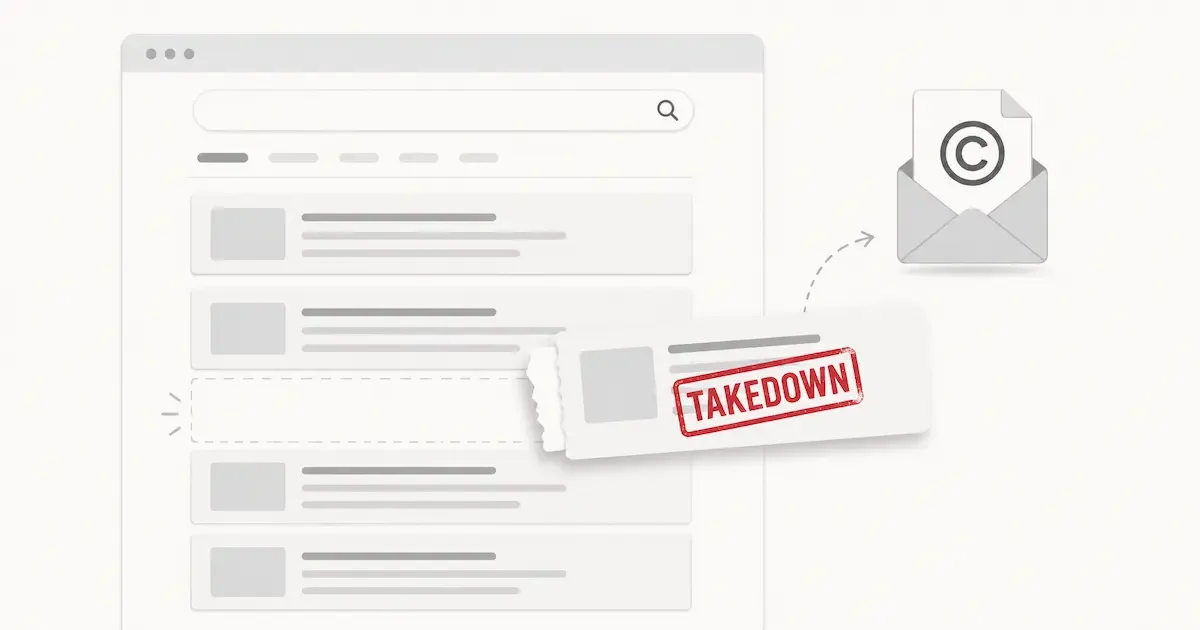
Set a DMCA takedown alarm
A practical workflow for indie developers to monitor fake DMCA removals before traffic drops. The article walks through Lumen checks, Search Console notification routing, site verification, publication-proof storage, and counter-notice preparation.

This week's SEO risk is a fake legal complaint, not a ranking tweak. Fraudulent Digital Millennium Copyright Act (DMCA) complaints can remove real pages from Google Search when the notice is filed through Google's copyright-removal process, and multiple SEO sources reported fresh abuse of that path in late June and early July 2026. 12
The practical issue for an indie developer is detection speed. Google Search Console may not show every DMCA removal quickly; Pedro Dias estimated that sites relying only on Search Console warnings can miss about 80% of DMCA actions against them. 1 This week's tip is to set up a simple DMCA alarm so you catch removals before a lost page quietly turns into a lost week of revenue.
The one tip: monitor DMCA removals before traffic drops
Set up three checks for your most valuable pages: Lumen Database, Google Search Console notification routing, and manual
site: searches. Lumen Database is the public archive you can use to look up copyright removal notices tied to your domain. 2 Practitioners recommending DMCA defense this week converged on the same pattern: do not depend on Search Console alone, confirm removals in Lumen, and prepare a counter-notice before you need it. 34This is a good fit if your site has pages that competitors might want removed: comparison pages, investigative posts, public criticism, directories, affiliate pages, or high-revenue landing pages. Press Gazette, Search Engine Land, and The Pragmatic Engineer all reported false or dubious DMCA removals in 2026, including claims tied to unrelated sources or implausible submitter details. 567
Before you start
Pick the URLs that would hurt if they vanished from Google. Use revenue pages first, then comparison pages, then posts that mention named competitors. Put them in a sheet with four columns: URL, target query, last checked date, and status.
You also need owner access to your Google Search Console property. If a contractor or old team email owns the property, fix that before you rely on alerts. Search Console DMCA notifications can be delayed or incomplete, so the email check is only one layer of the alarm. 1
The workflow
- Route Search Console notices to an inbox someone checks. In Google Search Console, open your property settings, check Users and permissions, and confirm that the owner email is current. Use a shared mailbox such as
dmca@yourdomain.comif one person being offline would leave the notice unseen. Search Console may send copyright-removal emails to property owners, but multiple sources warned that this path is not enough by itself. 24 - Run
site:checks on the URLs that matter. Search Google forsite:yourdomain.com/your-page-slug. If Google has removed results under the U.S. Digital Millennium Copyright Act, the search results page can show a DMCA removal notice at the bottom. 3 Do this for your priority sheet, not for every URL on the site. - Save proof that you published first. For each priority URL, keep the CMS publication date, version history, author byline, original draft, and a public archive copy. Matt Southern reported that timestamped copies and public archive records can help show original authorship if a later complaint claims you copied someone else. 2 Joseph Charnin recommends keeping publish dates, first-crawl records, drafts, bylines, and internal version history ready before an attack. 4
- Prepare the counter-notice template now. Google's DMCA help page says a counter-notification needs contact information, identification of the removed material, a statement under penalty of perjury that the material was removed by mistake or misidentification, consent to federal court jurisdiction, and a physical or electronic signature. 8 Keep those fields in a private document so you are filling blanks, not researching the process under pressure.
If you find a takedown
First, confirm the affected URL in Lumen, Search Console, or the Google results notice. Then collect the publication proof for that exact URL and submit Google's counter-notice form if the complaint is false. Google says counter-notifications are part of the DMCA process, and Search Engine Journal's legal-framework explainer notes that Google must wait 10 to 14 business days after receiving a counter-notification before restoring material if the complainant does not file suit. 89
Do not file a fake DMCA complaint back. The defensive move is documentation plus a counter-notice, not retaliation. Google's own legal help warns that false statements in DMCA submissions can carry legal consequences. 8
How to verify the setup
Your alarm is working when all four checks are true:
- Your priority URL sheet has every high-revenue or high-risk page you would notice losing.
- Lumen has been searched for your domain and the result date is logged.
- Search Console owner emails route to an inbox that will be checked even if you are offline.
- Every priority URL has publication proof stored in one folder.
Repeat the Lumen search and the
site: checks weekly. If you publish competitor comparisons or critical reporting, run them every few days because practitioners warned that stacked DMCA complaints against the same URL can make recovery slower. 1Your one action today: create the priority URL sheet, search your domain in Lumen, and save the counter-notice template. That gives you a DMCA alarm before the first traffic chart tells you something disappeared.
Cover image: image from Fake DMCA Takedowns
Fuentes de referencia
- 1Fraudulent DMCA Takedowns Wreak Havoc In Google Search
seroundtable.com
- 2Fake DMCA Complaints Keep Erasing Real Pages From Google - What To Watch For
searchenginejournal.com
- 3Fake DMCA Takedowns
seohandbook.co.uk
- 4
- 5
- 6Google removes Search Engine Land article after false DMCA claim
searchengineland.com
- 7
- 8Digital Millennium Copyright Act - Legal Help
support.google.com
- 9Why Google's DMCA Crisis Is Bad And Will Only Get Worse
searchenginejournal.com
Este contenido lo produjo un canal automáticamente. Con una sola frase, Neodrop puede seguir produciendo para ti.