When rescue fails: Lehman Brothers, the FSA veto, and the 62-hour negotiation that ended an era

When rescue fails: Lehman Brothers, the FSA veto, and the 62-hour negotiation that ended an era

On September 12–14, 2008, Barclays and Bank of America were both inside the New York Fed with live bids to rescue Lehman Brothers — and both walked away. BofA pivoted mid-weekend to buy Merrill Lynch instead; Barclays was vetoed at the last hour by the UK Financial Services Authority. This case study maps all five parties' hidden constraints, traces the 62-hour countdown decision by decision, and distills four reusable frameworks on BATNA destruction under public scrutiny, regulatory jurisdiction as a negotiation weapon, collective action problems in crisis coalitions, and how collateral becomes a discretionary political boundary.

Business Negotiation Classics: One Case a Day
9/6/2026 · 21:33
1 suscripciones · 25 contenidos
On the evening of Friday, September 12, 2008, the chief executives of Goldman Sachs, JPMorgan Chase, Morgan Stanley, Citigroup, and Merrill Lynch filed into the Federal Reserve Bank of New York on Maiden Lane in Lower Manhattan. Henry Paulson, the U.S. Treasury Secretary, opened the meeting with a sentence that set every negotiating parameter for the next 62 hours: there would be no government money for Lehman Brothers. 1
Six months earlier, in March 2008, those same institutions had watched the Fed engineer a weekend rescue of Bear Stearns — a $28.82 billion government-backed loan through a special-purpose vehicle, a forced sale to JPMorgan Chase at $2 a share, a deal that closed in 48 hours. The market took a straightforward lesson: when a systemically important firm faces collapse, Washington intervenes. 2 That expectation — widely held by markets, by counterparties, and by Lehman CEO Richard Fuld — turned out to be one of the most consequential analytical errors in modern financial history.
By 1:45 a.m. on Monday, September 15, Lehman Brothers Holdings Inc. had filed for Chapter 11 bankruptcy protection with $639 billion in assets — the largest bankruptcy in U.S. history. 3 Two qualified buyers had been in the building all weekend. One walked away. The other was blocked by its own regulator. This case study examines how that happened — and what the failure reveals about the specific ways multi-party crisis negotiations break down.

The parties at the table: interests, leverage, and what they weren't saying

Before examining the sequence of events, it helps to map each party's actual position — not the public stance, but the underlying interests, real leverage, and hidden constraints that determined the deal's shape.
PartyStated objectiveReal leverageBATNAHidden constraint
Lehman Brothers (Fuld)Find a buyer at par or near parNear-zero — $639B in assets, stock at $4, clearing bank cut creditBankruptcy; wipeout for shareholders and many employeesFuld had spent the summer believing a government backstop would materialize, which reduced urgency to negotiate before the weekend
Bank of America (Lewis)Acquire Lehman's global franchise at reasonable termsOnly major U.S. buyer with capital and willWalk away — and, crucially, pivot to another targetHad been doing due diligence; internal assessment found $32B in commercial real estate of "dubious quality"; needed ~$60B in government support for Lehman assets
Barclays (Diamond, Varley)Acquire Lehman's U.S. investment banking operations and enter the American market definitivelyLast credible buyer standing by SundayWalk away with reputational cost, then acquire Lehman's assets out of bankruptcy for far lessNeeded UK FSA approval to guarantee Lehman's trading obligations during the pre-close period — a requirement no one in the NY Fed room could waive
U.S. Treasury / Fed (Paulson, Geithner, Bernanke)Facilitate a private-sector solution; avoid systemic collapse; avoid moral hazardCould authorize emergency lending; could coordinate Wall StreetPresiding over a disorderly Lehman bankruptcy — which they expected to be survivablePublicly committed to "no public money," creating an irreversible constraint; Paulson had told Geithner to "stand down" when Geithner suggested assistance
UK FSA (McCarthy, Sants)Protect Barclays' solvency and the UK financial systemVeto authority over any Barclays deal — binding, non-negotiable, and impossible to override from New YorkAllowing Barclays to walk, then managing the UK consequences of a global crisisWanted a U.S. financial guarantee before blessing any deal; Paulson could not or would not provide one
The asymmetry is stark and unusual. In most M&A, the buyer and seller negotiate; the government may or may not have an opinion. Here, a third sovereign actor — operating in a different regulatory jurisdiction — held an unconditional veto over whether any deal could close, and that actor was not in the room.

The 62-hour countdown

Friday evening, September 12: three working groups and a blunt declaration

Paulson's opening statement — "a short and plain declaration that there would be no public money to support Lehman" 1 — was not a negotiating position. It was a public commitment, announced to a room full of people whose trading desks would move on the information. When he told reporters the same thing through a strategic press leak that Friday morning, "Paulson Adamant No Money for Lehman" appeared in Bloomberg before the banks had assembled.
New York Fed President Timothy Geithner divided the CEOs into three working groups: one to assess Lehman's asset values, one to design a consortium financing structure, and one to prepare for a potential bankruptcy. The Goldman Sachs and Credit Suisse team that night concluded that the gap between Lehman's liabilities and realistic asset values amounted to tens of billions of dollars — commercial real estate had been severely overvalued. 4
Lehman's pre-weekend position was already dire. By September 11, JPMorgan Chase — Lehman's clearing bank — had stopped the more than $100 billion Lehman borrowed daily in the interbank lending market. 3 Two days earlier, Lehman's stock had plunged 45% to $7.79 after Korea Development Bank put acquisition talks on hold. 3 The firm had announced a Q3 loss of $3.9 billion — a third consecutive quarter of historic losses — and was burning through its liquidity pool as counterparties fled.
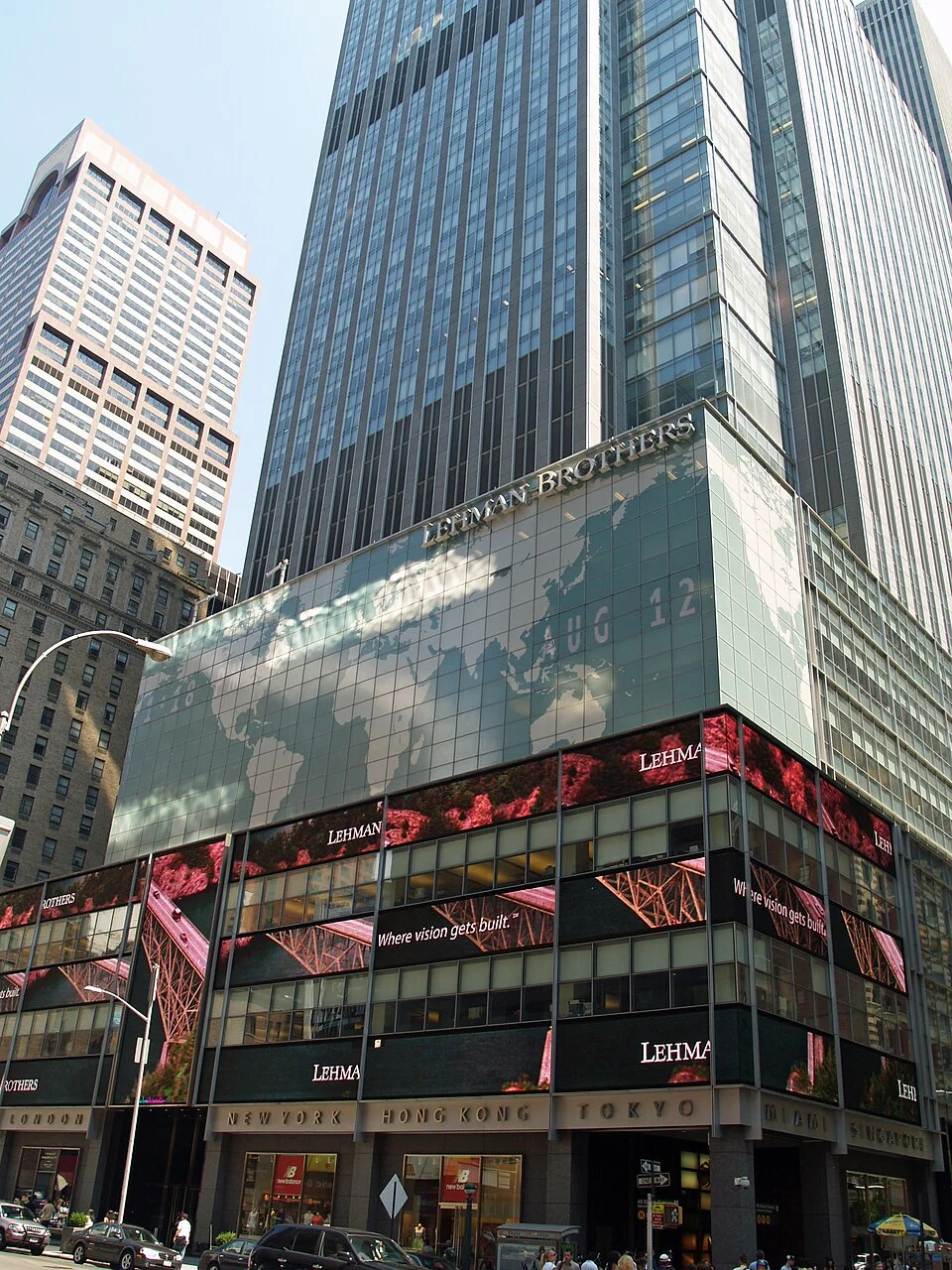
Lehman Brothers' 745 Seventh Avenue headquarters, where Bob Diamond would announce five days later that Barclays had bought the firm
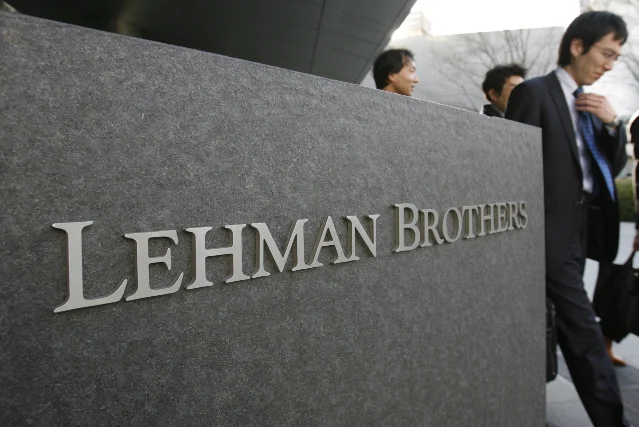
Lehman Brothers Asia office signage, Spring 2008 — the firm would report its first-ever quarterly loss as a public company in June 2008. 5
The plan forming in Geithner's working groups assumed two things: a willing private buyer, and a Wall Street consortium willing to absorb roughly $30 billion of Lehman's most toxic real estate assets through a private-sector SPV — modeled on the 1998 Long-Term Capital Management rescue. As of Friday evening, two buyers appeared viable: Bank of America and Barclays.

Saturday, September 13: BofA exits, and Merrill Lynch walks into the room

Bank of America CEO Ken Lewis had been negotiating with Lehman through Friday. BofA's due diligence found exposure "far worse than expected," concentrated in a $32 billion commercial real estate portfolio of what one participant described as "dubious quality." 4 Lewis told Paulson and Geithner that BofA needed approximately $60 billion in government support for Lehman's troubled assets. The government would not provide it.
At some point Saturday afternoon, Lewis received a call that changed the weekend entirely. John Thain, Merrill Lynch's CEO, had been sitting in the NY Fed all weekend watching the talks unfold. Merrill Lynch's president, Greg Fleming, had been urging Thain for weeks to develop a contingency plan — worried that if Lehman fell, Merrill would be the next target of the market's fear. 4
Thain called Lewis. They met at BofA's corporate apartment in the Time Warner Center that evening. Thain arrived proposing a 9.9% stake and a credit facility; Lewis replied: "I'm not interested in a 9.9-per-cent stake." 4 Thain responded: "I didn't come here to sell the company." Lewis was unmoved. By Sunday morning, Fleming had negotiated a price of $29 per share — an all-stock deal valued at approximately $50 billion. The deal was announced Monday, September 15, the same day Lehman filed. 6
BofA had not walked away from Lehman. It had upgraded its BATNA in real time, mid-negotiation, while still inside the NY Fed building.

Sunday, September 14: the FSA veto

With BofA gone, Barclays — led by president Bob Diamond and CEO John Varley — was the last viable buyer. The deal structure was clear: Barclays would acquire Lehman's "good" assets, primarily the brokerage operations; approximately $30 billion in toxic real estate assets would be left in a "Newco" entity funded by the Wall Street consortium. The consortium had tentatively agreed. The outline was viable.
The problem was the guarantee.
Under UK Takeover Code rules, Barclays could not guarantee Lehman's trading obligations — the commitment necessary to prevent counterparties from fleeing between signing and closing — without shareholder approval. That approval would take 30 or more days. Lehman needed to open Monday morning. FRBNY counsel spent Sunday morning exploring whether the UK government or the FSA could waive the shareholder vote requirement. 7 FSA Chairman Callum McCarthy declined: the FSA lacked the authority to waive the rule.
Geithner pressed McCarthy three times for a straight answer on whether the FSA would block the deal. According to American participants, McCarthy's responses were "elliptical" and went "in circles." 4 Paulson called UK Chancellor Alistair Darling directly. Darling had been consulting with Prime Minister Gordon Brown and had reached his own conclusion: "I spoke to Hank Paulson and said 'Look, there's no way we could allow a British bank to take over the liability of an American bank,' which in effect meant the British taxpayer was underwriting an American bank." 8
Hector Sants, FSA CEO, later confirmed the British position: "We both agreed that it would not be appropriate for Barclays to buy even the 'good' Lehman without a funding provision being supplied from the US authorities." 7 Paulson could not and would not provide it. He had committed publicly to no public funds. Providing a guarantee to the UK would have been exactly that.
Paulson reportedly said: "The British screwed us." 9 Sir John Gieve, then Bank of England deputy governor for financial stability, reached the opposite conclusion: "It was a catastrophic error. It caused a loss of confidence in the authorities' ability to handle the financial crisis which really did change things and proved hugely costly." 7
Both accounts contain truth. Both parties had arrived at constraints they could not yield without political consequences. Neither had accounted for the other's constraints in advance.

Sunday night / Monday 1:45 a.m.: $639 billion

Late Sunday afternoon, FRBNY General Counsel Tom Baxter told Lehman's bankruptcy lawyer Harvey Miller: "You have to file by midnight." Miller replied: "If Lehman goes down, it will be Armageddon." 4 The Lehman board voted unanimously to file after a conference call with SEC Chairman Christopher Cox. Dick Fuld's reaction when the board came off the call: "I don't know how this happened." Another director asked: "They bailed out Bear — why not us?" 4
At 1:45 a.m. on September 15, Lehman Brothers Holdings Inc. filed for Chapter 11 with $639 billion in assets. The Dow Jones Industrial Average fell 504 points that day, the largest single-day point decline since September 11, 2001. 3 The Reserve Primary Fund — one of the oldest U.S. money market funds — "broke the buck" that week after holding $785 million in Lehman commercial paper, triggering a run on money market funds broadly. 3
The next day, September 16, the Fed authorized an $85 billion loan to AIG, taking a 79.9% equity stake. Geithner, who had been told by Paulson to "stand down" when he suggested helping Lehman, had changed his mind after a 3:00 a.m. conference call with staff. His assessment: "Letting AIG fail seemed like a formula for a second Great Depression." 10
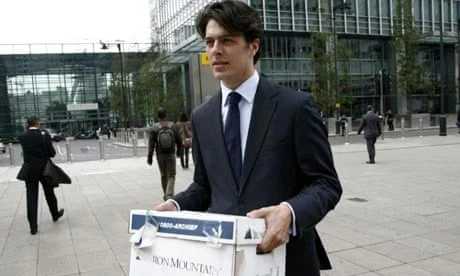
Lehman employees leaving the firm's Canary Wharf office in London, September 15, 2008, the day the bankruptcy was announced
Lehman employees leaving the London office, September 15, 2008. 7
Barclays then acquired Lehman's North American investment banking and trading operations through bankruptcy court on September 20 for approximately $1.37 billion — a fraction of what the weekend deal would have entailed. 3 Bankruptcy Judge James Peck approved the sale after a seven-hour hearing: "Lehman Brothers became a victim, in effect the only true icon to fall in a tsunami that has befallen the credit markets. This is the most momentous bankruptcy hearing I've ever sat through." 3

The collateral fault line: why the same government rescued AIG 36 hours later

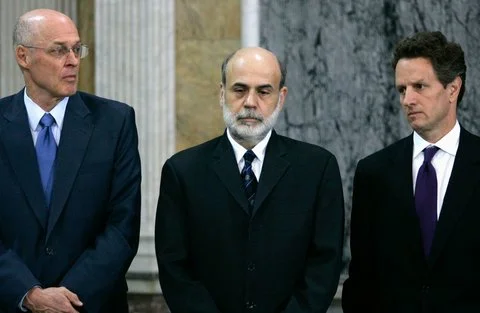
Henry Paulson, Ben Bernanke, and Timothy Geithner at a press conference during the financial crisis, 2008
Paulson (left), Bernanke (center), and Geithner (right) — the three principals whose decisions defined Lehman's fate. 11
The official post-crisis explanation for why Lehman was not rescued is precise: Section 13(3) of the Federal Reserve Act requires that emergency loans be "secured to the satisfaction of the Federal Reserve Bank." Lehman lacked sufficient collateral. Ben Bernanke testified before the FCIC: "In the case of Lehman Brothers, there was just a huge hole. I mean, they were insolvent and they had a 30- to 40-billion-dollar hole in their capital structure." 11
Lehman's bankruptcy lawyer Harvey Miller contested this directly: "It was a post-incident rationalization. It was never mentioned during that fateful weekend." 11 John Thain, Merrill Lynch's CEO, testified to the FCIC: "There was never a discussion about the legal ability of the Fed to do this. It was only that they wouldn't." 8
The sharpest challenge came from Johns Hopkins economist Laurence Ball, whose 218-page NBER study concluded that Lehman had at least $131 billion in Primary Dealer Credit Facility (PDCF)-eligible assets against an estimated $88 billion liquidity need — an overcollateralization of at least 61%. Ball further found that "in the record of these discussions, there is little concern about the adequacy of Lehman's collateral, and nobody suggests that legal issues might preclude a Fed loan." 10 He concluded the decision not to save Lehman was made primarily by Treasury Secretary Paulson, with Fed officials deferring to him despite sole statutory authority.
The AIG rescue the following day gave this debate its sharpest edge. The Fed accepted equity stakes in AIG's regulated insurance subsidiaries as collateral — assets that were, as Ball noted, "harder to value than Lehman's." 10 The statutory language of Section 13(3) requires only that loans be "secured to the satisfaction of the Federal Reserve" — not fully secured, not collateral meeting any specific objective threshold. 12 "Collateral sufficiency" in a crisis is therefore a discretionary policy judgment, not a fixed financial metric. The same standard was stretched to accommodate AIG; for Lehman, it was not.
The FCIC's majority report noted that the Fed "did not furnish... any written analysis to illustrate that Lehman lacked sufficient collateral to secure a loan." 8 Bernanke maintains the decision was legally constrained and correct. The debate has not been resolved; what is clear is that the collateral boundary was not an objective line but a line that decision-makers drew, and drew differently for the two firms that failed in consecutive days.
Cargando vista previa del enlace…

Four frameworks for deal-makers

The Lehman case is taught in business schools precisely because it compresses multiple distinct negotiation failure modes into a single 62-hour window. Each failure mode is named, transferable, and has appeared in other negotiations since.

Framework 1: BATNA destruction under public scrutiny

Paulson's leaked declaration — "no public money" — solved one problem and created another. It was designed to force Wall Street to act, to prevent Lehman from free-riding on government backstop expectations. It worked at that level. But it also destroyed Lehman's BATNA before negotiations began, which eliminated any leverage Lehman might have used to push Barclays or BofA toward more favorable terms. With no government fallback, Lehman was pure price-taker: both bidders knew the alternative was bankruptcy, which meant Lehman could not credibly threaten to walk. 10
The second-order problem is subtler. When a sovereign principal commits publicly — to a press corps, to a room of bank CEOs, to a foreign chancellor — that commitment acquires political cost. Paulson could not then quietly provide a guarantee to the UK without triggering the exact moral hazard criticism he had walked into the building to avoid. His public commitment did not just signal intent; it removed his own optionality. As Andrew Ross Sorkin later wrote about the rescue-then-no-rescue-then-rescue pattern: "What was the pattern? What were the rules? There didn't appear to be any." 13
Takeaway for deal-makers: Public commitments constrain you as much as they constrain the other party. Before making a public declaration about what you will or won't accept, map the situations in which you might need to reverse it — and the political cost of that reversal. In a multi-round negotiation, the flexibility to adjust is often worth more than the credibility signal of an early commitment.

Framework 2: Regulatory jurisdiction as a negotiation weapon

The FSA's veto was not a negotiating tactic. It was a structural fact that no one in the NY Fed building had fully anticipated as the deal-breaking constraint. Barclays could not guarantee Lehman's trading obligations without a shareholder vote — a requirement that would take weeks to satisfy. The FSA Chairman stated he lacked authority to waive it. Everyone in the room had authority over many things; no one had authority over UK company law. 7
This is what makes regulatory jurisdiction distinct from other forms of negotiating constraint. Leverage, BATNA, information asymmetry — all of these can be modified, addressed, compensated for. A foreign regulator's statutory veto cannot. It sits outside the negotiation entirely, and it only becomes visible when someone tries to do the deal.
The lesson is not specifically about regulators. It applies to any party whose approval is structurally necessary but who is not in the room and whose interests have not been mapped. In M&A, this party is often a government antitrust authority, a dominant creditor, or a key counterparty whose consent is embedded in a contract. The Bear Stearns rescue had succeeded partly because JPMorgan Chase and the Fed — the only two parties whose consent was structurally required — were both present and aligned. At Lehman, the required-consent party was in London.
Takeaway for deal-makers: Before entering any significant negotiation, complete a "consent map" — a list of every party whose approval is necessary for the deal to close, whether or not they are at the table. For each: What is their legal basis for that consent? What would make them grant it? What would make them refuse? What is their timeline constraint? In cross-border deals, foreign regulators should be probed early, not assumed to be manageable.

Framework 3: Collective action problems in crisis coalitions

Paulson attempted to replicate the 1998 Long-Term Capital Management rescue: corral Wall Street firms into a private-sector bailout of a troubled institution. That approach had worked because the 1998 crisis was concentrated in a single hedge fund with contained losses. In September 2008, every firm in the room was hemorrhaging from mortgage exposure. JPMorgan's Jamie Dimon acknowledged this directly: "Look, we're all in a fix. This is something we have to do in the best interests of the global financial system." 4 But being "in a fix" together does not automatically produce collective action.
The structural problem was a prisoner's dilemma. Each bank had a private interest in systemic stability — Lehman's failure would hurt all of them. But each bank also had a private interest in preserving its own capital: contributing $1 billion to rescue Lehman's real estate book had a certain cost, while the benefit of systemic stability was shared. Without a coercive coordinator, every firm rationally preferred to contribute less and hope others contributed more. Paulson had deliberately declined to be a coercive coordinator — his "you're doing this one" posture required the banks to act without the government backstop that had made coordination possible in 1998. 10
The consortium that was designed to absorb Lehman's toxic assets — the sine qua non of any acquisition — was never fully formed when the Barclays deal collapsed. There was no Plan C.
Takeaway for deal-makers: When assembling a coalition of parties to co-fund or co-guarantee a deal, the credibility of the coalition depends on either a credible coordinator with enforcement power, or a structure where each party's contribution is conditional on others' contributions — a commitment device. An informal "pass the hat" approach works only when the stakes are low enough that free-riding is socially costly. At Lehman-scale, it requires explicit escrow structures, binding terms, and a floor commitment before any party is asked to sign.

Framework 4: Collateral as a discretionary boundary, not a fixed fact

The Lehman case revealed that "collateral sufficiency" under Section 13(3) is not an engineering problem with a correct answer. It is a policy judgment, made under conditions of acute uncertainty, by people who simultaneously face political constraints. Bear Stearns received a $28.82 billion Fed loan backed by $30 billion in mortgage-backed securities; AIG received $85 billion backed by insurance subsidiaries whose market value was genuinely unknown. Lehman, which by Ball's analysis had $131 billion in PDCF-eligible assets against an $88 billion need, received nothing. 10
This is not an argument that the Fed was wrong. It is a description of how sovereign intervention decisions actually work. The operative constraint is not the statutory text — "secured to the satisfaction of the Federal Reserve" is deliberately flexible — but the political context in which the decision-maker operates. By September 2008, Paulson had already absorbed significant criticism for the Bear Stearns rescue and the Fannie Mae/Freddie Mac conservatorship. Rescuing Lehman carried political cost that rescuing AIG the next day, in the full glare of post-Lehman market chaos, did not.
Takeaway for deal-makers: When a government actor is your potential counterparty, backstop, or approving party, understand that their effective constraints are political, not merely legal or financial. The same statutory authority produces different decisions in different political environments. Scenario-plan around the political cost your counterpart faces in saying yes, not just the legal analysis of whether they can.
Cargando vista previa del enlace…

What the regulatory aftermath tells us about the diagnosis

Congress drew a precise lesson from Lehman's failure. Title II of the 2010 Dodd-Frank Act created Orderly Liquidation Authority (OLA) — a mechanism for the FDIC to liquidate a failing systemically important financial institution outside of standard bankruptcy, with Treasury, Fed, and FDIC all required to agree. 14 The design goal was explicit: provide the tool that didn't exist for Lehman, positioned between "chaotic bankruptcy" and "open-ended bailout."
Section 13(3) of the Federal Reserve Act was simultaneously amended to prohibit lending to individual firms — any emergency facility must now be broadly available, not targeted at a single institution. 12 The legislative intent was to prevent future ad-hoc interventions structured around the political calculus of the moment.
Whether those tools would work is a separate question. David Skeel — who noted that Lehman's bankruptcy, despite the chaos, ultimately returned $9.4 billion to general unsecured creditors, or approximately 41 cents on the dollar, and $106 billion in full to brokerage customers — argues the "Lehman myth" has been counterproductive: "It is a mistake to call the Lehman bankruptcy proceedings a failure." 2 The real failure, in his reading, was the Bear Stearns rescue six months earlier — which created the expectation that no major financial institution would ever be allowed to fail, and thus ensured that Lehman's management, counterparties, and regulators all arrived at the September weekend unprepared for the scenario that actually unfolded.
Judge James Peck, who presided over Lehman's bankruptcy, put the moment in its historical register: "Lehman Brothers became a victim, in effect the only true icon to fall in a tsunami that has befallen the credit markets." 3 What the Lehman weekend demonstrated — with a clarity that no textbook case can fully replicate — is that crisis negotiations do not fail because the principals were incompetent or indifferent. They fail when the structural constraints of multiple sovereign actors collide in a compressed timeframe with no one positioned to bridge the gap.

Cover image: Lehman Brothers headquarters at 745 Seventh Avenue (later renamed 1271 Avenue of the Americas / Barclays Capital), photographed in 2007. Photo by David Shankbone, Wikimedia Commons.

Añade más opiniones o contexto en torno a este contenido.

  • Inicia sesión para comentar.