The 25C energy credit is dead — but your 2025 upgrades can still save you up to $3,200

The 25C energy credit is dead — but your 2025 upgrades can still save you up to $3,200

Congress killed the Energy Efficient Home Improvement Credit after December 31, 2025 — but if you installed a heat pump, new insulation, efficient windows, or a high-efficiency HVAC system any time in 2025, you can still claim up to $3,200 on your 2025 return. This issue covers exactly who qualifies, which form to file (Form 5695 Part II), the deadline, and the average amount claimed.

Credits You're Owed
10/6/2026 · 20:19
1 suscripciones · 1 contenidos

The 25C credit is dead — but 2025 homeowners can still claim up to $3,200

Congress killed it. The One Big Beautiful Bill (signed July 4, 2025) shut down the Energy Efficient Home Improvement Credit (Section 25C) effective December 31, 2025. No new improvements after that date qualify. But here's the part most people are sleeping on: if you installed a heat pump, upgraded your insulation, replaced your windows, or had a home energy audit any time in 2025, you can still claim this credit on your 2025 tax return. The deadline to file is April 15, 2026 — or October 15, 2026 with an extension.1
The credit averaged $882 per return in 2023. For heat pump installers, the per-project cap was $2,000. The rule: you can't claim what you didn't know existed.2
Cargando tarjeta de estadísticas…
Not tax advice. Rules changed in 2025. Verify your eligibility using the IRS links in this article before filing.

Who qualifies

You qualify if all of these apply:
  • You own (not rent) the home where the improvement was installed
  • The home is in the United States and is your primary residence (where you live most of the year)
  • The improvement was placed in service in 2025 — meaning installed and operational, not just purchased or contracted
  • The property is existing, not new construction
  • The equipment or materials are new (not used or refurbished)
You do not qualify if:
  • You're a landlord or investor who doesn't live in the home
  • The improvement was in a vacation home or second home (different rules apply)
  • You use the home exclusively for business1

What's covered and how much

The credit is 30% of your qualifying costs, subject to annual caps by improvement type.
ImprovementCredit rateAnnual cap
Heat pump (electric or gas)30%$2,000
Heat pump water heater30%$2,000 (combined with heat pump)
Insulation & air sealing30%$1,200 (labor excluded)
Exterior windows & skylights30%$600 total
Central A/C, gas furnace, boiler30%$600 per item
Electrical panel upgrade (200A+)30%$600
Exterior doors30%$250/door, $500 total
Home energy audit30%$150
The caps are per year, not per lifetime — but since the credit expires after 2025, the total you can claim is whatever the applicable cap is for work you had done last year.
One critical 2025 rule: for most equipment categories (heat pumps, A/C, furnaces, water heaters, panels), the manufacturer must be registered with the IRS as a "qualified manufacturer" and must have issued a Qualified Manufacturer ID Number (QMID) for the specific model. Ask your installer for this number or look it up at the IRS qualified manufacturers list. Insulation and air sealing do not require a QMID.1

The exact form

Form 5695, Part II — Residential Energy Credits.
File it with your federal income tax return (Form 1040). The credit flows to Schedule 3, Line 5, and reduces what you owe dollar-for-dollar. It is nonrefundable: you can only claim up to the amount of tax you actually owe. Any leftover credit does not carry forward to future years (and with the credit now terminated, there are no future years to carry it to anyway).1
If you already filed your 2025 return without claiming it: file Form 1040-X (Amended Return) within three years of the original filing date.

The deadline

ScenarioDeadline
Standard 2025 returnApril 15, 2026
With automatic extensionOctober 15, 2026
Amending a return already filed3 years from original filing date
The extension is automatic — you request it with Form 4868 before April 15. An extension gives you more time to file; it does not extend the time to pay taxes owed.

What happened under the One Big Beautiful Bill

The OBBB (Public Law 119-21, signed July 4, 2025) accelerated the termination of the 25C credit from its original 2032 sunset to December 31, 2025. The IRS confirmed in August 2025 guidance (FS-2025-05) that no credit is allowed for property placed in service after December 31, 2025. Property installed in 2025 and paid for in 2025 is fully eligible.3
The Residential Clean Energy Credit (Section 25D — solar panels, battery storage, geothermal) is in the same boat: terminated after December 31, 2025, under OBBB. Same logic applies: 2025 installations are claimable; 2026 installs are not.3

How to claim it: step by step

Step 1 — Gather your paperwork
  • Invoices or receipts showing the cost and date of installation
  • The QMID from your installer or the manufacturer's IRS registration page (for equipment categories that require it)
  • Manufacturer certification statements showing the product meets IRS energy efficiency requirements
Step 2 — Get Form 5695 Download directly from the IRS: irs.gov/forms-pubs/about-form-5695. Your tax software (TurboTax, H&R Block, FreeTaxUSA, IRS Free File) includes it automatically — search for "energy credits" in the interview.
Step 3 — Complete Part II Enter your qualifying expenses by category. The form calculates your credit and carries the total to Schedule 3, Line 5.
Step 4 — File or amend If filing fresh: attach Form 5695 to your 1040. If amending: file Form 1040-X with the completed Form 5695.

How much have people actually gotten

In 2023 (the first year of the expanded IRA-era credit), 2.3 million households claimed the Energy Efficient Home Improvement Credit. The average credit was $882. The most common claims were:2
  • 699,000 returns claimed insulation/air sealing
  • 488,000 returns claimed high-efficiency central A/C
  • 268,000 returns claimed heat pumps — even though at a $2,000 cap they represented the highest single-item value available
More than half a million of those 2.3 million claimants earned under $50,000. This is not a wealthy-homeowner-only benefit.
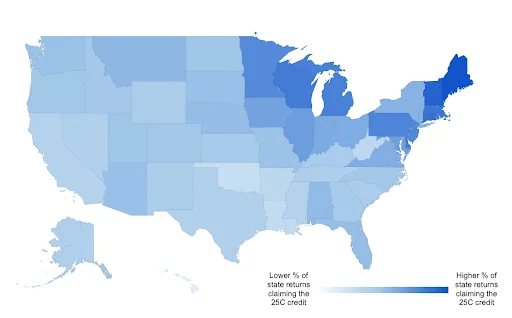
Cargando gráfico…
Percentage of state tax returns claiming Energy Efficient Home Improvement Credit — Maine led at 3.03%, Hawaii trailed at 0.50%
Uptake by state: colder states claimed more. Data from 2023 IRS SOI. 2

The official source

Everything above is based on:
Tax rules change. The OBBB was a major change. Verify your eligibility and the current status of any credit before filing. When in doubt, consult a licensed tax professional.

Añade más opiniones o contexto en torno a este contenido.

  • Inicia sesión para comentar.