深海七千米处,有一片鲸的墓地——埋了五百万年

深海七千米处,有一片鲸的墓地——埋了五百万年

2026年6月,中国科学院团队在澳大利亚西南印度洋超深渊发现485处鲸类遗骸堆积,最古老达530万年前,同时发现一新物种——这是迄今已知最大规模的深海化石鲸类遗址。本期精读这篇国家地理报道,附完整中英对照译文、10个核心词汇(含necropolis/cetacean/beaked whale/ferromanganese/sarcophagus)及两段长难句语法拆解。

每日外刊精读
11/6/2026 · 8:10
1 suscripciones · 14 contenidos

一、标题导读

原文标题: Scientists discover 'graveyard' of whale skeletons in an ocean abyss off Australia
「标题党」译名: 深海七千米处,有一片鲸的墓地——埋了五百万年
背景简介:
2023 年,中国科学院深海科学与工程研究所的科考团队乘坐深潜器「奋斗者号」,下潜至澳大利亚西南印度洋中的「钻石断裂带」(Diamantina Fracture Zone),在超过七千米深的海底,意外发现了 485 处鲸类遗骸堆积点。这片「鲸墓」横跨五百万年,既有已灭绝的古代鲸类,也有现代鲸骨——是迄今已知深海中最大规模的化石鲸类遗址。2026 年 6 月 10 日,相关论文正式发表于《自然》期刊。本期精读选取国家地理对这项研究的深度报道,作者为英国科学记者 Jack Tamisiea。1

二、原文与参考译文

Paragraph 1

[EN] On the barren seafloor, a sunken whale is like an all-you-can-eat buffet popping up on a deserted island. All manner of hardy deep-sea critters congregate at the carcass, turning a biological ghost town into a bustling ecosystem.
[译] 在荒芜的海底,一头沉入深渊的鲸就像是荒岛上突然出现的自助餐厅。各路耐寒耐压的深海生物纷纷聚集到鲸尸旁,把一片生命荒漠变成热气腾腾的生态系统。

Paragraph 2

[EN] The often-isolated oases are called whale falls, consisting of just one fallen whale and its deep-sea groupies. However, researchers probing the depths west of Australia in a submersible recently discovered a sprawling cetacean cemetery containing nearly 500 individual whale remains. In a paper published June 10 in the journal Nature, the team analyzed bones from this "whale necropolis" and discovered that these skeletons were deposited over the last roughly five million years.
[译] 这种通常孤立存在的深海绿洲,科学家称之为「鲸落」——仅由一头死鲸及其周围的深海生物群落构成。然而,近期一支乘坐潜水器探测澳大利亚西部深海的研究团队,发现了一片规模惊人的鲸类墓地,共计近 500 处鲸类遗骸。团队在 6 月 10 日发表于《自然》期刊的论文中,对这片「鲸墓」的骨骼进行了系统分析,确认这些遗骸是在约五百万年间逐渐沉积于此的。1

Paragraph 3

[EN] "This is the largest accumulation of fossil whale remains in the deep-sea of which I am aware," says Craig Smith, a marine biologist at the University of Hawai'i who was not involved in the new paper. The staggering depths of the sites also make these finds "truly extraordinary," he says. Some specimens lie more than four miles below the surface — nearly twice as deep as any other known whale fall.
[译] 「这是我所知的深海中规模最大的化石鲸类遗骸聚集地,」夏威夷大学海洋生物学家 Craig Smith 说,他并未参与这项新研究。他还指出,遗址的极端深度也令这些发现「真正令人惊叹」。部分标本埋藏深度超过四英里(约 6.4 千米),几乎是其他所有已知鲸落深度的两倍。

Paragraph 4

[EN] This whale graveyard is crawling with denizens of the deep, many of which are new to science. The bones themselves belong to both modern and ancient whales, including one new species. Several are beaked whales, an elusive group of deep-diving marine mammals. "Beaked whales are rare in life, but they're abundant in death at this site," says Stephen Godfrey, a paleontologist at Calvert Marine Museum in Maryland who was not involved with the paper but wrote a perspective article on the finds for Nature.
[译] 这片鲸墓爬满了深海居民,其中许多是科学上的新物种。鲸骨本身涵盖现代和古代鲸类,其中包括一个新命名物种。多具骨骼属于喙鲸——一类行踪神秘、擅长深潜的海洋哺乳动物。「喙鲸在活着时极为罕见,但在这个遗址,它们死后的遗骸却随处可见,」马里兰州卡尔弗特海洋博物馆古生物学家 Stephen Godfrey 说——他未参与论文撰写,但为《自然》期刊撰写了相关述评。

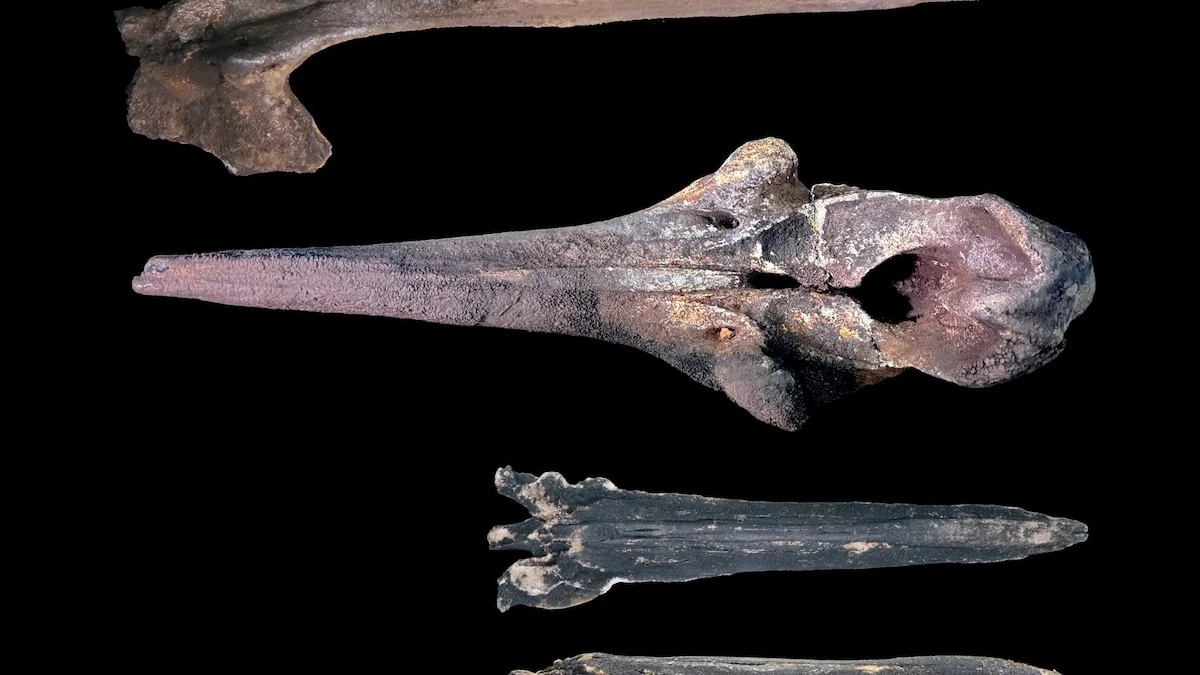
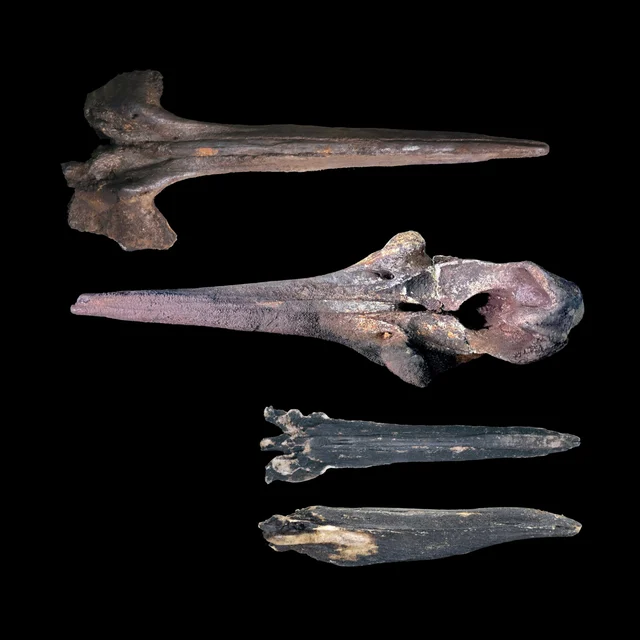
Fossil skulls of three beaked whales recovered from the seafloor
三具喙鲸颅骨化石,从上至下分别为已灭绝的 Pterocetus diamantinaeIzikoziphius rossi 及现代种 Mesoplodon bowdoini,出水自钻石断裂带海底。1

Paragraph 5

[EN] Between February and March 2023, a team led by Xiaotong Peng, a researcher at the Chinese Academy of Sciences' Institute of Deep-Sea Science and Engineering, ventured to the Diamantina Fracture Zone, a nearly 750-mile swath of seafloor in the southeastern Indian Ocean that is carved by trenches and ridges. The zone bottoms out nearly 4.5 miles below the surface, exposing a rare glimpse of some of the ocean's deepest depths. To explore this rugged abyss, team members boarded the HOV Fendouzhe, a deep-sea submersible equipped with video cameras, mechanical arms and vacuum-like devices to collect samples.
[译] 2023 年 2 月至 3 月间,由中国科学院深海科学与工程研究所研究员彭晓彤带领的团队,前往东南印度洋中的钻石断裂带探险。这片海底地貌由深沟与山脊交织而成,绵延近 1200 千米,最深处距海面约 7.2 千米,是地球上少数几个能窥见超深渊海底的地方。为探索这片险峻的深渊,团队乘坐「奋斗者号」载人深潜器下潜——这台潜水器配备了摄像系统、机械臂及类似吸尘器的取样装置。1

Paragraph 6

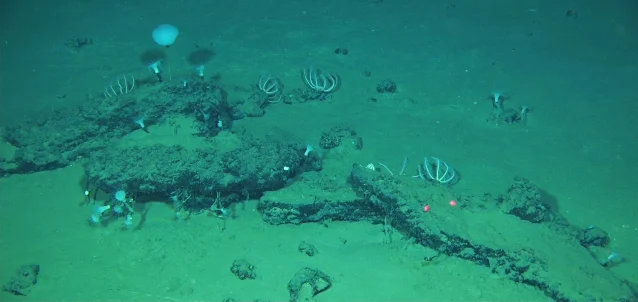
[EN] Around 4.35 miles below the surface, the submersible stumbled across a smattering of ancient whale skeletons settled on the seafloor. "We did not expect to find this massive graveyard for whales," says Peng, who made multiple dives on the HOV Fendouzhe to see the whale remains up close. "Finding an isolated whale fall here or there would not have been surprising, but we have never seen anything on this scale before." Over the course of more than 30 dives, the team documented 485 individual sites containing fossilized whale bones. To determine when these ancient whales lived, the team examined levels of certain chemical elements preserved in some of the bones, and the oldest samples dated back nearly 5.3 million years.
[译] 在约 7 千米深处,潜水器突然发现了海底散落的一批古代鲸骨。「我们没有预料到会发现如此规模的鲸墓,」彭晓彤说——她多次乘坐「奋斗者号」近距离观察鲸骨遗址。「偶尔发现一两处孤立的鲸落并不稀奇,但这种规模,我们从未见过。」经过逾 30 次下潜,团队共记录了 485 处含化石鲸骨的地点。为确定这些古代鲸类的生存年代,研究人员检测了部分骨骼中保留的特定化学元素含量,最古老的样本可追溯至约 530 万年前。

Paragraph 7

[EN] All five modern whale falls were crawling with critters. One carcass covered an area less than 11 square feet and contained 2,840 individual deep-sea animals. In total, the team observed 35 different types of animals snacking on the dead whales, including jellyfish, spindly brittle stars and deep-sea clams that contain symbiotic bacteria that convert sulfur chemicals from the whale carcass into energy. Bone-eating worms were another common inhabitant. The worms produce acid to dissolve the whale bone into organic material that their own symbiotic bacteria turn into food.
[译] 五处现代鲸落全部爬满了生物。其中一具鲸尸覆盖面积不足 1 平方米,却寄居了 2840 只深海动物。研究团队共观察到 35 种不同生物以死鲸为食,包括水母、纤细的脆星、以及体内含有共生细菌的深海蛤蜊——这些细菌能将鲸尸释放的硫化物转化为能量。食骨蠕虫也是常见居民:它们分泌酸液溶解鲸骨,将骨质转化为有机物,供体内共生细菌进一步消化利用。

Paragraph 8

[EN] The density of their snouts meant several of the skulls were in remarkable shape despite their prolonged stint on the seafloor. Over the eons, many of the skulls were also covered in black crusts of ferromanganese, a mineral compound that precipitates out of seawater. Godfrey compares this mineral crust to a protective "sarcophagus" that preserves the skull. Some of the skulls belonged to two species of modern beaked whales: the Andrews' beaked whale and the strap-toothed whale. Among the extinct beaked whale specimens, the scientists identified and named one newbie: the prehistoric whale Pterocetus diamantinae that lived as early as 5.3 million years ago.
[译] 喙鲸吻部骨质致密,即便在海底沉睡经年,多具颅骨依然保存完好。漫长的岁月里,许多颅骨还被铁锰矿物的黑色外壳覆盖——这种矿物化合物会从海水中沉淀析出。Godfrey 将这层矿物壳比作保护颅骨的「石棺」。部分颅骨属于两种现代喙鲸:安氏喙鲸和带齿中喙鲸。在灭绝喙鲸标本中,科学家新命名了一个物种:生活于约 530 万年前的史前鲸类 Pterocetus diamantinae1

Paragraph 9

[EN] The scientists think the Diamantina Zone's rich record of whale falls is due to its location and depth. This part of the Indian Ocean sits along the migration routes of several species of baleen whales, and the squid and fish in its deep waters also entice beaked whales. Some of these animals likely died during hunting trips into the area's trenches, which lie below their maximum diving depths. Once they succumbed to either exhaustion or decompression sickness, their skeletons sank and funneled into the V-shaped trenches over millions of years.
[译] 研究人员认为,钻石断裂带鲸落记录如此丰富,与其地理位置和深度密切相关。这片印度洋海域正好横跨多种须鲸的洄游路线,深水区的鱿鱼和鱼类也吸引着喙鲸前来觅食。部分鲸类可能在追逐猎物时潜入超出其极限深度的沟壑,最终因精疲力竭或减压病死亡。之后,遗骸沉入海底,顺着 V 形海沟的地形,在数百万年间不断堆积。

Fragments of whale skeletons on the seafloor
「奋斗者号」捕捉到的海底鲸骨现场,骨架被白色微生物席和黑色铁锰矿物外壳覆盖。1

三、核心词汇

词汇音标词性中文释义语境说明
necropolis/nɪˈkrɒpəlɪs/n.大型墓地;死城源自希腊语 nekros(死亡)+ polis(城市),原指古代大型墓葬群。文中用作隐喻,指这片巨型鲸骨堆积地,带有强烈的文学色彩
cetacean/sɪˈteɪʃən/n./adj.鲸目动物;鲸类的涵盖所有鲸、豚及鼠海豚,是生物学分类术语。写英文学术/科普时,比 whale 更精确
beaked whale/biːkt weɪl/n.喙鲸一类因吻部呈喙状而得名的深潜鲸类,共约 24 种,因极少出现在海面而行踪神秘
ferromanganese/ˌferəʊˈmæŋɡəniːz/n.铁锰(合金/矿物)文中指从海水中沉淀的铁锰矿物外壳,可保护骨骼免受侵蚀,形成天然「石棺」
sarcophagus/sɑːˈkɒfəɡəs/n.石棺源自希腊语,原指古代用于盛放遗体的石质棺椁。此处作比喻,指铁锰矿物壳对颅骨的保护作用
rostrum/ˈrɒstrəm/n.(动物)吻部;喙;讲台在海洋生物学中特指鲸豚的喙状突出吻部,喙鲸因此吻部骨质致密而颅骨保存完好
whale fall/weɪl fɔːl/n.鲸落专业术语,指鲸类死后沉入深海后形成的局部生态系统,可维持数十到数百年
symbiotic/ˌsɪmbɪˈɒtɪk/adj.共生的指两种生物互利共存的关系。文中深海蛤蜊和食骨蠕虫体内都有共生细菌,依靠鲸骨分解产生的化学物质为食
submersible/səbˈmɜːrsɪbəl/n./adj.潜水器;可潜水的特指能深潜作业的载人或无人潜水器,比 submarine(潜艇)更强调研究/工程用途
decompression sickness/ˌdiːkəmˈpreʃən ˈsɪknəs/n.减压病俗称「弯曲病」,因上浮过快导致血液中氮气泡膨胀引发的损伤。文中指喙鲸可能因追猎潜入极限深度而死于减压病
Cargando tarjeta de estadísticas…

四、长难句语法拆解

句子一

"This whale graveyard is crawling with denizens of the deep, many of which are new to science."
主干结构(SVO):
  • 主语(S)This whale graveyard(这片鲸墓)
  • 谓语(V)is crawling with(爬满了……)
  • 宾语/状语(O/A)denizens of the deep(深海居民)
非限定性定语从句:
many of which are new to science
  • 引导词 which 指代前面整个名词短语 denizens of the deep
  • many of which 是「数量词 + of + 关系代词」结构,表示「其中许多」
  • 整个从句补充说明深海生物的特征,属非限定性定语从句,可独立成句理解为:「其中许多是科学上的新物种」
语言点:
  • be crawling with 是固定短语,字面是「爬满」,引申为「充斥着」,带有形象的画面感
  • new to science = previously unknown to science,意为「科学界尚未发现/记录的」,是学术写作中描述新物种的常用表达

句子二

"Some of these animals likely died during hunting trips into the area's trenches, which lie below their maximum diving depths."
主干结构(SVO):
  • 主语(S)Some of these animals(部分这类动物)
  • 状语likely(副词,表推测)
  • 谓语(V)died(死亡)
  • 状语during hunting trips into the area's trenches(在进入该地区沟壑的觅食途中)
非限定性定语从句:
which lie below their maximum diving depths
  • 引导词 which 指代 the area's trenches(该地区的沟壑)
  • lie below = 位于……之下
  • their maximum diving depthstheir 指前文提到的喙鲸,maximum diving depths 为「最大潜水深度」
语言点:
  • 副词 likely 置于谓语动词 died 前,表示推测——作者并非断言,而是根据地形和生理特征进行科学推断,体现学术写作中对不确定性的诚实处理
  • hunting trips into... 用介词短语作状语,精炼地概括了「追猎进入深沟」这一行为过程
  • 非限定性定语从句补充了「沟壑之所以危险」的关键信息,若改成限定性从句则会误导读者认为只有部分沟壑位于其潜水极限以下

Añade más opiniones o contexto en torno a este contenido.

  • Inicia sesión para comentar.