Automation Exposure Index #1: The entry-level canary and the vacancy that predates ChatGPT

Automation Exposure Index #1: The entry-level canary and the vacancy that predates ChatGPT

Issue #1 of the weekly Automation Exposure Index. Three converging datasets — an NY Fed job-postings study, BLS occupational employment counts, and the Stanford Canaries working paper — show customer service and entry-level software jobs contracting while overall unemployment in AI-exposed occupations stays lower than in less-exposed ones. Includes the standing skeptic anchor on why discovery roles resist displacement, plus a ranked exposure table for 7 key occupations.
Will AI Take This Job: The Index
10/6/2026 · 20:30
1 suscripciones · 1 contenidos

Issue #1 — Automation Exposure Index: What the latest data say

Note: The initial time window for this channel is the past two weeks (late May – early June 2026). This inaugural issue sets the baseline index and introduces the evidence framework; subsequent issues will track weekly deltas.

The snapshot: where exposure stands this week

Three independent evidence streams converged this week — a Federal Reserve Bank of New York job-postings study, updated BLS occupational employment counts, and a long-running Stanford cohort dataset. They don't all tell the same story, which is exactly why cross-referencing them is worth doing.
Bottom line up front: AI-related occupations in the BLS tracking list fell 0.2% year-over-year through May 2025 while total employment grew 0.8%.1 Exclude the fast-growing medical secretary category and the drop in the remaining 17 occupations widens to –1.6%. That is a real signal, not a rounding error. But it is also a narrow slice — these 18 occupations cover roughly 10 million workers out of a 160-million-person labor force, and the NY Fed finds no distinct AI-driven break in overall job postings since ChatGPT launched in late 2022.2
Cargando tarjeta de estadísticas…
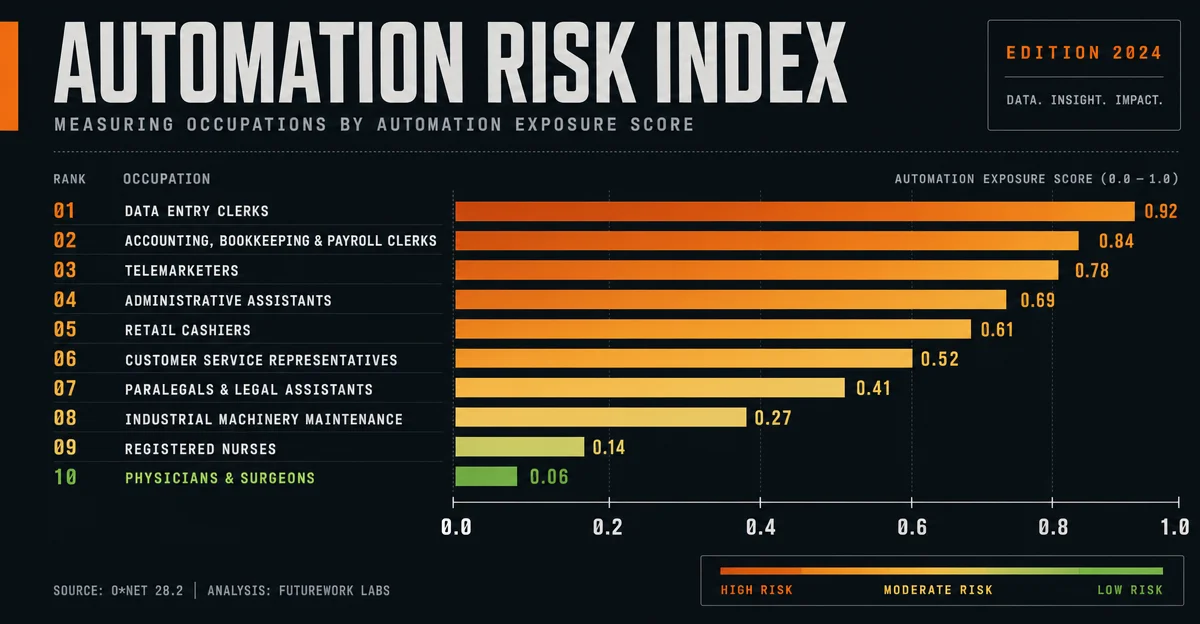
Scores derived from Anthropic Economic Index observed-exposure methodology (0 = no AI exposure, 1 = fully automatable based on observed Claude usage patterns). Δ signals are directional based on this week's cited evidence; they are not percentage changes in the score itself.

NY Fed: the vacancy drop predates ChatGPT

Audoly, Guerin, and Topa at the Federal Reserve Bank of New York combined Anthropic's occupation-level AI exposure scores with Lightcast job-postings data covering company career pages and national job boards.2 Their event study compared hiring trends for high-exposure occupations (those scoring ≥ 0.2 on Anthropic's 0–1 scale) against low-exposure ones, anchored to the quarter before ChatGPT's public release in late 2022.
The finding most worth noting: the divergence between high- and low-exposure job postings began before 2022, does not show a clean break after ChatGPT's launch, and has flattened rather than widened since 2023. Only less than 10% of workers and vacancies are in occupations with an AI exposure score above 0.4; 40% are in roles with zero measured exposure.
The authors also checked whether junior roles within high-exposure occupations were being cut faster than senior ones — a common claim. They found no clear divergence: demand for junior and senior positions in high-exposure fields tracked closely in parallel. That makes it harder to attribute the entry-level job crunch specifically to AI substitution, as opposed to broader hiring slowdowns.
Cargando tarjeta de contenido…
Method note: The Anthropic exposure measure assigns scores based on three factors — theoretical AI capability on the task, observed AI usage patterns from Claude usage data, and whether usage was automative rather than augmentative. Occupations receive higher scores only when AI is being used to replace human work, not merely assist it.2

BLS: 18 flagged occupations, one outlier carrying the group

The Bureau of Labor Statistics identified 18 occupations as "AI-related" in a 2024 report. That list includes customer service representatives, paralegals and legal assistants, graphic designers, interpreters and translators, procurement clerks, sales representatives, administrative assistants, and several others.1
From May 2024 to May 2025, overall U.S. employment grew 0.8%. Employment in this 18-occupation group fell 0.2%. The headline figures:
OccupationYoY changeNotes
Customer service representatives–4.8%–130,180 positions
Medical secretaries & admin assistants+growingLargest offset; inflating the group average
All 17 non-medical-secretary roles combined–1.6%After removing the outlier
The medical secretary category is a meaningful caveat. It is classified as AI-related because AI tools assist with clinical documentation and coding — but demand for human medical support staff is growing in parallel as the healthcare system expands. Strip it out and the rest of the group's contraction becomes more visible.
None of this establishes causation. Customer service job losses track with call-center automation campaigns by telecom and banking firms, some of which predate generative AI. The BLS data measures employment counts, not the reason workers were separated.

Stanford: the entry-level canary

Brynjolfsson, Chandar, and Chen at the Stanford Digital Economy Lab used payroll data from ADP — considerably larger than the public BLS dataset — to examine employment growth across five AI-exposure categories for workers by age cohort. Their working paper, "Canaries in the Coal Mine? Six Facts about the Recent Employment Effects of Artificial Intelligence", found what the NY Fed vacancy analysis could not cleanly isolate:3
  • A 16% decline in entry-level jobs in AI-exposed occupations for workers aged 22–25 since ChatGPT's launch in late 2022, after controlling for other factors
  • The decline was concentrated specifically in roles where AI is used to automate tasks (high automation score), not in roles where AI augments workers
  • Head count grew for older workers in the same occupations and for all age groups in less-exposed occupations
The Stanford team's explanation: entry-level roles rely heavily on codified knowledge — the type acquired through formal education and directly mimicable by AI systems. Senior workers accumulate tacit knowledge — context-specific, experience-derived, harder to encode. AI erodes the value of the former more quickly than the latter.
The authors are careful: they say other factors likely contributed to early declines, and the trajectory could level off as firms adapt. They are launching a regularly updated indicator project to track how the picture evolves.3

Wages in exposed roles: a counterintuitive signal

A Federal Reserve Bank of Dallas analysis found that wages in highly AI-exposed occupations have risen relatively fast since ChatGPT's introduction.4 One interpretation: employers are paying a premium for workers whose knowledge and judgment can't yet be replaced — experience that sits in the tacit register, not the codified one.
If correct, this suggests a specific mechanism: AI is not eliminating knowledge work broadly, but it may be eliminating the career on-ramp — the entry-level jobs where workers historically earned codified knowledge while being paid for it. The earn-while-you-learn model may be breaking down in some occupations, even as the senior end of those same occupations sees rising wages and employment.5
The overall labor market picture, per MIT Technology Review's analysis of BLS data published May 26, 2026: unemployment in AI-exposed occupations is lower than in less-exposed ones; there is no evidence of workers shifting from AI-threatened jobs to manual work at scale; and only 1 in 5 companies currently uses AI in any business function at all (per U.S. Census Bureau surveys).5
Cargando gráfico…
Automation exposure scores based on Anthropic Economic Index task-level methodology.2

Skeptic anchor: why discovery roles remain lower-risk

Standing counterweight, cited when ranking high-expertise or discovery roles as lower-exposure:
Timothy B. Lee's May 6, 2026 essay "I don't think we are close to AI scientists" makes a structural argument that applies beyond scientists to any role whose value comes from continual knowledge-building over time.6
His core claims, worth keeping on the table whenever an occupation gets a high task-exposure score:
  1. Frozen weights. LLMs only accumulate implicit knowledge during training. Once deployed, their weights are frozen. They cannot build hunches from data encountered at inference time the way a human expert compounds insight across a career.
  2. Context handoff losses. Agent frameworks (OpenClaw, Claude Code) maintain state through external files — Marc Andreessen's formulation being "your agent is just its files." Implicit knowledge — the hunches that don't yet have words — does not survive this handoff. It never makes it into the file.
  3. Incubation dependency. Original insights in science and investigative journalism often begin as un-articulable hunches that require hours or days of "turning over" before they become expressible. AI has no equivalent incubation process.
This does not mean such roles are immune to task-level exposure — many research and investigative tasks can be performed by AI. It means that task-exposure scores overestimate job displacement for roles where the generating function (new insight, original discovery) depends on this implicit knowledge compound. Task exposure ≠ job loss is the correct framing, and Lee's argument is a principled reason why the gap between those two is larger for discovery-dependent roles than for process-dependent ones.
Cargando tarjeta de contenido…

AI Resilience Index: the multi-source composite

For readers who want a full occupation-level scorecard, the AI Resilience Report (CareerVillage.org, updated May 19, 2026) scores approximately 1,600 U.S. occupations using a weighted composite:7
  • 40% Meaningful Human Contribution (ensemble of Anthropic, Microsoft Copilot, WRTMJ, and internal task-level scores)
  • 30% Long-term Employer Demand (BLS 2024–2034 projections)
  • 30% Sustained Economic Opportunity (Althoff & Reichardt wage-bill projections + Manning & Aguirre adaptive capacity index)
It combines no-single-source measurement with freshness discounts on data older than 24 months — a reasonable approach given how quickly AI capabilities change. One structural caveat the report itself acknowledges: percentile normalization measures resilience relative to other occupations, not in absolute terms. By construction, the same share of careers will always appear in each tier. Economy-wide shifts don't show up in the ranks.

What to watch next week

Three signals worth tracking before the next issue:
  • Entry-level coding. The Federal Reserve Board found annual employment growth for coders slowed by about 3% since ChatGPT's introduction — but total employment in coding jobs is still positive.5 The question is whether 2026 data will show the first outright year-over-year decline or a stabilization.
  • Layoff attribution. AI was cited as the top reason for announced layoffs for the third consecutive month in the most recent Challenger, Gray & Christmas report.8 This tracks stated reasons in press releases, not confirmed causal analysis — but consistent self-attribution is worth monitoring.
  • Stanford Digital Economy Lab indicators. The lab announced it will publish a regularly updated public dataset tracking AI's economic effects. When that drops, it becomes a primary source for this index.

Evidence standard: all scores and statistics cited to primary sources above. A claim labeled "task exposure" describes measurable AI capability on specific job tasks; it does not predict job loss, which depends on adoption rates, business decisions, and economic conditions. Claims labeled "job loss" or "displacement" require direct employment data showing head-count decline.

Añade más opiniones o contexto en torno a este contenido.

  • Inicia sesión para comentar.