The Armless Goddess: How a Farmer's Discovery Became the World's Most Famous Statue
On 8 April 1820, a Greek farmer on Milos uncovered two marble blocks that would become the most recognized sculpture in the world. This article traces the Venus de Milo (Louvre Ma 399, c. 150–125 BCE) from its discovery by Yorgos Kentrotas and French ensign Olivier Voutier, through the diplomatic scramble that brought it to Louis XVIII and the Louvre, to the pivotal 1821 decision not to restore the missing arms — a choice that accidentally created modern art's greatest enigma.
On 8 April 1820, a Greek farmer named Yorgos Kentrotas was pulling stones from an ancient wall in a field on the island of Milos when his spade struck something that was not a stone. 1 He had uncovered the upper half of a marble woman — smooth-limbed, nude to the waist, the size of a large person — lying in a rectangular niche as though someone had hidden her there deliberately. Kentrotas had no idea what he had found. He knew only that a passing French naval officer was watching from nearby and had suddenly gone very still.
That officer was Olivier Voutier, an ensign exploring the island for antiquities as a hobby. By his own account, he recognized the piece immediately as a masterpiece. "I was walking on the island, near the theater," he later wrote, "when I saw a peasant digging in his field. He had just discovered the upper part of a statue. I urged him to continue his excavation, promising him a reward. He soon uncovered the entire statue, in two main pieces, along with several other marble fragments." 2 Voutier made sketches of everything on the spot.
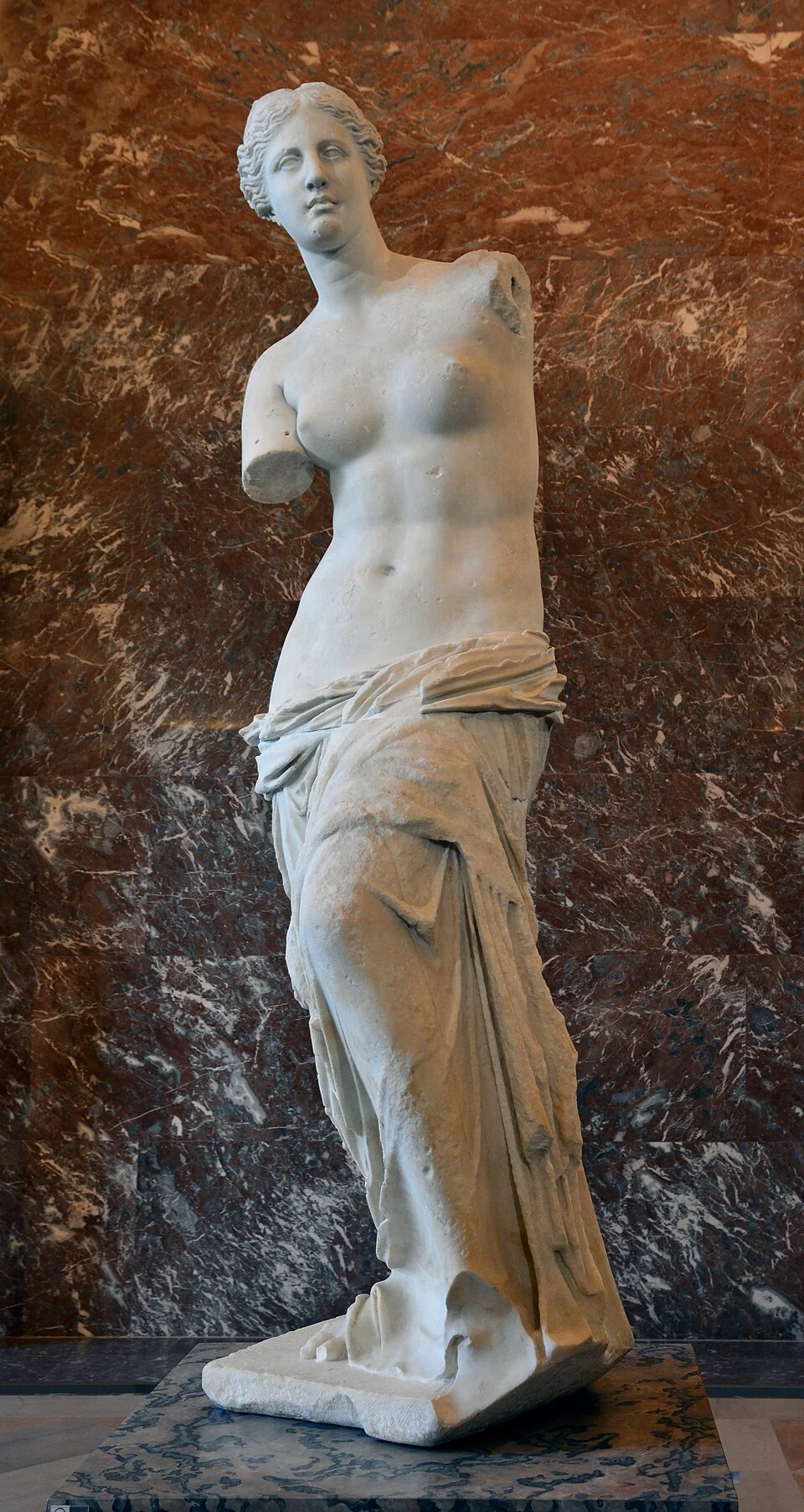
What they had found was a figure 204 centimeters tall, carved from Parian lychnites — the finest white marble available in the ancient Greek world, quarried by lamplight on the island of Paros because its translucency demanded it. 3 The torso was polished to a gloss that centuries underground had not entirely dulled. The drapery at the hips was carved in deep, tangled folds. The head turned fractionally to the left. Both arms were missing, broken off at the shoulder. So was the left foot. So were the earlobes.
Nobody was going to notice those details for a while, because within days the statue had set off a minor diplomatic crisis.
A race across the Aegean
Voutier had no money and no authority to purchase anything. Neither did Jules Dumont d'Urville, the French naval officer who arrived a few days later, recognized the statue's quality, and tried to acquire it. Dumont d'Urville sailed immediately to Constantinople to alert the French ambassador. 4
The man he reached was Comte de Marcellus, secretary to the Marquis de Rivière, France's ambassador to the Ottoman Empire. Rivière authorized the purchase and told Marcellus to get to Milos as fast as possible. When Marcellus's ship arrived on 22 May 1820, he found the statue already loaded onto another vessel — sold to an agent of the local Ottoman pasha and headed for Constantinople. 4 Marcellus intervened, threatened local officials with a breach of the prior agreement with the French vice-consul, and extracted the statue from the outbound ship. The final payment came to somewhere between 250 and 750 francs to local officials and the farmer's landowner — accounts vary — plus a total of 6,000 francs to settle all claims. 2 5
The statue left Milos on the French ship L'Estafette, then transferred to La Lionne for the voyage to France. On 1 March 1821, the Marquis de Rivière accompanied it into Paris and presented it to King Louis XVIII. 6 The king donated it to the Louvre. By May 1821 it was on public display in the Galerie des Antiques.
The timing was not incidental. France had recently been forced to return most of the artworks Napoleon had looted from across Europe, and the Louvre's great galleries stood notably emptier than they had a decade before. The British Museum had the Parthenon Marbles. The Louvre needed something. 1 The Venus de Milo, arriving from a Greek island still under Ottoman rule, with no prior owner to demand restitution, was exactly what the institution required.
What arrived, exactly
The statue is cut from two main blocks of Parian marble, joined at the hips where the seam disappears into the folds of the drapery. 3 The left arm was carved separately and attached via a mortise — the dowel hole is still visible at the left shoulder. Holes drilled into the marble confirm that bronze accessories were once attached: a diadem across the forehead, a bracelet on the right arm. A metal tenon hole just below the right breast supported a separately carved right arm.
The flesh surfaces of the torso are polished smooth. Chisel marks remain visible on the drapery and the less prominent surfaces. The rear of the statue is noticeably less finely finished than the front, which tells us the original setting: she was meant to be seen from one direction. 6 The drapery is more elaborately carved on the right side than the left, which suggests the left was originally against a wall or obscured by another figure.
She stands with her weight on the right leg, left leg slightly raised and bent, a pose that draws the hips into a gentle torsion. The head is more idealized than the body — small eyes and mouth, a strong nose and brow that belong to the classical tradition of the 5th century BCE. The torso, with its naturalistic warmth and the deeply carved, almost theatrical drapery below, belongs to a different century altogether.
Kenneth Clark, in The Nude (1949), put it precisely: "the planes of her body are so large and calm that at first we do not realise the number of angles through which they pass. In architectural terms, she is a baroque composition with classic effect." 1
That apparent contradiction — classical serenity wrapped around Hellenistic drama — is not a flaw. It was the point.
A second classicism on a small island
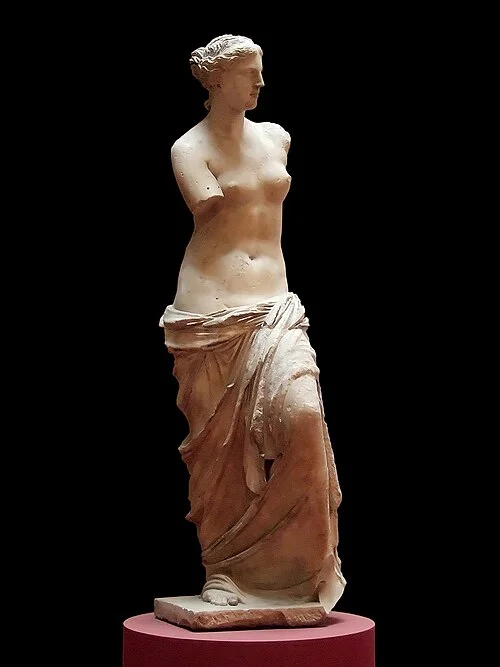
The modern scholarly consensus dates the Venus to approximately 150–125 BCE, during the late Hellenistic period — roughly 200 years after the classical age that the statue seems, at first glance, to represent. 3 The Louvre curators say "about 120 BCE." Archaeologist Christofilis Maggidis dates it 150–110 BCE; Marianne Hamiaux (curator at the Louvre) has argued for 160–140 BCE. 1
This dating arrived as a shock when Adolf Furtwängler first proposed it in 1893. 7 For most of the 19th century, the statue had been attributed to the classical period — specifically to Praxiteles or his immediate circle, a 4th-century master. The three French scholars who published assessments within a month of the Louvre acquisition (1821) disagreed with each other entirely: Toussaint-Bernard Éméric-David dated it to 420–380 BCE; Quatremère de Quincy attributed it to the mid-4th century; Comte de Clarac thought it a later copy of a Praxitelean work. 1 None of them were right. And one of them, as we will see, had a specific institutional reason to want a classical date.
Milos itself was a small, volcanic island with an outsized history. It had been an obsidian trading center since around 15,000 years ago, when the island's volcanic glass was among the most prized materials in the Aegean. 8 Its coins bore an apple (mêlon), a bilingual pun on the island's name and the fruit that was Aphrodite's attribute. By the late Hellenistic period, Milos was experiencing modest prosperity under Roman regional influence, and could afford to commission serious public sculpture. 1
A gymnasiarch inscription found alongside the statue — a dedication by one Bakchios, son of Satios, assistant gymnasiarch — points to a civic gymnasium as the original setting. 4 Rachel Kousser (City University of New York, writing in the American Journal of Archaeology in 2005) reads the gymnasium context as deliberately chosen: the sculpture "exemplifies a critical aspect of that institution's role during the Hellenistic period: the creation of a standardized and highly selective vision of the past to serve as a model for the present." 9 A goddess who looked 5th-century but was carved in the 2nd century was not an anachronism. She was an argument — about what classical Greece meant to a Hellenistic polis trying to remember itself.
The predecessor: Praxiteles' Aphrodite of Knidos
To understand what the sculptor on Milos was doing, you need to know what he was working against.
Around 350 BCE, the Athenian sculptor Praxiteles carved two statues of Aphrodite for the island of Kos — one clothed, one nude. The people of Kos chose the clothed version. The nude one was sold to the city of Knidos, on the southwest coast of what is now Turkey. 10 It was the first life-sized monumental female nude in the history of Greek sculpture. Before Praxiteles, female figures (korai) were always clothed. Male figures were not, but women were. Praxiteles changed this, and the statue became one of the most visited objects in the ancient world: Nicomedes I of Bithynia reportedly offered to pay off the entire debt of the city of Knidos in exchange for it. The Knidians refused. 10
The original was destroyed in a fire at the Palace of Lausos in Constantinople in 476 CE. It is known today through approximately 192 surviving ancient Roman copies. 10 The pose — goddess surprised at her bath, one hand lowering drapery, the other raised in a gesture that simultaneously offers and withholds — became known as the Venus Pudica (modest Venus) type, and it governed the representation of the female nude for the next five centuries.
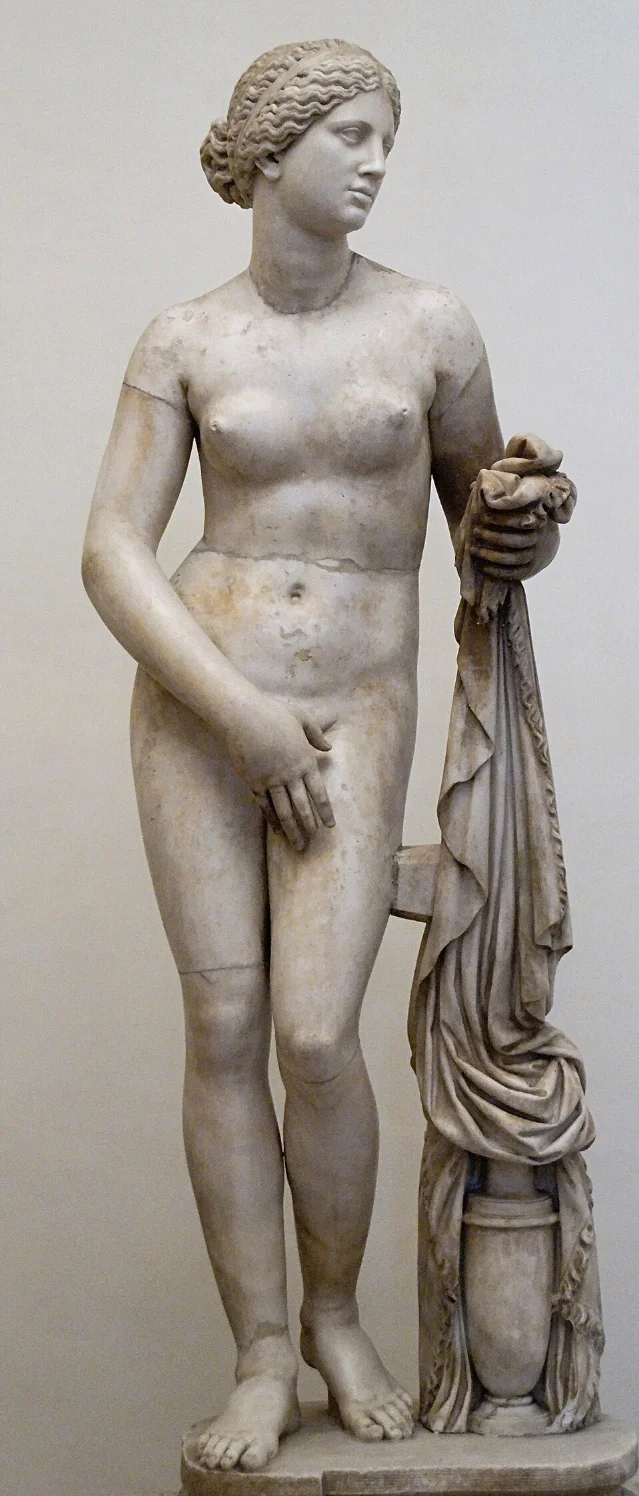
The Venus de Milo belongs to this lineage but departs from it. Where the Knidian goddess stands still, surprised, arms occupied with concealment and drapery, the figure from Milos twists. The weight shift and the turn of the hip create a spiral that Praxiteles did not use. The drapery at the waist threatens to fall without quite falling. Christine Mitchell Havelock described it as "a fresh invention" of the Hellenistic period rather than a copy of any earlier type. 1 Kousser agreed: "a conservative yet creative visual effect" offering "a well-preserved early example of the Hellenistic emulation of classical art." 9
The arms problem, or: 200 years of speculation
Within weeks of the statue's arrival in Paris, the question was already being asked: what were the arms doing?
It sounds like a simple question. It is not. The missing arms left no trace of their original position except a few mechanical clues: the dowel hole at the left shoulder, the metal tenon hole below the right breast, the angle of the stumps. From these fragments, scholars and artists have proposed no fewer than a dozen distinct reconstructions — and none has been proven. 11
The most widely accepted theory was proposed in stages. Wilhelm Fröhner (1876) suggested the right hand held drapery slipping from the hips while the left held an apple. 1 Adolf Furtwängler (1893) expanded this into a detailed reconstruction: the left arm extended away from the body holding an apple — the golden apple of the Judgment of Paris, the prize awarded to the goddess of love — while the right arm reached across the stomach toward the slipping drapery. In this reading, Aphrodite holds out the apple to show she has won. 1 7 Kousser called this reconstruction "the most plausible." 9
The apple reading acquired further force from an object that had been found alongside the statue in 1820: a marble hand holding an apple, in the same Parian marble. In 2010, scientific analysis during a major conservation project supported its identification as belonging to the Venus, and the Louvre's then-director Jean-Luc Martinez stated in his 2022 monograph that this finding "definitively proves" the Aphrodite identification. 7 6
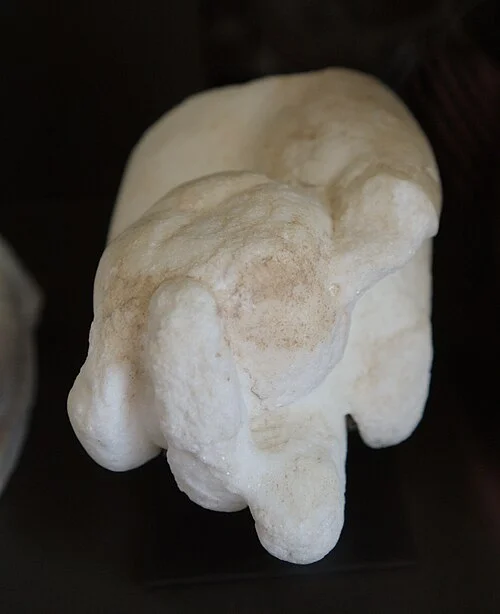
Penelope Chicago's Encyclopaedia Romana adds a pointed observation: the apple was not just Aphrodite's attribute. The island of Milos itself was named for its apple-shaped profile (mêlon = apple). Coins from Milos bore the apple image. "The prize of the apple may have reminded those who gazed upon the Venus why she had defeated her rivals Hera and Athena," the entry notes, "and what choices the young gymnasts, themselves, eventually would have to make: whether political power, military success, or love." 4
Other theories have accumulated for two centuries. Quatremère de Quincy (1821) argued the Venus was originally part of a two-figure group with Mars — the goddess of love whispering peace into the war god's ear — which neatly explained why the arms could not be restored without the missing companion. 4 Elmer Suhr (1960) proposed the left arm was raised holding a distaff for spinning, the right extending forward to turn a spindle — and connected spinning with fertility and sexuality in ancient Greek culture. 11 Elizabeth Wayland Barber (2015) seconded the spinning theory, further suggesting the statue might represent a hetaira (courtesian), since spinning was associated with ancient Greek sex workers. 11 In 2017, Louvre curator Marianne Hamiaux proposed the statue belongs to the same sculptural type as the Capuan Venus and the Aphrodite of Perge — that the figure originally held a shield and gazed at her own reflection in it, deriving from the cult statue of Aphrodite at Acrocorinth. 1
The Guardian's Jonathan Jones, writing in 2015, surveyed the field and concluded: "Who cares what her arms were doing? It is their absence that makes the Venus de Milo a modern enigma." 11 He is probably right that certainty is unattainable. The inscription that would have clarified everything was seen once, drawn by one man, and then disappeared.
The plinth that vanished, and the sculptor who may or may not exist
Among the objects uncovered at the 1820 excavation was an inscribed marble plaque that may have been part of the statue's base. The young artist Auguste Debay made a drawing of it on the spot. The inscription, as Debay recorded it, reads "[—]andros, son of [M]enides, of Antioch on the Maeander." 1
Friedrich Hiller von Gaertringen, working in 1901, restored the incomplete name as "Alexandros" and identified him with a poet of the same name from the same region — a man known from a separate inscription at Thespiae (IG VII 1761, dated to approximately 80 BCE). 1 The lettering style of the plaque, meanwhile, suggests a date of 150–50 BCE.
This was immediately inconvenient for the Louvre, which had publicly presented the statue as a classical or early Hellenistic masterpiece, comparable to Praxiteles. A late Hellenistic date placed the sculpture in what Johann Joachim Winckelmann's then-dominant theory of art history considered a period of decline. The Louvre's director, Comte de Forbin, had suppressed the plaque. As Encyclopaedia Romana bluntly documents: "So incongruous did it seem to Forbin that these two pieces should belong together (and so inconvenient the date if they did) that the inscribed portion of the base was thought to have been fitted to the statue sometime later. And, since the fragment obviously did not belong to the Venus, it need not be displayed." 4 The plinth was detached from the statue before the official presentation to Louis XVIII and has never been seen since.
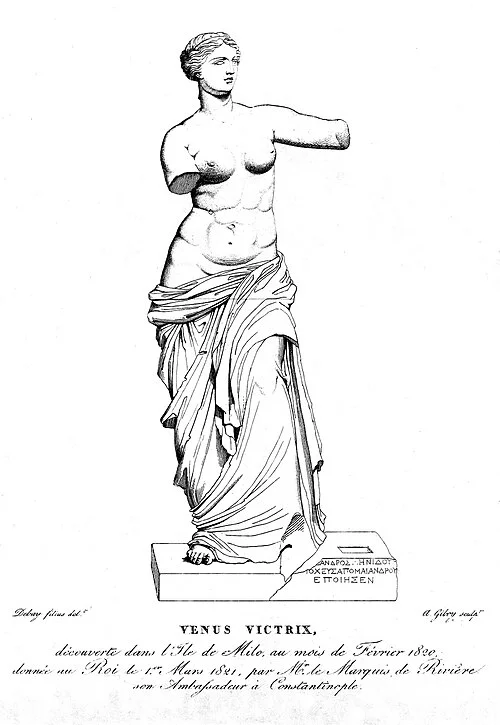
Kousser (2005) and Martinez (2022) both question whether the fragmentary plaque belonged to the Venus at all — Debay's drawing shows no evidence of the missing left foot that would have rested on the plinth, and Voutier's original sketch shows the inscribed block as the base of one of the herms found alongside, not the statue itself. 9 7
The World History Encyclopedia's Branko van Oppen takes the opposite view: "It is inconceivable that the curators at the Louvre would have added an inscribed part to the statue if they had not believed that the (perfectly fitting) fragment did belong to the plinth. Moreover, the plinth cannot have been a modern forgery as no one could have invented a name that would later prove to be historical." 7
The sculptor, if Alexandros of Antioch on the Maeander is his name, exists on paper in two documents: Debay's drawing and the Thespiae inscription. The inscription is lost. The drawing is a copy.
The god who wasn't far away
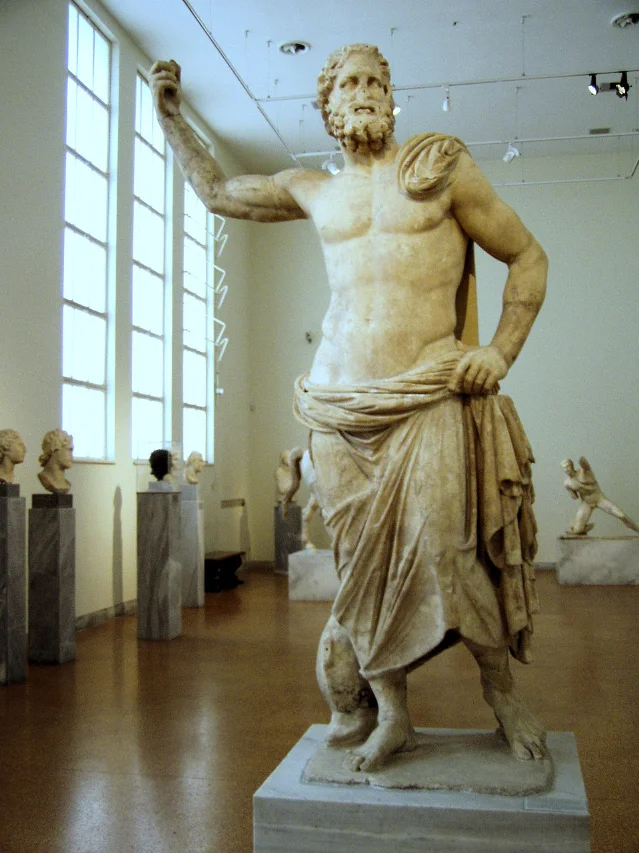
In 1877–1878, excavations on Milos uncovered a second major Hellenistic sculpture: a marble Poseidon, also in Parian marble, 2.35 meters tall, his right arm raised where a trident once rested. 12 It is now in the National Archaeological Museum in Athens (inv. 235), dated to the last quarter of the 2nd century BCE — within the same generation as the Venus.
The archaeologist Salomon Reinach used the Poseidon's proximity to propose that the "Venus" was actually Amphitrite — the sea goddess, consort of Poseidon, specifically worshipped on Milos — and that the two figures had once formed a group. 12 The island had a Sanctuary of Poseidon. The god and goddess side by side would have made specific local sense.
Maggidis dismissed the Amphitrite theory and argued the gym inscription made a civic gymnasium the more likely original setting. 1 The Louvre's official position settles on Aphrodite, not Amphitrite, pointing to the apple hand and the bronze jewelry as tipping the identification. 6 The debate continues at low heat — no new physical evidence has emerged from Milos that would resolve it.
The decision not to restore
Almost every fragmentary ancient sculpture that reached a European collection before 1850 was restored. Arms were rebuilt, noses replaced, missing torsos finished in new marble. The Apollo Belvedere has a restored left hand. The Laocoön was given a wrong right arm for three centuries. This was standard practice — the ancient sculpture was considered a draft that modern craftsmen had an obligation to complete.
The Venus de Milo was not restored.
The decision came from Quatremère de Quincy, secretary of the Académie des Beaux-Arts, who in 1821 recommended against any reconstruction. His stated reason was practical: the Venus had originally been paired with Mars, and without the Mars, no one could know what position the arms had held. Restoration was therefore impossible. 4 The Louvre accepted this argument and presented the statue as found — which was, at the time, a striking exception to normal museum practice.
What nobody fully foresaw was what the non-restoration would do to the statue's cultural life. Plaster casts were dispatched to the Berlin Academy within a year of acquisition. Replicas circulated across Europe. The arms were absent in every copy. Artists who saw the statue absorbed her armless form as the definitive image. By the time the Romantics got to her, the missing arms had ceased to be a loss. They were the point.
The usurpation
Before 1820, the most admired female nude in Europe was the Venus de' Medici — a 1st-century BCE marble copy of a Greek original, housed in the Uffizi Gallery in Florence, universally regarded as one of the half-dozen finest ancient statues in existence. Lord Byron had devoted five stanzas of Childe Harold to it. Napoleon had it shipped to Paris in 1803; the Florentines had to wait until his fall to get it back. 13
Kenneth Clark, looking back from 1949, recorded what happened next with precise economy: "Within a few years of her discovery in 1820, the Venus de Milo had taken the central, impregnable position formerly occupied by the Venus de' Medici." 1
The usurpation was not entirely spontaneous. Vox journalist Phil Edwards, writing in 2020, noted that "the French went to extreme lengths to make sure nobody questioned her legitimacy." 14 The Louvre not only suppressed the Hellenistic dating plinth but actively positioned the statue as a 4th-century classical masterpiece rivaling anything in other national collections. Parnassian poets wrote ekphrastic odes to her. Elizabeth Prettejohn (in a 2006 essay in Classics and the Uses of Reception, Blackwell) identified this 19th-century poetry as instrumental in establishing the Venus as a canonical work of Western art. 1 More than 70 poems about the sculpture have been published in total.
In 1860–65, Honoré Daumier painted The Connoisseur, in which an art collector studies a statuette of the Venus. Eugène Delacroix may have drawn on the Venus's pose for Liberty Leading the People (1830) — though this connection remains inferential. 1 A plaster cast was shown at the Crystal Palace in London. The image circulated as broadly as photography would later allow.
The 20th century, or: the Surrealists take over
The First World War broke something in European culture's relationship with beauty, wholeness, and the classical body. The Surrealists were not interested in the Venus de Milo as an idealized feminine form. They were interested in the arms.
Salvador Dalí made the most explicit statement in 1936: Venus de Milo with Drawers, a half-size painted plaster cast fitted with metal drawer-pulls protruding from the forehead, breasts, abdomen, knees, and feet — each drawer representing a layer of hidden psychic content. 7 Jonathan Jones described Dalí as seeing the armless goddess "as a ready-made surrealist object straight out of a dream." 11 René Magritte painted a plaster copy with incongruously mismatched colors in Les Menottes de Cuivre (1931). Max Ernst included her in his collage novel The Hundred Headless Woman.
Jones's summary of what the Surrealists recognized holds: "The Venus de Milo is an accidental surrealist masterpiece. Her lack of arms makes her strange and dreamlike. She is perfect but imperfect, beautiful but broken — the body as a ruin. That sense of enigmatic incompleteness has transformed an ancient work of art into a modern one." 11
Later in the century came a different kind of appropriation. In 1928, Photoplay magazine concluded, after careful measurement, that Joan Crawford was the Hollywood actress whose body most closely matched the Venus de Milo's proportions. Clara Bow and Jean Harlow were both photographed posed as the Venus for magazine spreads. The advertising industry took note: Kellogg's cornflakes, Levi's jeans, and Mercedes-Benz all used the Venus's image in campaigns. 1 Yves Klein cast her in his signature International Klein Blue.
The statue even traveled, once. In 1964, the Louvre sent it to Tokyo and Kyoto — the only time it has left France since 1821. 5 It attracted 1.7 million visitors. It sustained slight damage during sea transport. It has not traveled since.
The scholarly correction, and what it couldn't undo
Furtwängler's Hellenistic re-dating, confirmed over the 20th century, had a side effect: classicists largely stopped writing about the Venus de Milo. If it was not a 4th-century masterpiece, it was a late work — and Winckelmann's shadow still fell across Hellenistic sculpture as a period of decline. Martin Robertson, in his History of Greek Art, argued the Venus's reputation was "due more to propaganda than to its own artistic merit." 1 Prettejohn (2006) observed that classicists had developed a systematic bias toward written sources, preferring to study Roman copies of sculptures mentioned in ancient texts over Hellenistic originals, "even when those copies are generally considered to be technically inferior to the Venus." 1
Kousser's 2005 AJA article was a pointed correction. The Venus de Milo, she argued, was "carefully adapted to its contemporary setting, the minor Hellenistic polis of Melos" — a precise, intentional work by a sculptor navigating a specific civic commission, not a pale echo of classical greatness. 9 The gymnasium setting, the apple of the Judgment of Paris, the apple coins of Milos, the young gymnasts choosing between love, power, and glory — the sculpture was local and purposeful before it was universal.
What the scholarly correction could not undo was 180 years of accumulated cultural weight. The Venus de Milo is currently seen by more than 7 million visitors annually. 7 She stands alone in Salle 345, Sully Wing, Louvre, on a low platform without a vitrine, under high ceilings. No glass case, no barrier. Closer than you expect. The marble is warm-looking under gallery light. The torso is extraordinary. The stumps of the arms are exactly the right amount of wrong — present enough to remind you, absent enough to keep you wondering.
Clark's final verdict, written in 1949, still holds: the Venus had "taken the central, impregnable position formerly occupied by the Venus de' Medici, and even now that she has lost favour with connoisseurs and archaeologists she has held her place in popular imagery as a symbol, or trade mark, of Beauty." 1
She got there, in part, because a naval ensign recognized what a farmer had dug up, because a diplomat intercepted a shipment, because a director suppressed an inscription, and because someone in 1821 decided not to restore the arms. The absence was a decision. The decision became the myth.
What the arms were actually doing remains, formally, unknown.
Cover image: Venus de Milo (Aphrodite of Milos), c. 150–125 BCE, Parian marble, 204 cm, Musée du Louvre (Ma 399). Wikimedia Commons / CC BY-SA.
Fuentes de referencia
- 1Wikipedia: Venus de Milo
- 2Broaden Horizons: The Story of Venus de Milo
- 3Musée du Louvre: Vénus de Milo — collections
- 4Penelope Chicago / Encyclopaedia Romana: Venus de Milo
- 5Art Journey Paris: The story of the Venus de Milo
- 6Musée du Louvre: Ideal Greek Beauty
- 7World History Encyclopedia: Disarming Aphrodite
- 8Wikipedia: Milos
- 9AJA Online: Kousser 2005, Creating the Past
- 10Wikipedia: Aphrodite of Knidos
- 11The Guardian: Why we're still up in arms about the Venus de Milo
- 12Wikipedia: Poseidon of Melos
- 13Wikipedia: Venus de' Medici
- 14Vox: How the Venus de Milo got so famous
Añade más opiniones o contexto en torno a este contenido.