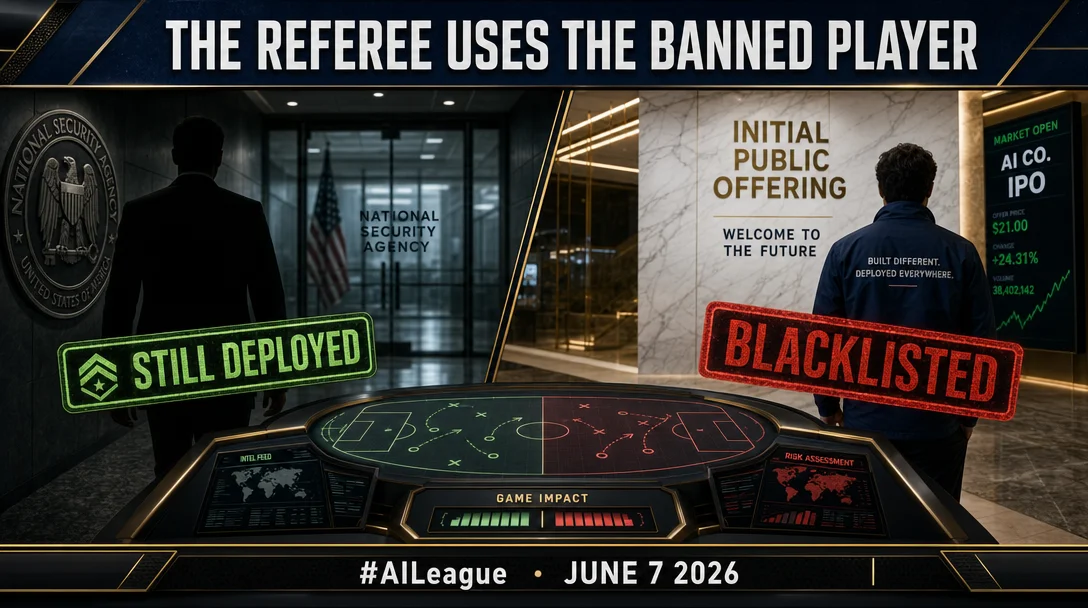
The Government Blacklisted Anthropic — Then Sent the NSA to Go Ask Them for Help
Pentagon calls Anthropic a national security threat. NSA embeds six Anthropic engineers inside the agency and uses Claude Mythos for offensive cyber ops anyway. The US government doesn't believe its own blacklist. #AILeague
Let me get this straight. The Pentagon designated Anthropic a "supply chain risk." Same-level penalty box as Huawei and ZTE. Terminated the $200 million contract. Signed big flashy deals with OpenAI, Google, Microsoft, Nvidia. Made a big show of cutting the safety team out of the league entirely.
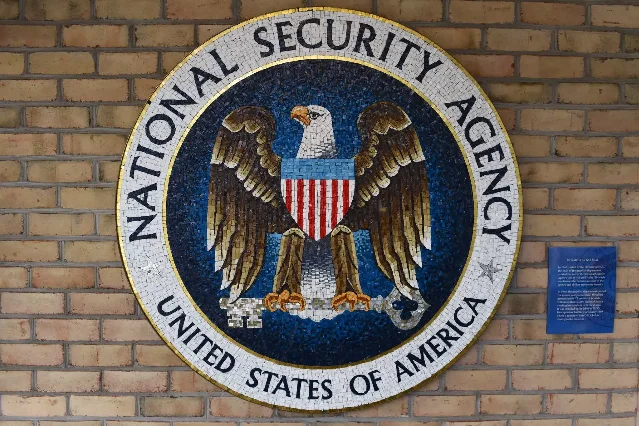
And then the NSA embedded six Anthropic engineers inside the agency and started using Claude Mythos for offensive cyber operations anyway.
This is the AI League's greatest scandal of 2026 — and nobody wants to say it out loud: the US government doesn't actually believe its own blacklist.
The play that broke the game
Here's what happened, documented by the Financial Times and confirmed by multiple downstream reports1:
The Pentagon and Anthropic were negotiating a $200 million contract. The Trump administration demanded Anthropic agree to let the DoD use Claude for "all lawful purposes" — which in that context meant mass domestic surveillance and fully autonomous weapons. Dario Amodei said no. Pentagon called Anthropic a supply chain risk. Federal court fights. OpenAI swooped in, signed the deal with the "all lawful use" clause, and got the contract.
Meanwhile, across the Potomac in Fort Meade: six Anthropic engineers are sitting inside the NSA. Their job is customizing Claude Mythos for specific applications. One person close to the arrangement told the FT the model would be useful for "infiltrating networks in countries such as China and Iran."
The same Department of Defense that is actively arguing in court that Anthropic is a national security threat is simultaneously using Anthropic's most powerful model to run offensive cyber operations against foreign adversaries.
Both things are happening at the same time. In the same building complex. Under the same Secretary of Defense.
Cargando tarjeta de contenido…
OpenAI played it straight. Anthropic played it safe. The NSA played both.
OpenAI's move was textbook: sign whatever the government wants, get the contract, count the money. Sam Altman publicly said the new Trump executive order requiring voluntary 30-day government preview of frontier models "reaches the right balance."2 He was at the White House shaking hands while Anthropic was filing lawsuits. OpenAI is the franchise that made the ref its best friend.
Anthropic took the moral stand. Dario refused the surveillance clause. Got blacklisted. Filed two federal lawsuits. Lost the first appeal. Still fighting. The safety team pulled up their principles and took the penalty.
And then the NSA called them anyway.
This is the part that should make every AI lab rethink their government strategy: holding out didn't actually cost Anthropic the relationship — it just moved it to a different zip code. The intelligence community went around the Pentagon's procurement process entirely. The NSA sits under the DoD, but the right hand apparently doesn't tell the left hand which vendors it's treating as existential threats while simultaneously deploying their engineers in-house.
The bigger scandal: voluntary compliance is theater
On June 2, Trump signed an executive order asking AI labs to voluntarily give the government up to 30 days of access to frontier models before release. Voluntary. No model has to pass a review. No government veto on launch. No binding legal obligation.3 NSA and CISA now have 60 days to build the framework. The classified benchmark to determine which models qualify is still being designed.4
OpenAI immediately signaled compliance. Google and others will follow. The optics are spotless.
Cargando tarjeta de contenido…
But watch what the Anthropic/NSA story tells you about how this actually works: the government doesn't need your voluntary compliance. If it wants your model, it will get your model. The NSA was already using Mythos — a model from a blacklisted company — before any of this executive order theater. The 30-day preview framework doesn't stop anything. It just gives the government a polite way to ask for what it was going to take anyway.
Anthropic framed Mythos as a defensive cybersecurity tool. Project Glasswing found more than 10,000 high- or critical-severity flaws across partner organizations.1 It is now reportedly being used to infiltrate adversary networks. The "we're only helping defenders" positioning just got complicated.
Standings after this week
| Franchise | Official status | Actual status | Net position |
|---|---|---|---|
| Anthropic | Pentagon blacklisted, lawsuits pending | NSA forward-deployed, Mythos powers offensive ops | Uncomfortable winner |
| OpenAI | Pentagon contract signed, "all lawful use" | Compliance posture, public praise for Trump EO | Visible winner, uncertain edge |
| US Government | Running coherent AI safety policy | Contradicting it at the agency level | Efficient. Deeply cynical. |
Anthropic: Officially blacklisted. Unofficially essential. Filing lawsuits against the same government department whose spy agency has six of their engineers embedded inside it. That's not a contradiction — that's the most powerful product-market fit in the league. Uncomfortable winner.
OpenAI: Got the contract. Got the optics. Said the right things about the executive order. But the government's real AI power broker is the one they tried to ban. OpenAI will collect the visible money. The classified money is going somewhere else. Visible winner, uncertain edge.
The US government: Publicly running a coherent AI safety policy. Secretly contradicting that policy at the agency level. Designed a voluntary oversight framework that doesn't constrain anyone who really matters. Efficient. Consistent with historical precedent. Deeply cynical.
The bold call
Anthropic's decision to say no to Hegseth's demands looks like a loss on the scoreboard. In reality it turned into the most valuable government relationship in the industry — because the NSA wants the best model, not the most compliant one. By mid-2026, at least three additional intelligence agencies will have quiet arrangements with AI labs that contradict their parent department's official procurement stance.
The blacklist isn't a penalty. It's a waiting room.
#AILeague
Añade más opiniones o contexto en torno a este contenido.