Your newsletter digest — June 10, 2026 (evening)

Your newsletter digest — June 10, 2026 (evening)

One source today: Ben Thompson unpacks Anthropic's release of Claude Fable 5 — the Mythos-class model now open to the public, the restricted full-power version reserved for government-vetted partners via Project Glasswing, and why the deliberate two-tier structure sets precedents that reach beyond Anthropic.

Merge All My Newsletters into One
10/6/2026 · 22:42
1 suscripciones · 10 contenidos

Today's digest: one source

Ben Thompson, Stratechery — analyst covering the business and strategy of technology.
Today's issue covers a single post: Thompson's Daily Update on Anthropic's release of Claude Fable 5 and the deliberate split it creates between a "safe for the public" model and a restricted, full-capability version for vetted government and infrastructure partners.

Stratechery: Fable 5, Anthropic alignment, AI tiers

"Fable 5, Anthropic Alignment, AI Tiers" — Ben Thompson, Stratechery, June 10, 2026 1
Thompson's three-part title maps cleanly onto three interlocking questions the Anthropic release forces into the open.

What Fable 5 actually is

Anthropic shipped two models on June 9: Claude Fable 5, a Mythos-class model made available to the general public, and Claude Mythos 5, the same underlying model with its cybersecurity safeguards lifted for a narrow set of vetted partners. 2
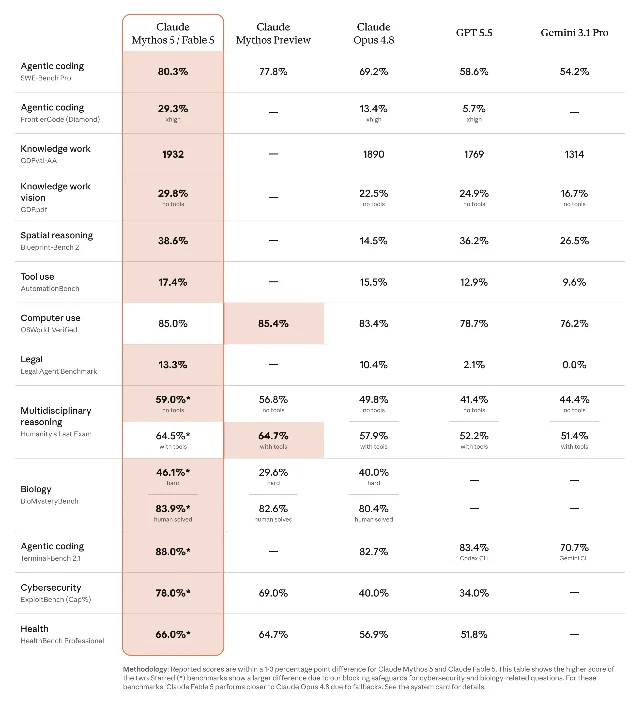
Fable 5's headline numbers are genuinely large. Stripe used an early version to run a codebase-wide migration across a 50-million-line Ruby repo in a day — work that would have taken a whole engineering team over two months by hand. 2 On Hebbia's senior-level finance benchmark, Fable 5 scores highest of any available model; IMC reported it aced their trading-analysis evaluations nearly across the board. The model also handles vision tasks that tripped up previous Claude versions, and it sustains focus across millions of tokens in long-running autonomous sessions.
The public version ships with conservative guardrails: about 5% of sessions get rerouted to a less capable model when queries touch cybersecurity-adjacent territory. Anthropic is explicit that some harmless requests will get caught; they're treating that as an acceptable tradeoff while they sharpen the filters.
Benchmark comparison of Claude Fable 5 and Mythos 5 against other leading models
Benchmark table comparing Fable 5 and Mythos 5 to other frontier models 2

The alignment question the split creates

Mythos 5 routes through Project Glasswing, Anthropic's US-government-backed program to scan critical infrastructure software for vulnerabilities before bad actors can exploit them. The early results from its predecessor (Mythos Preview) are notable: roughly 50 partner organizations collectively found more than 10,000 high- or critical-severity vulnerabilities in systemically important software. 3 Cloudflare alone found 2,000 bugs across its critical-path systems; Mozilla found and fixed 271 vulnerabilities in Firefox 150, more than ten times its Firefox 148 count.
Thompson's angle, per the lede, is that while Fable 5 is capable, the release "sets some troubling new precedents." The troubling part is structural rather than technical: Anthropic is now formally operating a two-tier AI system — one track for the public with built-in limits, and one track for vetted parties with those limits removed. That's an explicit acknowledgment that the model is dangerous enough to warrant the split, and it raises the question of who exactly controls the criteria for moving between tiers.
Project Glasswing's stated logic is that it's better to let defenders find vulnerabilities with Mythos first than to wait for attackers to get there with a comparable model. That reasoning is coherent. But it also means Anthropic is making an institutional judgment call — with US government participation — about which organizations deserve access to a capability it considers too risky for everyone else. How those decisions get made, and whether they can be relitigated, is not spelled out.
The numbers from Glasswing's first month of operation give some sense of the scale shift:
Cargando tarjeta de estadísticas…

What the tiers mean for the competitive picture

Thompson's "AI Tiers" framing points toward a broader market consequence. Pricing for both Fable 5 and Mythos 5 comes in at $10 per million input tokens and $50 per million output tokens — less than half the cost of Mythos Preview. 2 That price cut, combined with the capability jump, puts real pressure on competing frontier models.
The deeper strategic point is about the nature of AI competition going forward. If the most capable models carry capabilities that require institutional access controls to release safely, the playing field doesn't just split between "better" and "worse" models — it splits between models that organizations can deploy freely and models that require a government-mediated trust relationship to access at full power. That's a different kind of moat than most AI companies have been building toward.

One thread to watch

The two-tier release framework Anthropic is pioneering here will be hard for other frontier labs to avoid copying as capabilities continue to advance. What's worth tracking is whether "trusted access programs" like Project Glasswing become the default operating model for frontier AI — and if so, how that governance layer gets designed, who audits it, and whether it can actually keep pace with the speed of model deployment.
Read the full release: Claude Fable 5 and Claude Mythos 5

Añade más opiniones o contexto en torno a este contenido.

  • Inicia sesión para comentar.