NotebookLM's growth playbook: zero marketing, 80,000 organizations, and a one-feature viral moment
How NotebookLM grew from a quiet Google Labs experiment to 80,000+ organizations in two years — using Audio Overviews as a zero-cost viral acquisition trigger, notebook-level data gravity as the retention layer, and Google One/Workspace billing rails to avoid building a procurement motion from scratch.

Google didn't plan to build a breakout consumer product when it launched Project Tailwind at I/O 2023. The experiment from Google Labs was modest in scope — an AI notebook that could answer questions about your uploaded documents. Two years later, a single feature caused monthly traffic to jump 371% in one month, Spotify shipped a partnership to 600 million users based on NotebookLM's API, and 80,000 organizations were using the product before Google had finished pricing the enterprise tier. No paid marketing. No sales team. Just a free tool that people started sending to each other.
The growth story hinges on three structural choices that most AI product builders miss: a viral surface that does the acquisition work at zero cost, a data architecture that makes every user more locked in over time, and a monetization path that doesn't require NotebookLM to win procurement battles — because it rides Google's existing billing rails instead.
Acquisition: the Audio Overviews trigger
NotebookLM's first 14 months were quiet. The product launched publicly in the US in December 2023 and expanded to 200+ countries in June 2024, but it was primarily reaching researchers and students who actively sought out AI research tools. That changed on September 11, 2024. 1
Audio Overviews converts whatever documents a user uploads into a podcast-like conversation between two AI hosts. The feature was technically unremarkable relative to what language models could already do. What made it work as a distribution channel was sharability. People started posting clips of their notebooks turned into podcasts — their dissertations, their diaries, their legal briefs — and the format produced a consistent reaction: "I need to try this with my stuff."
The traffic data is the clearest proof. NotebookLM had 652,000 monthly visits in August 2024. One month after Audio Overviews launched, that figure reached 3.07 million — a 371% increase in 30 days, per SimilarWeb data cited by TechCrunch. 2 By January 2025, monthly visits reached approximately 9 million, and SimilarWeb measured 28.18 million total visits in the three-month window ending February 2025. 3
Cargando gráfico…
The Spotify Wrapped partnership in December 2024 showed the brand-awareness ceiling for a viral tool with no marketing budget. Spotify integrated NotebookLM's Audio Overview technology directly into its annual personalized Wrapped experience, reaching tens of millions of listeners with a first-person AI podcast about their own listening history. 5 Spotify built the integration; Google got the distribution.
By October 2024 — before Google had even launched a paid tier — more than 80,000 organizations were using NotebookLM. 2 That baseline of organizational users gave Google a commercial beachhead built entirely through product-led growth before the first sales call.
The acquisition pattern here is unusually clean: one free, shareable surface drove the initial spike, word-of-mouth inside organizations did the enterprise seeding, and a high-profile third-party integration amplified brand reach. No outbound. No paid search. No demo request funnel.
Retention: the notebook as knowledge gravity
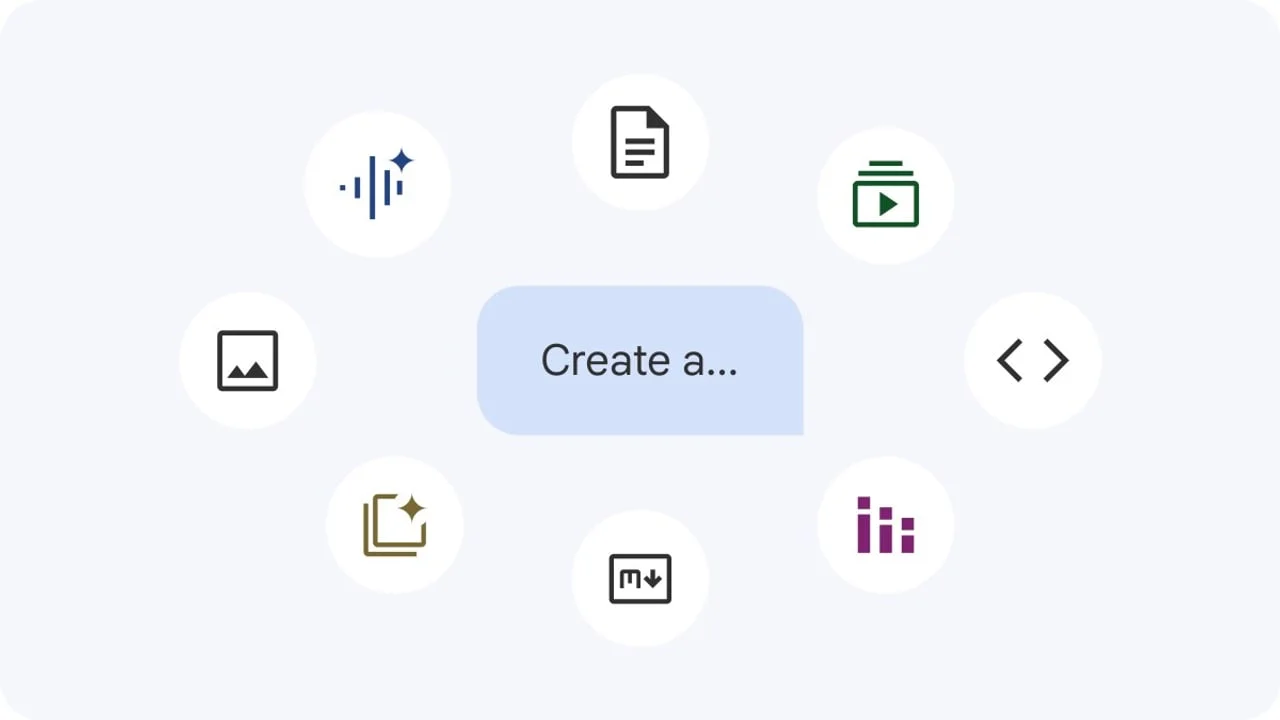
The product's retention architecture becomes visible once you understand what a "notebook" actually is. It is not a saved conversation or a document. It is a bounded knowledge base: uploaded sources live inside it (PDFs, Google Docs and Slides and Sheets, YouTube video transcripts, websites, audio files, Word documents), chat history is stored against those sources, and every output — summaries, Audio Overviews, study guides, timelines, infographics — is generated from and tied to that notebook.
Switching costs accumulate passively. The longer a user works within a notebook, the more irreplaceable it becomes — not because the AI is doing anything proprietary, but because the notebook contains the user's own documents, their questions, and the outputs shaped by those questions. Moving to a competitor means rebuilding that context from scratch.
Google reinforced this architecture with two upgrades that compound switching costs over time:
October 2025 brought an 8x expansion of the context window and a 6x increase in multi-turn conversation memory, meaning notebooks now carry a richer, longer history of user interactions. 6 A user who has been running research through a notebook for months has a conversation thread Google describes as the product equivalent of a persistent co-researcher.
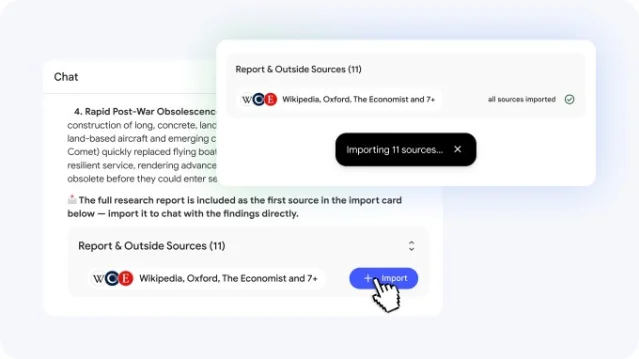
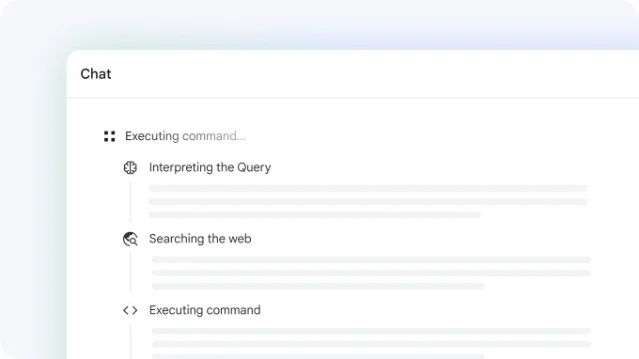
November 2025 added Deep Research, an autonomous web-research agent that browses the web on the user's behalf and adds vetted sources directly to a notebook. 7 The effect is that the notebook now grows semi-autonomously — the user doesn't have to manually gather sources, so the friction of keeping a notebook current drops to near-zero.
The output surface expansion matters for retention, too. In the roughly 18 months from Audio Overviews to mid-2026, Google added: Video Overviews (July 2025), Infographics and Slide Deck output powered by Nano Banana Pro (November 2025), Data Tables (December 2025), and in June 2026, the ability to generate PDFs, Excel files, PowerPoint presentations, and SVG charts directly inside a notebook. 8 Each new output format creates an additional reason for a different type of user — a consultant, a student, a data analyst — to stay inside the product rather than exporting raw material to another tool.
The June 2026 Gemini 3.5 upgrade quantified the product's own performance improvements in an unusual way. Google ran side-by-side evaluations against the prior system and disclosed the win rates: 65% overall, 69.9% on large-document analysis, and 78.2% on web research. 8 Publishing internal benchmarks is a retention signal, not just a product announcement — it tells users who already have notebooks that the tool they have invested in is getting materially better.
There is one structural retention advantage that has nothing to do with features: the product does not train on user data. NotebookLM's PM Raiza Martin confirmed this to TechCrunch in October 2024, saying explicitly: "Your use of it, or whatever queries you enter, whatever answers you enter, we don't train the models with it." 2 For enterprise users who would otherwise face procurement objections around data exposure, that commitment removes a meaningful objection.
Monetization: riding Google's billing rails
NotebookLM has no standalone pricing page in the traditional sense. It monetizes through three access tiers that all attach to existing Google billing relationships, which means Google never had to build a separate subscription business or negotiate separate procurement contracts.
| Tier | Price | Key limits |
|---|---|---|
| Free | $0 | 100 notebooks, 50 sources/notebook, 3 Audio Overviews/day |
| NotebookLM Plus (Google One AI Premium) | $19.99/month | 500 notebooks, 300 sources/notebook, 500 chat queries/day, 20 Audio Overviews/day; also includes Gemini Advanced + 2TB storage |
| Enterprise (Google Cloud standalone) | $9/user/month | 5x limits vs. free, VPC-SC, IAM controls, shared notebooks, usage analytics |
Students in the US (18+) get Google One AI Premium at $9.99/month. 3
The Google One AI Premium bundle is the most important pricing decision in the stack. A $19.99/month plan that also includes Gemini Advanced, integration with Gmail and Docs, and 2TB of cloud storage means NotebookLM Plus isn't sold on its own value proposition — it is included in a plan most heavy Google users were already considering buying for other reasons. The upgrade conversation starts at "do you want 2TB and Gemini in Gmail?" and NotebookLM Plus is part of what arrives.
The February 2025 Workspace inclusion was the enterprise equivalent. Google added NotebookLM Plus as a core service in Workspace Business Standard and above — which means tens of millions of corporate users got access to the paid tier through their organization's existing Workspace contract, with no separate line item approval required. 9
The $9/user/month enterprise tier (sold via Google Cloud) targets organizations that want the compliance infrastructure — VPC-SC, IAM controls — rather than just higher limits. 10 The June 2026 agentic upgrades (Gemini 3.5 + cloud computer + Deep Research) are explicitly being gated to "Google AI Ultra" and "Workspace AI Ultra Access / AI Expanded Access" subscribers, which is consistent with a pattern of using each generation of capability to define a new billing tier. 8
Google has not disclosed NotebookLM-specific revenue, and no public ARR figure exists. The product's commercial value to Google is harder to read than a standalone SaaS company's, because upgrades to NotebookLM likely convert users to Google One AI Premium subscriptions that carry value across Gemini Advanced, Google Drive, and other services. The revenue from a NotebookLM upgrade is also Gemini Advanced revenue.
Takeaways
One viral surface beats a launch strategy. Audio Overviews drove a 371% traffic spike in one month without a product launch event, press push, or paid distribution. The feature worked because it produced shareable outputs people wanted to send to others. The lesson isn't "build podcast features" — it's that one output format with strong sharing mechanics can do more acquisition work than a full go-to-market motion.
Build toward data gravity, not feature lock-in. NotebookLM's retention isn't enforced through format restrictions or deliberate lock-in mechanics. It happens because the notebook architecture accumulates the user's own knowledge — documents, queries, outputs — in one place. Every session the user runs makes their notebook harder to replicate elsewhere. The product gets stickier as a side effect of being useful, rather than through artificial friction.
Monetize through existing billing relationships when possible. Most SaaS products have to build a pricing page, a trial flow, a billing system, a churn model, and a procurement conversation. NotebookLM inherited all of that from Google One and Google Workspace. The upgrade path is "check a box in your existing Google account." For builders inside large ecosystems — or for products that can partner with platforms that already have billing infrastructure — this reduces the cost of monetization to near-zero.
Give away the activation feature. The free tier includes Audio Overviews (3 per day). The shareable feature that drove the viral moment is available to users who never pay. This is deliberate: the feature that does acquisition work should be on the free tier, because its job is to create new users, not to extract revenue from existing ones. Revenue comes later, when users have enough notebooks and queries to justify the upgrade.
Fuentes de referencia
- 1Google Blog: NotebookLM Audio Overviews launch
- 2TechCrunch: NotebookLM business pilot launch, Oct 2024
- 3TechCrunch: Google expands NotebookLM Plus to individual users
- 4TechCrunch: NotebookLM's new update, June 2026
- 5Google Blog: NotebookLM and Spotify Wrapped
- 6Google Blog: NotebookLM custom goals and engine upgrade
- 7TechCrunch: NotebookLM adds Deep Research
- 8Google Blog: Do better research with NotebookLM
- 9Google Workspace Updates blog
- 10Google Cloud: NotebookLM for enterprise
Añade más opiniones o contexto en torno a este contenido.