The Wound in the Marble: How the Parthenon's Sculptures Were Split Between Athens and London — and Why They May Never Be Reunited
In 1801, the British Ambassador to the Ottoman Empire hired a Neapolitan painter named Lusieri to saw and haul half the Parthenon's sculptures off the Acropolis. The document authorising the removal has never been found in any archive. The stones have been in London since 1816, scraped by over-zealous cleaners in the 1930s, stored in the Underground during the Blitz, and displayed under a 1960s gallery roof while Greece has demanded them back for 40 years. At UNESCO in May 2026, 20 countries formally backed Greece. Britain still says no.
In the summer of 1801, a young Neapolitan painter named Giovanni Battista Lusieri climbed the scaffolding he had erected against the south colonnade of the Parthenon and directed his workmen to cut. The frieze block they were after — a section of the great continuous procession carved above the inner cella wall — had been part of the temple for 2,230 years. 1 Lusieri was employed at £200 per year by Thomas Bruce, 7th Earl of Elgin, British Ambassador to the Ottoman Empire. He worked through the summer and into the autumn, through 1802 and 1803 and beyond, sawing and hauling. By 1812, when the last of 80 cases of antiquities arrived in England, his employer had spent £74,240 on the enterprise — roughly £6 million in today's money — and had removed roughly half of the surviving Parthenon sculptures. 1
They have been in London ever since. The question of whether they should stay there has never been more contested than it is right now.
What Phidias made
The Parthenon rose above Athens between 447 and 432 BCE, commissioned by the statesman Pericles as a temple to Athena Parthenos — "Athena the Virgin" — on the crest of the Acropolis. 2 Architects Iktinos and Callicrates designed the building in Doric order: eight columns across each short façade, seventeen along each long side, in a rectangle roughly 70 meters by 31 meters. The blocks came from Mount Pentelicus, about 19 kilometers northeast of Athens — approximately 22,000 tons of the fine-grained white stone that develops, over centuries of oxidation, a warm honey patina. 2
Overseeing the sculptural programme was Phidias, son of Charmides, whom Plutarch called "the man who directed all the projects and was overseer for [Pericles] — almost everything was under his supervision." 3 Phidias was also designing the colossal chryselephantine statue of Athena Parthenos inside the cella — gold and ivory over a wooden core, about 12 meters tall — and had already built the bronze Athena Promachos, the warrior goddess whose spear tip was visible from ships rounding Cape Sounion. He would go on to sculpt the Statue of Zeus at Olympia, one of the Seven Wonders. 3 The Parthenon's exterior sculptures were almost certainly executed by multiple hands working under his direction; the quality differences between individual metopes suggest different sculptors, but the conceptual unity is unmistakable.
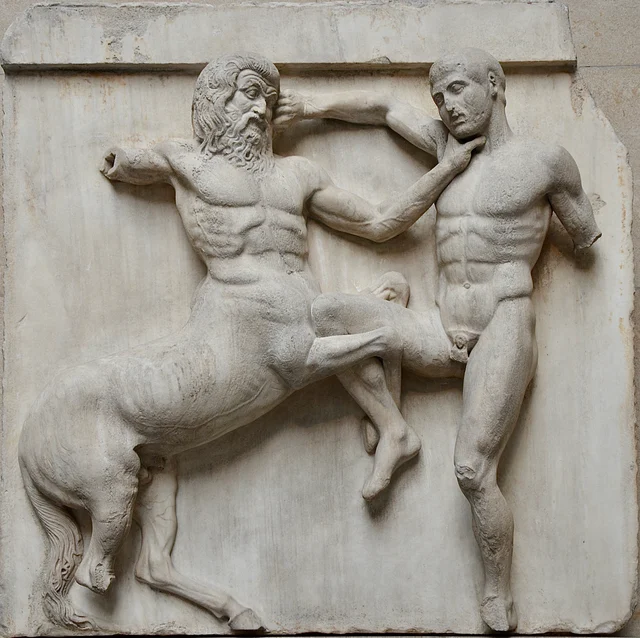
The programme comprised three elements. The 92 metopes — square panels in high relief, arranged in the spaces between the beam-ends above the outer colonnade — depicted cosmic battles on each of the temple's four sides: gods against giants to the east, Greeks against Trojans to the north, Greeks against Amazons to the west, and Lapiths against Centaurs to the south. 4 The general theme was order against chaos, civilisation against barbarism — a metaphor the Athenians read as commentary on the Persian Wars that their grandparents had fought. The pediments — the great triangular gables at each end of the building — held monumental figures carved fully in the round, the largest such pedimental sculptures in classical Greece. The east pediment showed the birth of Athena from the head of Zeus; the west showed the contest between Athena and Poseidon for patronage of Athens. 5 The carvers gave the same care to the backs of these statues — faces that would never be visible from the ground, 16 meters below — as to their fronts. The frieze was the strangest element of all: a continuous band of carved narrative, 160 meters long and 1 meter high, running along the top of the outer wall of the inner chamber, high above the colonnade in dim shadow. It depicted the Panathenaic procession — the great festival held every four years in honour of Athena — with riders, chariots, elders, musicians, sacrificial cattle, and at the centre, the twelve Olympian gods seated and watching, rendered one-third larger than the human figures around them. 6
None of this was white. The metope backgrounds were red; the frieze backgrounds were blue; figures had painted eyes, hair, and lips; bronze was attached through drill-holes for weapons, harnesses, and gilded wreaths. Colour traces survive, and Visible-Induced Luminescence studies completed in 2023 have revealed them more fully than previously known. 7 The sculptures we see in the British Museum today — honey-patinated marble, stark in the white artificial light of the Duveen Gallery — look nothing like what fifth-century Athenians saw.
The centuries that damaged them first
The Parthenon was already badly compromised before Elgin arrived. In the sixth century CE, Christian authorities converted the temple into a church, and in doing so hacked out most of the metopes on three sides — destroying the carved images of pagan deities. 1 The south metopes, showing the Centauromachy, survived largely intact because their figures could be read as morally useful combat. By the fifteenth century the Ottomans had converted the church into a mosque and built a minaret in the southwest corner of the cella. The temple survived these transformations without catastrophic structural damage.
Then came September 26, 1687.
A Venetian fleet under Admiral Francesco Morosini had besieged the Ottoman garrison on the Acropolis for two weeks. The Ottomans had stored their powder magazine inside the Parthenon — which meant, presumably, that they expected Morosini to hesitate. He did not. At around 7 p.m., a Venetian mortar bomb penetrated the roof and detonated approximately 700 barrels of gunpowder. 8 The explosion blew out the central chamber of the building, killed some 300 people, and sent about three-fifths of the surviving frieze slabs crashing to the ground. Morosini then tried to remove the sculptures from the west pediment as trophies; his tackle failed, and Poseidon and two horses of Athena's chariot team shattered on the rock of the Acropolis below. 8
Over the following century the Parthenon sat as a half-roofed shell, gradually losing whatever survived the explosion. Travellers reported sculptures being burned for lime, fragments sold to tourists as souvenirs. Edward Daniel Clarke, an English antiquarian who visited in 1801, watched Lusieri's workmen in action and called what he saw a "spoliation." He wrote that the temple had "sustained a greater injury than it had already experienced from the Venetian artillery." 1
The ambassador and the document
Thomas Bruce, 7th Earl of Elgin, was 32 years old when he was appointed British Ambassador to the Sublime Porte in November 1798, and 33 when he arrived in Constantinople. 9 His original intention was documentary: he wanted to commission drawings and plaster casts of the Parthenon sculptures, to provide British artists with accurate models of Classical Greek work. The British government declined to fund this, so Elgin financed it himself, hiring Lusieri and a team of artists and moulders at a total annual cost that would rapidly escalate beyond anything he had planned. 1
At some point in mid-1801, Elgin's chaplain Philip Hunt obtained a document from Ottoman authorities in Athens. In Western diplomatic circles it was called a firman — an Ottoman imperial decree — and Elgin claimed it authorised his agents not only to draw and cast the sculptures, but to "take away any pieces of stone with old inscriptions, and figures." 1 Whether those words authorised the removal of sculptures still attached to a standing building has been disputed ever since. The legal scholar David Rudenstine argued that the document, read carefully, covered only material found during excavations — not attached architectural members. 1 Mary Beard put the uncertainty most plainly: "No amount of poring over the text can provide the answer. As often with documents sent out from head office, the precise interpretation would rest with men carrying out the orders on the spot." 1
The document itself has never been found in Turkish archives. The original was last seen in Athens in 1810 and is presumed destroyed during the Greek War of Independence in the 1820s. 1 The British Museum holds an Italian-language translation. In May 2024, at the UNESCO Intergovernmental Committee for Promoting the Return of Cultural Property (ICPRCP) session in Paris, a senior Turkish cultural ministry official, Zeynep Boz, made a statement that upended 200 years of Ottoman ambiguity: "We are not aware of any document legitimising this purchase." She added: "I don't think there's room to discuss its legality, even during the time and under the law of the time." 10 Turkey — as the successor state to the Ottoman Empire — had never before taken so explicit a position in an international forum.
The removal itself took eleven years. Lusieri's teams sawed frieze blocks from the wall, detached metopes from the colonnade, and pried pedimental figures from their beddings. One shipment — carried by the brig Mentor — sank in a storm off Cape Matapan near the island of Kythera in 1804. Salvage took two years; Elgin paid for it personally. 1 He was also detained in France as a prisoner of war from 1803 to 1806 after Napoleon resumed hostilities with Britain, and spent those years watching his marriage collapse and his nasal cartilage eaten away by a disfiguring disease — punishment, his critics said, poetic in its specificity.
Eighteen sixteen
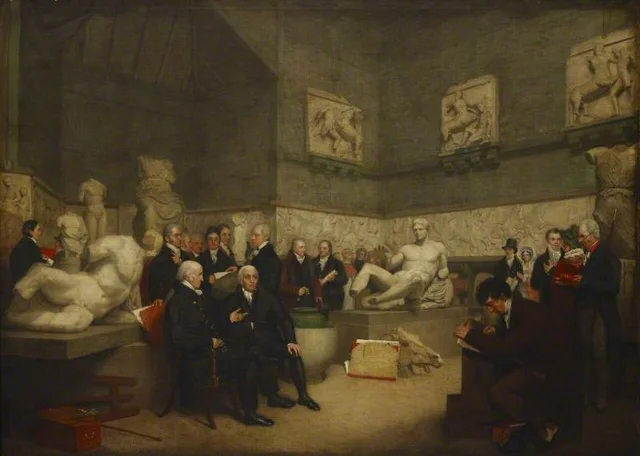
Back in Britain, Elgin set up a private museum in his London house on Park Lane and invited artists to study the sculptures. What followed was a culture war conducted in rhyming couplets.
The painter Benjamin Haydon saw the marbles in 1808 and wrote in his diary of a sustained rapture: "I felt as if a divine truth had blazed inwardly upon my mind." 1 He dragged his friend John Keats to see them in 1817; Keats wrote the sonnet "On Seeing the Elgin Marbles," recording his sense of mortal smallness before something vast and inhuman. Benjamin West, president of the Royal Academy, called them "sublime specimens of the purest sculpture." 1 Goethe believed the British government's purchase would herald "a new age of great art." 1
The most famous dissenter was Lord Byron, who had visited Athens in 1809 and watched what he described as desecration in progress. In Childe Harold's Pilgrimage (1812) he wrote:
"Dull is the eye that will not weep to see / Thy walls defaced, thy mouldering shrines removed / By British hands, which it had best behoved / To guard those relics ne'er to be restored."— Childe Harold's Pilgrimage, Canto II (1812) 1
Byron was not alone, but he was the loudest. When the question came before Parliament in 1816, however, the committee tasked with investigating it found differently. A House of Commons Select Committee heard testimony from Elgin himself and from a roster of expert witnesses; it cleared him of all allegations of illegal acquisition or misuse of his ambassadorial powers. 1 The committee recommended purchase for £35,000 — roughly half of Elgin's total costs of £74,240. Parliament approved the purchase by 82 votes to 30 in June 1816. On August 8, 1816, the marbles were formally transferred to the British Museum, to be kept together and designated "the Elgin Marbles." 1
They went on public display in a temporary room the following year, 1817, and attendance records were broken. 1 In 1832, they moved to the purpose-built Elgin Saloon, designed by the architect Robert Smirke, where plaster casts were made and distributed to museums and academies across Europe. The sculptures became the foundation of nineteenth-century academic art training.
What the British Museum holds
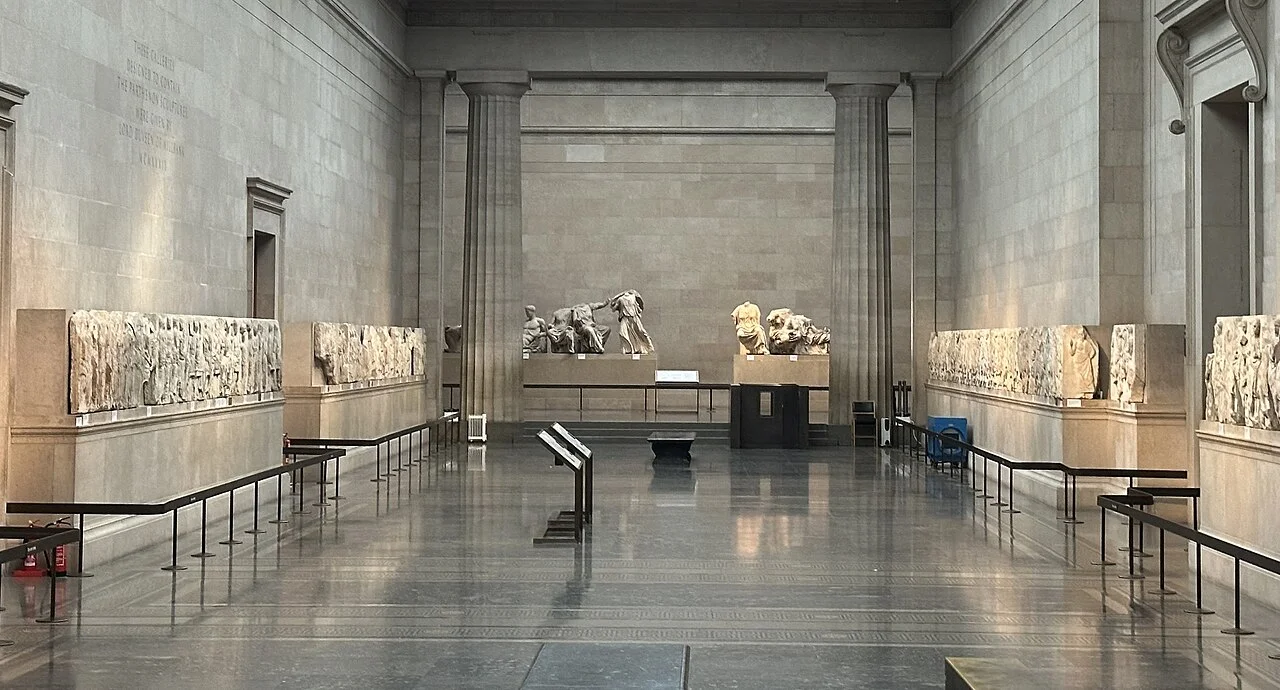
The British Museum's collection from the Parthenon — formally designated Room 18, the Duveen Gallery — contains: approximately 21 figures from the east and west pediments (out of an original total of around 50); 15 of the original 92 metope panels, all from the south colonnade; and 75 metres of the Parthenon Frieze, representing roughly half of the 128 metres that survive. 11 Beyond the Parthenon itself, the collection includes one caryatid from the Erechtheion (part of the famous "Porch of the Maidens"), four slabs from the parapet frieze of the Temple of Athena Nike, architectural fragments from the Propylaia, and a column from the Treasury of Atreus at Mycenae. 1
The split with Athens is not simply geographic. The Acropolis Museum, which opened in 2009 on a site at the foot of the hill specifically designed to accommodate a potential reunification, holds 40 frieze blocks, fragments of the pediments, and 14 metopes. Smaller fragments are in the Louvre, the Vatican, Copenhagen, Vienna, Würzburg, and Munich. 1 The frieze — that singular 160-metre narrative of a city celebrating its goddess — is distributed across at least eight institutions on two continents. Scholars who want to study it whole must do so via photographs.
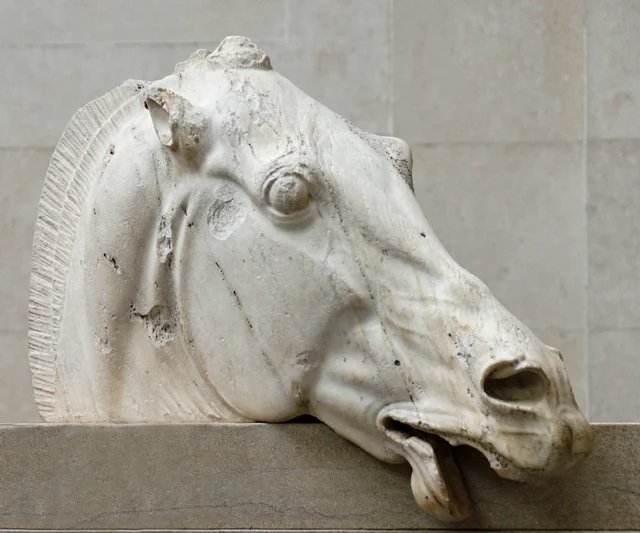
What is in London is extraordinary. The pediment figures include the reclining Dionysus from the east pediment — the best-preserved of all the pedimental statues, showing the god as young and athletic, stretched across a panther skin, muscled with an ease that the later "pathetic" school of sculpture would never quite recapture. 5 The head of one of Selene's horses, from the opposite corner of the same pediment — the moon-goddess's team exhausted at the end of the night, muzzle distended, muscles flat beneath the skin — is probably the most reproduced single piece in the collection, and justly. The frieze blocks show a range that continues to astonish specialists: the restrained geometry of the seated gods, the loose naturalism of the Athenian cavalcade (cavalry fill 46 percent of the surviving composition), the sense of actual wind in the drapery of figures that were carved 2,450 years ago. 6
The cock-up that cost them their skin
In the 1930s, a new gallery was funded for the collection by the art dealer Joseph Duveen, 1st Baron Duveen, a man who had made his fortune selling Old Masters to American plutocrats and who had decided that the Elgin Marbles were originally pure white. Acting on this belief — which is historically incorrect; Pentelic marble turns honey-coloured through oxidation, and the sculptures were polychrome besides — Duveen arranged for stone-masons to scrape the patina from the sculptures. 12
The tools used are still in the British Museum's Department of Preservation: seven copper scrapers, one chisel, and a block of carborundum stone. Harold Plenderleith, who later examined the damage, estimated that the surface had been removed in some places by as much as 2.5 millimetres — a tenth of an inch. 12 The museum's director John Forsdyke discovered the work in September 1938, halted it, and convened an investigation committee that found the damage "obvious and cannot be exaggerated." The mason foreman was sacked. A curator named Roger Hinks resigned.
The British Museum suppressed knowledge of the incident for decades, not publicly acknowledging it until a symposium on the cleaning was held in 1999. There, the museum's deputy keeper of Greek and Roman antiquities, Ian Jenkins, addressed the matter in terms that became widely quoted: "The British Museum is not infallible, it is not the Pope. Its history has been a series of good intentions marred by the occasional cock-up, and the 1930s cleaning was such a cock-up." 1
A 2023 archaeometric study by Emma Payne concluded that the cleaning damage was less severe than previously feared, in part because VIL (Visible-Induced Luminescence) imaging has since revealed substantial traces of original polychromy surviving on surfaces that the scrapers did not reach. 1 The Duveen Gallery itself — completed in 1939, the year the sculptures were finally to be installed — was destroyed by German bombing during the Blitz before a single marble was moved into it. 1 The marbles spent the war in the tunnels of the London Underground. The reconstructed gallery opened in 1962 and remains in use today.
"Cutting the Mona Lisa in half"
Greece has formally requested the return of the Parthenon sculptures from UNESCO since 1984. The British Committee for the Reunification of the Parthenon Marbles was founded in 1983, galvanised by the Greek culture minister of the time, Melina Mercouri — actress, politician, and the figure who transformed a bilateral diplomatic argument into an international cultural conversation. 1
The legal obstacle is simple: the British Museum Act 1963 prohibits the museum from permanently disposing of any object in its collection. Any return requires an Act of Parliament. British governments of all parties have declined to legislate. The British Museum has consistently argued that it holds the sculptures in trust for "the world," that London's millions of annual visitors benefit from their presence, and that the case should not be used as a precedent for other repatriation claims.
Negotiations reached something like momentum in late 2022, when the museum's chairman, George Osborne (formerly Britain's Chancellor of the Exchequer), met privately with Greek Prime Minister Kyriakos Mitsotakis in London. Greek state minister Giorgos Gerapetritis confirmed to the press: "It is true there is a dialogue between the Greek government and the British Museum." 13 A "Parthenon partnership" framework was floated — a long-term loan arrangement under which the London sculptures might travel to Athens in exchange for other Greek antiquities coming to London.
The framework collapsed in November 2023. Mitsotakis appeared on the BBC's Laura Kuenssberg programme and told the interviewer that the sculptures had been "essentially stolen" and that keeping them split between two cities was like "cutting the Mona Lisa in half." 14 Downing Street announced that Prime Minister Rishi Sunak had cancelled a scheduled meeting with Mitsotakis the following day, claiming that Greece had promised not to "relitigate long-settled matters" during the visit. Greece denied making any such promise. The British Labour opposition called the cancellation "petty" and "small-minded." 14
The structural deadlock is ownership. The British Museum's standard loan terms require the borrowing institution to acknowledge the museum's title to any object it receives on loan. Greece will not sign such terms — doing so would imply acceptance of British ownership. So when Osborne spoke in December 2025 of being "pretty optimistic" about a "landing zone" for a deal, he was describing a zone that the two sides have not yet found coordinates for. 15 Museum director Nicholas Cullinan put the British Museum's position as diplomatically as it can be put: "I'd like to talk more about a partnership rather than debating ownership." 16 Mitsotakis, by late 2025, confirmed that talks had "stalled." 16
In October 2025, the British Museum held a fundraising gala in the Duveen Gallery itself — a "Pink Ball" at £2,000 per ticket, attended by Mick Jagger, Jerry Hall, Sacha Baron Cohen, and Miuccia Prada, raising €2.7 million for museum renovations. 16 Guests dined under the gaze of the pediment figures. Greek culture minister Lina Mendoni said the museum "once again is exhibiting provocative indifference." The speaker of the Greek parliament, Nikitas Kaklamanis, was more specific: "At a time when the Parthenon Sculptures, born in Athens 2,500 years ago, are patiently awaiting their return to their homeland… the British Museum lays out provocative, lavish tables in the Duveen Gallery with our sculptures as a backdrop and cynical means of raising money for its own benefit." 16
Twenty countries and an unresolved question
At the UNESCO ICPRCP's 25th session in Paris in May 2026 — just days before this article was written — 20 countries formally declared support for Greece's demand for permanent return. 17 The list included Italy, Brazil, China, Colombia, Egypt, Poland, Cyprus, Turkey, Nigeria, Mexico, and a dozen others. 17 The committee passed a recommendation, unprecedented in its language, recognising the sculptures as "an integral part of Greek identity" and expressing "deep concern" that the dispute had remained in "pending" status for so long. 18 Turkey reiterated that "no Ottoman document or firman exists to legitimise Elgin's looting" and urged Britain to "stop using the existence of such a firman as an argument in international intergovernmental forums." 17
Britain restated its established position. The sculptures were legally acquired. Current law prohibits their return. The matter is settled.
A 2021 YouGov poll found that 59 percent of British respondents believe the sculptures belong to Greece, against 18 percent who think they belong to Britain. 19 The Times of London, which had supported retention for decades, reversed its editorial position in January 2022. The public and the press have moved; the law has not.
In September 2025, a Greek non-profit called Debate House did something unusual: it organised a public debate in Athens, at the old parliament building, on the question of whether the sculptures should be returned. What made it unusual was that two of the four participants were arguing against return — a position that, as the organiser Philippos Petropoulos noted, is "rare for arguments for the retention of the marbles in Britain to be publicly expressed and debated in Greece." 20 The retention argument rested partly on the proposition that great museums today "no longer have a national character, but a global one" — that the British Museum, precisely because it holds objects from everywhere, belongs to everyone. 20 It's an argument the British Museum has been making for years, and it may be its strongest one. It is also, for anyone who has stood in the new Acropolis Museum and looked through the floor-to-ceiling glass windows at the Parthenon across the road — seeing the copies where the originals should be — a hard argument to find convincing.
What they are, finally
The sculptures were carved between 447 and 432 BCE by workers in Phidias's workshop, on a hill above a city that would not last the century intact. The Parthenon survived the fall of Athens, Macedonian conquest, Roman rule, Byzantine conversion, Ottoman occupation, and a catastrophic explosion. It was carved in war's aftermath, in a period of democracy so brief and so specific that historians still argue about how democratic it actually was. The sculptures were always about more than they showed: the Centauromachy wasn't really about Centaurs, and everyone who passed under them on festival day knew it.
Phidias was eventually charged with embezzlement — accused of pocketing gold meant for Athena's cult statue — and died in prison, or possibly in exile, around 430 BCE. Pericles died of plague two years later. The civilisation that built the temple did not survive its completion by a generation. 3
They are in Room 18, the Duveen Gallery, in the British Museum. They have been there since 1816. Five million people a year pass through the building. 11 The question of where they should ultimately rest is unresolved, and the pace at which it might be resolved — given 20 countries newly aligned against Britain at UNESCO, Turkey now explicitly denying the firman, and public opinion in Britain itself having shifted decisively toward return — suggests the answer will eventually change. What form that change takes, what ownership framework might thread the legal needle, and which government might finally legislate: none of this is clear. What is clear is that the document justifying their removal has never been found, the scraping of their surface was covered up for half a century, and the case for their staying where they are grows harder to make each year.
They are the most comprehensively argued-over objects in any museum in the world. They are also, as Goethe and Keats and Haydon all understood when they first saw them, among the finest things human hands have ever made.
Cover image: The Elgin Marbles (Parthenon Sculptures) on display in Room 18 (Duveen Gallery) at the British Museum, January 2024. CC BY-SA 4.0 via Wikimedia Commons.
Fuentes de referencia
- 1Elgin Marbles — Wikipedia
- 2Parthenon — Wikipedia
- 3Phidias — Wikipedia
- 4Metopes of the Parthenon — Wikipedia
- 5Pediments of the Parthenon — Wikipedia
- 6Parthenon Frieze — Wikipedia
- 7The Parthenon Sculptures — World History Encyclopedia
- 8Elgin Marbles — Wikipedia, Damage section
- 9Thomas Bruce, 7th Earl of Elgin — Wikipedia
- 10Turkey denies firman giving Lord Elgin rights — eKathimerini
- 11Elgin Marbles
- 121937–1938 Elgin Marbles cleaning scandal — Wikipedia
- 13Greece in preliminary talks with British Museum — The Guardian
- 14Greece denies promising not to raise Parthenon Sculptures — BBC
- 15Hope Rises for Parthenon Deal — Greece Is
- 16The Long Road Home: The Battle for the Parthenon Sculptures — Greece Is
- 17UNESCO Calls on UK and Greece to Intensify Talks — Greek Reporter
- 18Greece calls for permanent return at UNESCO meeting — The Jerusalem Post
- 19YouGov Parthenon Marbles poll 2021
- 20The Parthenon Marbles return to debate — eKathimerini
Añade más opiniones o contexto en torno a este contenido.