The goat who nursed a god

The goat who nursed a god

Amalthea doesn't appear in Hesiod. She barely appears in Homer. And yet she ended up in Bernini's studio, on the ceiling of the Palazzo Vecchio, and in a specially designed grotto for Marie Antoinette. Today's Wikipedia Featured Article traces how two completely unrelated Greek myths — a magical horn and a divine nurse — slowly entangled over eight centuries until Ovid wrote them into the same paragraph, creating the origin story of the cornucopia most people carry in their heads today.

Wikipedia Featured Article
10/6/2026 · 8:11
2 suscripciones · 23 contenidos
She doesn't appear in Homer. She doesn't appear in Hesiod. The earliest account of Zeus's birth — written around the 8th century BC — places the infant god in a cave on Crete, surrounded by noise and darkness, with no nurse named at all. 1
And yet by the Renaissance, Amalthea was everywhere: in the ceiling frescoes of Florentine palaces, in the hands of court painters working for Flemish royalty, in a teenage Bernini's studio before he turned 17. By 1787, she had her own marble statue at Versailles, installed in a specially designed grotto for Marie Antoinette's royal dairy. 1
How does a figure who barely appears in the oldest Greek texts become one of the most depicted subjects in 2,000 years of Western art? The answer involves two completely unrelated myths, centuries of slow entanglement, and one Roman poet who finally wrote them into the same paragraph.

A nymph, a goat, or both?

The core identity problem with Amalthea (Ancient Greek: Ἀμάλθεια) is that nobody can agree on what she actually was. 1 The older tradition describes her as a nymph — a divine or semi-divine woman who owns a goat and feeds the infant Zeus its milk. The later tradition, from the Hellenistic period onward, collapses nymph and goat into one being: Amalthea is the goat.
The earliest known author to make that move is the 3rd-century BC poet Callimachus, in his Hymn to Zeus. But even there, Callimachus hedges. The word he uses — mazón (μαζόν) — suggests a human breast rather than an animal teat. The scholar Susan Stephens reads this as Callimachus "calling attention to his own rationalizing variant of the myth" — a knowing wink at the fact that he is departing from tradition. 1 He is not simply describing a goat; he is explaining why he is describing her as one.
The nymph-who-owns-a-goat version appears more clearly in a text attributed to the shadowy figure Musaeus, probably written in the 4th century BC. There, Rhea hands the newborn Zeus to the goddess Themis, who passes him to the nymph Amalthea, who raises him on the milk of a she-goat descended from the sun god Helios. The two figures — woman and animal — remain distinct. 1
Later mythographers tried to fix the ambiguity by multiplication. Apollodorus reports that two nymphs, Adrasteia and Ida, daughters of a Cretan king named Melisseus, raised Zeus together — with Amalthea's goat providing the milk. Didymus (1st century BC) names both Amalthea and Melissa as Melisseus's daughters, dividing the labour: one supplied goat's milk, the other honey. The Orphic tradition collapses this further, making Amalthea the wife of Melisseus and the mother of the pair. 1 Each variant solves the ambiguity by adding more people to the story.

The name nobody can explain

The etymology of Amáltheia has been unsettled for over two centuries. The name's origin is unknown. 1 That hasn't stopped scholars from trying.
The 19th century produced two proposals: that the name derives from álthō/althaínō (ἄλθω, ἀλθαίνω — "to tend, to nourish"), or alternatively from amalè theía (ἀμαλὴ θεία — "divine goat"). Alfred Chilton Pearson, writing in 1917, thought both were inadequate and instead connected the name to amalós (ἀμαλός, "soft, tender, weak") and amálē (ἀμάλη, "sheaf, bundle") — suggesting it encodes a notion of abundance. 1
Gerard Mussies argued in 1999 for a more physical reading: amalthḗs (ἀμαλθής, "not softening"), a description of the goat's udder when swollen and taut with milk. 1 Pearson's own case was strengthened after his death by the discovery of the verb amaltheúein (ἀμαλθεύειν, "to nurture") in a fragment from the 5th-century BC tragedian Sophocles — a period that aligns with when Amalthea first appears as Zeus's nurturer in the sources.
None of these proposals has won consensus. The name sits in that uncomfortable category of ancient Greek words that feel meaningful but resist clean translation.

The magical horn — an entirely separate story

Running parallel to the nursing myth, and originally unconnected to it, is the tradition of the horn of Amalthea — what Latin would later call the cornucopia, the horn of plenty. 1
The horn appears in the literary record as early as the 6th century BC, mentioned by the poets Anacreon and Phocylides: a magical object that produces an inexhaustible supply of any food or drink the holder desires. By the 5th and 4th centuries BC it had become a standard comedic prop, referenced in plays by Cratinus, Aristophanes, and Antiphanes. The 4th-century comic poet Eubulus wrote an entire lost work titled Amaltheia — the scholar Richard L. Hunter suggests it may have cast Amalthea as an innkeeper whose unlimited horn made her stock the best in town. 1
Cargando vista previa del enlace…
The horn's origin story, however, involved a completely different set of characters. In a lost poem by Pindar, the hero Heracles fights the river god Achelous — who can take the shape of a bull — for the right to marry the princess Deianeira. Heracles tears off one of Achelous's bull horns. To buy it back, Achelous trades a magical horn he possesses: the horn of Amalthea, who in this version is a daughter of the sea-god Oceanus, with no connection whatsoever to Zeus's upbringing. 1
This Achelous connection created lasting confusion. Apollodorus describes Amalthea's horn as that of a bull rather than a goat — apparently having absorbed the Achelous variant. Diodorus Siculus and Strabo both treat the horn of Amalthea as simply another name for the horn of Achelous. The two traditions are thoroughly tangled by the 1st century BC, though the historian Robert Fowler argues they were already "entangled" as early as the 5th-century mythographer Pherecydes. 1

The terrifying goat and Zeus's weapon

Between the nymph-nurse tradition and the magical horn, there is a third layer to the myth: Amalthea as the source of Zeus's divine armor.
In the Eumolpia attributed to Musaeus, the goat that nurses Zeus is not a normal animal. She is the daughter of the sun god Helios, and her appearance is so frightening that the Titans — the primordial divine beings Zeus will one day overthrow — begged Gaia to hide her from them. Gaia complied, concealing the goat in a Cretan cave and entrusting her to Amalthea. 1
When Zeus reaches adulthood, an oracle tells him to use the goat's skin as a weapon against the Titans. This skin becomes the aegis — the divine shield or cloak that marks Zeus as sovereign, and which he later lends to Athena. Diodorus Siculus connects this directly to Zeus's epithet aigíokhos (αἰγίοχος, "aegis-bearing"), reading the word as literally meaning "goat-skin holder." 1
The infant meal and the weapon of conquest come from the same creature. Amalthea's body, in this reading, is not just food: it is the origin of divine power itself.
The 2nd-century mythographer Hyginus adds a structural detail that scholars have found curious: in his version, Hera (not Rhea) carries the infant Zeus to Crete, and Amalthea — now unambiguously a nymph — hides him in a cradle hung in a tree, so that he "could not be found in the sky, on earth, or on the sea." She then gathers the Kouretes, the armed divine dancers, and equips them with shields and spears to clang noisily around the child, drowning out his cries. 1 The scholar Martin Nilsson thought the tree-cradle detail was not Hyginus's invention — that it preserved a genuine archaic connection between the young Zeus and tree worship.

Ovid writes the definitive version

The scholar Jan N. Bremmer argues that the Roman poet Ovid was the first writer to explicitly bring the nursing myth and the magical horn tradition together into a single narrative. 1 Ovid's account, in the Fasti, is the origin myth for the cornucopia most people carry in their heads today.
In Ovid's telling, Amalthea is a naiad — a water nymph — living on Mount Ida in Crete, where she hides the young Zeus from Cronus. A she-goat nurses the child. One day the goat catches one of her horns on a tree and snaps it off. Amalthea picks up the broken horn, fills it with fruit, and brings it to Zeus as a gift. Zeus, as thanks, later places the goat among the stars — the goat becomes the brilliant star Capella in the constellation Auriga — and makes the horn an object of perpetual abundance. 1
The scholar John F. Miller calls the episode a "miniature masterpiece" that weaves together threads from Aratus, Callimachus, and the Achelous tradition into a single elegant story. 1 Ovid departs from the older versions in one notable direction: where the Eumolpia describes the goat as so terrifying that the Titans themselves fled from her, Ovid calls her formosa — beautiful — and gives her magnificent horns. The nightmare creature becomes a pastoral ideal.
The star connection was not Ovid's invention. The 3rd-century BC poet Aratus had already identified Amalthea with Capella, calling her "Olenian" — a word whose meaning scholars still debate, variously connecting it to the Achaean city of Olenos, to the arm (olene) of the constellation's Charioteer figure, or to a figure named Olenus who may have been her son. Ovid echoes Aratus's opening line deliberately, as a scholarly citation in verse. 1
Cargando vista previa del enlace…

A euhemerist footnote: Amalthea in Libya

Not everyone in antiquity was content with a goat. Diodorus Siculus, writing in the 1st century BC, offers what might be called the rationalizing version: Amalthea was a beautiful young woman, the lover of Ammon, king of Libya. He gave her a fertile territory shaped like a bull's horn — and this, according to Diodorus, is why any exceptionally fertile land came to be called "the horn of Amalthea." In this account, Amalthea and Ammon are also the parents of Dionysus. 1
The euhemerist move — converting gods and myths into historicized humans and geography — strips out the magic and keeps the cultural memory. Diodorus's Amalthea is neither a nymph nor a goat: she is a queen with excellent real estate.

Three sculptures, one subject

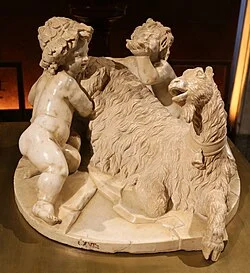
If any single object demonstrates Amalthea's peculiar grip on the artistic imagination, it may be a small marble group now in the Galleria Borghese in Rome. The sculptor is Gian Lorenzo Bernini. The date is before 1615 — meaning Bernini was under 17 years old when he carved it. 1
The work shows Amalthea as a goat, with the infant Jupiter feeding himself from her milk while a miniature satyr watches. The surface carving is so precise — so reminiscent of Hellenistic sculpture — that the statue was thought to have been made in antiquity until relatively recent examination. By 1615 it was in the collection of Cardinal Scipione Borghese, possibly carrying a political subtext: Amalthea as abundance may have symbolized the "Golden Age" of Pope Paul V, who was also a Borghese.
The Baroque period produced a cluster of treatments of the subject. The Flemish painter Jacob Jordaens returned to it repeatedly through the 1630s. In his best-known version, now in the Louvre, Amalthea is being milked by the nymph Adrasteia beside a bawling infant Jupiter holding a bottle — a scene whose domesticity sits oddly against the divine subject. An engraving after the painting by Schelte a Bolswert added a Latin inscription giving the picture a moral: Jupiter's later adulterous tendencies, the caption implies, were unsurprising given that he was raised on goat's milk among satyrs. 1
Giorgio Vasari's treatment, painted in 1555–56 for the Sala di Giove (Room of Jupiter) in Florence's Palazzo Vecchio, is unusual for a different reason: Vasari left a written explanation of what the painting meant. The child Jupiter, he stated, represented Cosimo I de' Medici, the Duke of Florence who owned the building. The goat's milk gave the young Cosimo foresight; the honey of the nymph Melissa gave him wisdom. 1 The myth of Zeus's nursing had become a flattery machine for Florentine dynastic ambitions.
Cargando vista previa del enlace…

Marie Antoinette's grotto

The last and perhaps strangest chapter in Amalthea's art history is a room at the Château de Rambouillet. In 1787, Louis XVI commissioned a dairy for his wife Marie Antoinette — an aristocratic fashion of the period, a retreat to pastoral fantasy. As its central element, he ordered a marble statue from the French sculptor Pierre Julien. 1
Julien's Amalthea depicts a young nude woman with a goat at her feet, her pose consciously echoing the Venus de' Medici. The statue was installed not in the main dairy room but in a specially constructed grotto — artificial rocks, flowing water, a skylight overhead. The scholar Meredith Martin reads the grotto as deliberate allusion: the dairy was designed to evoke the cave from the myth of Jupiter's infancy, making Marie Antoinette, implicitly, the royal patron of abundance itself. 1
The walls of the room carried two friezes, one of them depicting Amalthea as a goat nursing Jupiter. The full marble statue is now in the Louvre. The dairy at Rambouillet still stands.
Two years after the dairy was completed, the French Revolution began.

Amalthea's persistent appearance across 25 centuries of art and literature is a measure of what the myth carries: the idea that divine power itself was once helpless, dependent on milk and noise and a hiding place in the dark — and that the creature or woman who provided those things deserves to be remembered. Whatever her name actually means, and whoever she actually was, she kept the future king of the gods alive.
Wikipedia's Featured Article for June 10, 2026, is Amalthea (mythology). 2

Añade más opiniones o contexto en torno a este contenido.

  • Inicia sesión para comentar.