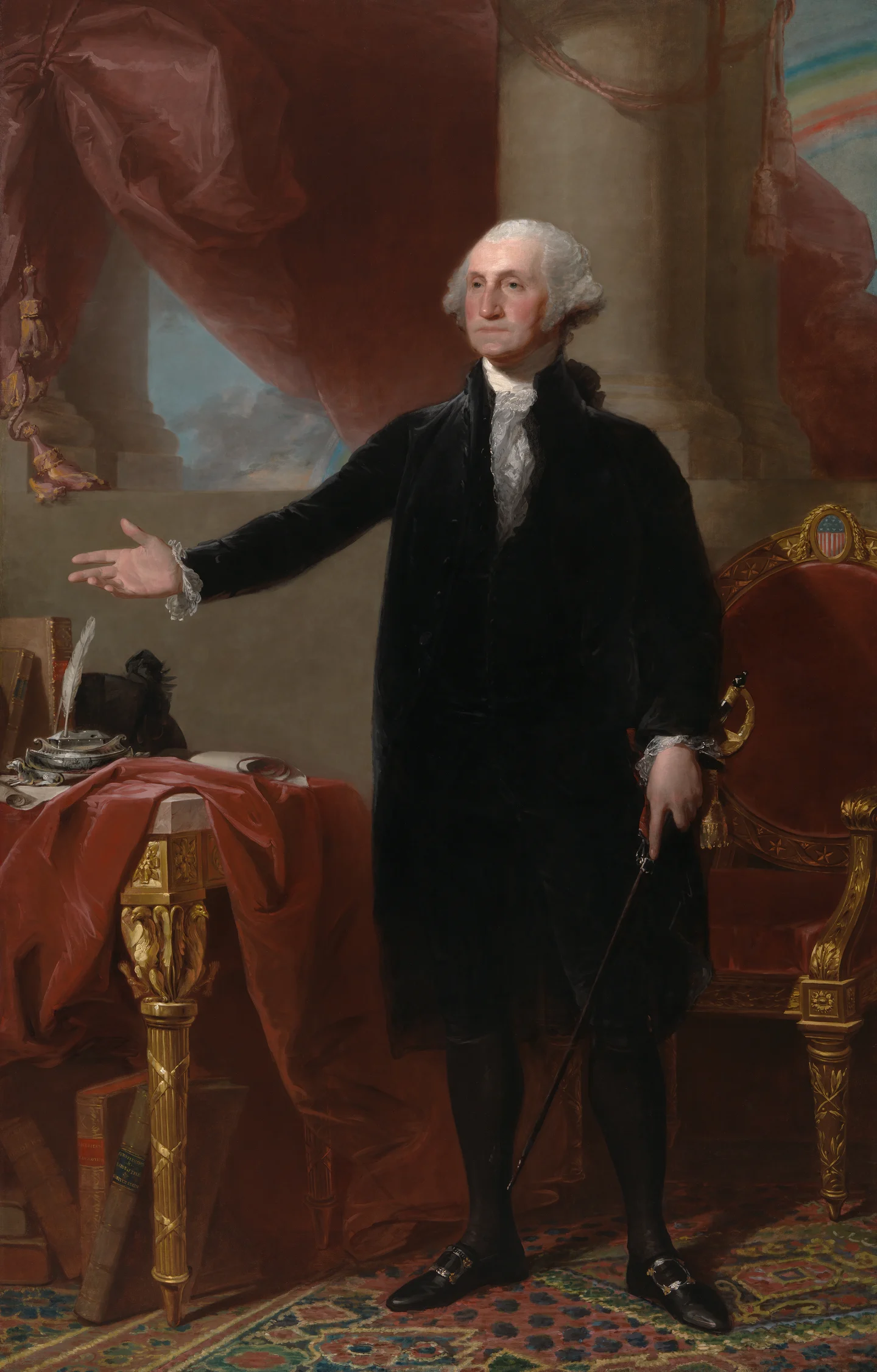
The Argument in the Frame: Gilbert Stuart's Lansdowne Portrait of George Washington
In April 1796, Gilbert Stuart spent a single morning painting George Washington's face in a Philadelphia studio, then completed an eight-foot canvas packed with a systematic argument about American republican values — civilian suit, ceremonial sword, Masonic rainbow, fasces table leg, and a shelf of constitutional texts. Commissioned as a diplomatic gift for the Marquess of Lansdowne, the painting spent 205 years in England before the Smithsonian's National Portrait Gallery acquired it for $20 million in 2001. Along the way, a White House replica was saved from British flames by Dolley Madison in 1814, a bankrupt merchant sold the original by lottery, and a future British Prime Minister added it to his family collection.
The canvas is nearly eight feet tall and a little over five feet wide. 1 Stand in front of it in South Gallery 240 of the Smithsonian National Portrait Gallery and George Washington stands in front of you at something close to life size — 247.6 × 158.7 centimeters of oil on linen, accession number NPG.2001.13, unsigned and undated. 1 He is dressed entirely in black velvet. His right arm reaches toward you, palm up, in the gesture of a man mid-sentence. His left hand rests on a ceremonial sword that hangs at his hip. He is 64 years old, and it shows in his face — a tension around the jaw, a tightness that Gilbert Stuart, who painted him, later explained with the candor of a man who kept good gossip:
"When I painted him, he had just had a set of false teeth inserted, which accounts for the constrained expression so noticeable about the mouth and lower part of the face." 1
The year was 1796. Washington was nine months from leaving the presidency. The nation had just survived a treaty with Britain so unpopular that protesters had burned John Jay in effigy. And a Philadelphia senator named William Bingham had decided that what the situation required was a painting.
The treaty, the senator, and the diplomat's gift
The Jay Treaty — negotiated in London in 1794 by Chief Justice John Jay and signed by Washington in August 1795 — settled the outstanding grievances from the Revolutionary War that Britain had ignored for a decade: withdrawing troops from American frontier posts, agreeing to arbitration on debts and wartime ship seizures. 2 The Senate ratified it in June 1795 by exactly 20 votes to 10, the minimum two-thirds required. 2 The House approved funding only on April 29, 1796, after a 49-49 tie in committee was broken by the speaker, Frederick Muhlenberg, who sacrificed his congressional career with the deciding vote and was subsequently stabbed by his own brother-in-law. 2
Across the Atlantic, one man had done more than almost anyone to make peace between the two countries possible. William Petty, 1st Marquess of Lansdowne — former British Prime Minister, liberal Whig, friend to Benjamin Franklin and friend to American independence — had been agitating for Anglo-American reconciliation since the 1780s. 3 He had spoken in Parliament for the treaty's ratification. He was, in the political vocabulary of the 1790s, the treaty's best advocate in London.
William Bingham knew this, and he saw an opportunity. Bingham was the richest man in America — a Philadelphia senator who had made his fortune as a British colonial agent during the Revolutionary War and then pivoted, with considerable social agility, into the new republic's mercantile elite. 4 His wife Anne Willing Bingham was the foremost social hostess of the Federal period, a woman whose connections stretched from Philadelphia's drawing rooms to London's political salons. Together they decided to commission a portrait of George Washington as a gift to Lansdowne — not a polite bust or a modest half-length, but a full-length state portrait in the European grand manner: a deliberate statement, painted in oil, about what the American republic had become and what its leader represented.
The fee was $1,000, paid to Gilbert Stuart. 1
The sitting: one morning, Philadelphia, 1796
Stuart had come back to America in early 1793 with a specific plan. He had spent six years studying in Benjamin West's London studio, absorbed the conventions of British state portraiture, built a reputation with canvases like The Skater (1782), and survived seven years of fashionable success and attendant debt in Dublin. 5 His idea for recouping everything was straightforward: paint George Washington from life and sell reproductions. In 1794, he told his uncle: "The object of my journey is only to secure a picture of the President." 1 Mount Vernon's records note, with characteristic dryness, that Stuart wanted to paint Washington because "he expected that he could make a 'fortune' on images of the Revolutionary War hero and American leader." 6
He had already secured one Washington sitting in autumn 1795, from which he painted the head-and-bust image now called the Vaughan type. Stuart kept the resulting likeness and painted 12 to 16 replicas at $100 each. 1 He had also retained, in a deliberate act of commercial cunning, the unfinished Athenaeum portrait — the head-and-shoulders study he had promised to Martha Washington but never delivered, kept expressly so he could use it as a template for copying. He would eventually produce roughly 75 replicas from that single unfinished original. 1
For the Lansdowne, he needed a new sitting. Anne Willing Bingham arranged it. On April 11, 1796, Washington wrote to Stuart: "I am under promise to Mrs. Bingham to set for you to-morrow at nine o'clock." 1 The sitting took place April 12 in Stuart's studio in the William Moore Smith house at Fifth and Chestnut Streets in Philadelphia. Washington was there for a single session. Stuart, under time pressure, concentrated entirely on the face and head — the hardest and most commercially valuable part. For the body, his landlord Smith reportedly stood in as the model. 1
John Adams, who had his own portrait done by Stuart around this time, described the artist's studio manner with something close to envy: "I should like to sit to Stuart from the first of January to the last of December, for he lets me do just what I please, and keeps me constantly amused by his conversation." 5 Whatever Stuart's conversation managed with Washington, the face he captured carries unmistakable stress — the new dentures, probably made from hippopotamus ivory, pushed the cheeks outward and tightened the lips into a line of controlled discomfort. Stuart finished the rest of the painting in Germantown, eight miles outside Philadelphia, working from memory, from Smith, and from a systematic iconographic program that someone — probably Bingham, working with Stuart — had designed in detail.
By late November 1796, the painting was crated and on a ship to England. Lansdowne received it before March 5, 1797. His letter of thanks to Anne Bingham has survived:
"A very fine portrait of the greatest man living in a magnificent frame found its way into my hall... It is universally approv'd and admir'd, and I see with satisfaction, that there is no one who does not turn away from every thing else, to pay their homage to General Washington." 1
A London newspaper observed that "the portrait presented by the President to the Marquis of Lansdowne is one of the finest pictures we have seen since the death of Reynolds." 7
Reading the painting: every object is an argument
The Lansdowne portrait is not a likeness with a background. It is a complete argument, organized across every inch of the canvas.
Washington wears a black velvet suit of American manufacture — civilian, not military. His left hand rests on a dress sword, not a battle sword: an instrument of ceremony, the emblem of authority that is never unsheathed. 1 The combination — civilian clothes, ceremonial weapon — makes a pointed claim. This is a leader who has power over armies but has chosen not to use it, a man who holds a sword he carries for protocol. Stuart had been trained on the European grand manner tradition of state portraiture, which stretches back through Joshua Reynolds and George Romney to Hyacinthe Rigaud's 1701 portrait of Louis XIV. 7 With ironic precision, the Pennsylvania Academy of the Fine Arts has noted that Stuart used the visual language of monarchy — the full-length pose, the theatrical drapery, the classical architecture — to celebrate a democratic leader who had rejected monarchy. The iconography works against itself, deliberately: a king's portrait format used to depict a man who refused to be king.
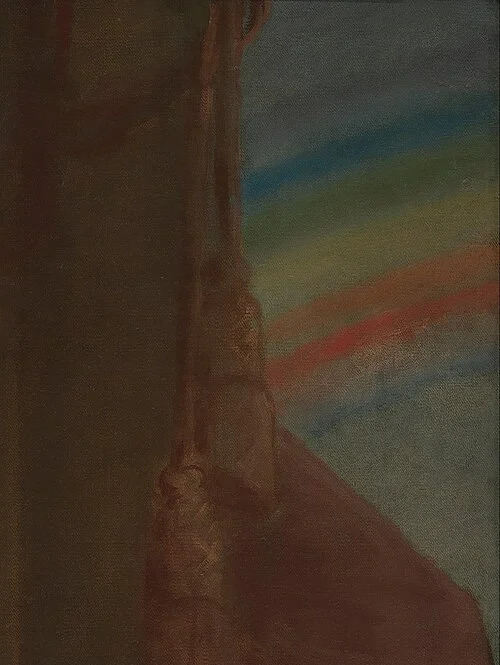
Behind Washington, two rows of Doric columns rise into deep shadow, their bases solid, their proportions austere. The Doric order, the most stripped-down and severe of the classical column types, carried in the eighteenth century a load of associations with republican virtue — the discipline and moral simplicity of Rome before its empire. 8 At the upper right of the canvas, past the crimson curtains with their gold tassels, the sky is clearing. Dark storm clouds on the left give way to a rainbow — its color bands in reversed order, running violet-through-red from top to bottom rather than red-through-violet, the optical signature of a secondary arc in a double rainbow. 1 The Smithsonian's own iconographic analysis is explicit: the rainbow symbolizes the peace and prosperity that followed the revolutionary storm, and Washington being a committed Freemason — initiated at Fredericksburg Lodge in 1752, Master of Alexandria Lodge No. 22 when he became president in 1789 — the rainbow connects to the Royal Arch of Masonic tradition, "sometimes interpreted as the Arch of Heaven, supported by the pillars of Wisdom and Strength." 8
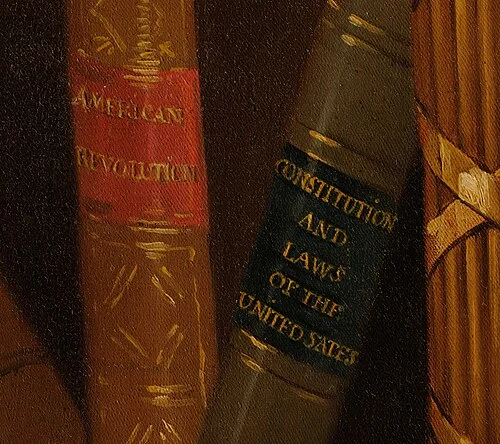
The table at left is a museum of objects, each one labeled with meaning. On the tabletop: a silver inkwell bearing the Washington family coat of arms (the signing of the Jay Treaty, implied), a white quill pen resting on silver dogs (an ancient symbol of loyalty), an open letter, and a black hat. Stacked on the table and leaning against its side are books whose spines are legible — or were, before time and varnish had their way. The research into the painting identifies Federalist (The Federalist Papers), Journal of Congress (the Congressional Record), General Orders, American Revolution, and Constitutional Bylaws. 1 The library is a résumé: the documents of the government Washington helped design, the military orders he gave during the war he won.
The table leg deserves separate attention.
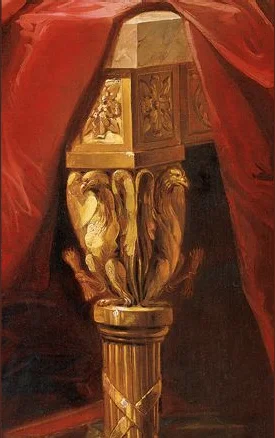
The carved support — gilded, topped with a bald eagle perched on what appears to be a ceremonial column — is directly inspired by the mace of the House of Representatives, which was itself derived from the Roman fasces, the bound bundle of rods that Roman lictors carried as an emblem of civic authority. 1 8 The new American republic was translating ancient Roman symbols of governance into its own visual vocabulary. Stuart built that translation into the furniture.
Near the books — in a detail that became famous much later for the wrong reason — an open ledger in the White House copy of this portrait carries the words "UNITED SATES" instead of "UNITED STATES." Stuart, who painted at least three full-size replicas of the Lansdowne, deliberately misspelled "States" in that copy to distinguish it from the original. 1 The original says what it should.
The chair at right holds one more detail: its back medallion is decorated in red, white, and blue, the colors of the American flag. 1 Washington stands between the flag, the sword, the books, and the rainbow, one arm extended toward the viewer in the posture of a man presenting all of it. The Pennsylvania Academy's analysis calls it "an allegorical weight" — Stuart deploying Republican Rome as a prototype for the new nation and painting Washington as a modern Cincinnatus, the Roman citizen-soldier who put down his arms after saving the republic and returned to his farm. 7 Washington, who had done exactly this after the Revolutionary War and was now doing it again by refusing a third presidential term, fit the archetype with uncomfortable precision.
The three Washington types
Stuart had, by the time he completed the Lansdowne, developed three distinct portrait types for Washington — each one serving a different function.
The Vaughan type (autumn 1795) was a standard bust portrait, face turned right. It produced 12 to 16 replicas for private subscribers. The original is at the National Gallery of Art. 1
The Athenaeum type (1796) was never finished. Stuart retained the original — the unfinished head-and-shoulders study for which Washington sat in 1796, face turned left — for the rest of his life, using it to produce approximately 75 replicas. He never delivered the original to Martha Washington, despite his promise to do so. The Athenaeum portrait is jointly owned today by the National Portrait Gallery and the Museum of Fine Arts, Boston. 1 It is also, in a roundabout way, the most distributed artwork in American history: George Frederick Cumming Smillie's engraving of the Athenaeum type first appeared on U.S. currency in 1899, and since 1918 has appeared on every one-dollar bill. 9 By the end of 2019, approximately 12.7 billion one-dollar bills were in circulation worldwide. 9 Stuart's Washington became, as Mount Vernon describes it, "the household Washington of the world." 6
The Lansdowne type was the grandest — full-length, programmatic, designed for a specific diplomatic purpose. Stuart produced three full-size replicas. The PAFA copy (signed "G. Stuart, 1796," 243.8 × 152.4 cm) was kept by Bingham himself and bequeathed to the Pennsylvania Academy of the Fine Arts in 1811. 7 A second copy (244.5 × 153 cm) was commissioned by New York merchant William Kerin Constable in 1797; Stuart's receipt dated "Philadelphia. 13 July 1797" acknowledges payment of $500, and the painting is now at the Brooklyn Museum. 1 A third copy, intended as a diplomatic gift to France by South Carolina's Charles Cotesworth Pinckney, was never delivered — French foreign minister Talleyrand refused to receive Pinckney as part of the XYZ Affair — and ended up being sold to a New York dealer named Gardiner Baker, and then purchased for the White House for $800 in July 1800. 1 This last copy, now hanging in the East Room, would eventually have its own drama.
1814: Dolley Madison and the canvas that could not be left behind
On August 23, 1814, British forces under Major General Robert Ross were advancing toward Washington. President James Madison had already left the capital. Dolley Madison remained in the White House, packing government documents and whatever could be saved before she fled. At 3 pm she wrote to her sister:
"Our kind friend Mr. Carroll has come to hasten my departure, and in a very bad humor with me, because I insist on waiting until the large picture of General Washington is secured, and it requires to be unscrewed from the wall." 10
The White House Lansdowne was screwed into the wall in a heavy frame. There was no time to remove the frame. What actually happened next was described in a 1865 memoir by Paul Jennings, a formerly enslaved man who had served in the Madison household: White House doorkeeper Jean Pierre Sioussat — known in household records as "John Suse'" — and head gardener Thomas McGrath carried out the actual work of unscrewing the canvas from its frame and getting it out of the building. 10 11 Two New York visitors named Barker and Depeyster transported the rolled canvas to safety. The British torched the building the next day.
Dolley's insistence on waiting for the portrait — and her letter recording that insistence — fixed the story in the national imagination, though Jennings's memoir quietly corrected who had actually held the ladder. The portrait survived. It hangs in the East Room today, misspelled "UNITED SATES" and all. 1
Stuart himself, when asked about this copy, told a mutual acquaintance that he "denies most pointedly having painted the picture in the President's house." NPG curator Ellen G. Miles, reviewing the documentation, concluded: "The comment does suggest that Stuart did not paint the entire portrait." 1 Whether the White House copy is partly the work of landscape painter William Winstanley, who had access to Stuart's studio, remains unresolved.
205 years: the original's wandering
While the White House replica was being rescued from flames, the original Lansdowne had been in England for seventeen years, passing through a sequence of owners that would have made a good novel.
After Lansdowne's death in 1805, his estate went to auction. Samuel Williams, an American merchant based in London, purchased the portrait in March 1806 for $2,000 — double the commission fee. 1 George C. Mason, writing in 1879, recorded the transaction plainly: "After the death of Lord Lansdowne, his pictures were sold by auction. The Washington was purchased by Samuel Williams, an English merchant, for $2,000." 1
Williams went bankrupt in 1827. His creditors liquidated the painting by lottery: 40 tickets at 50 guineas each. 1 The winning ticket went to John Delaware Lewis, an American merchant who was the nephew of Philadelphia banker William D. Lewis. The portrait, painted in Philadelphia to celebrate a treaty between the United States and Britain, had become the prize in a gentlemen's lottery held in England. Lewis's son, John Delaware Lewis Jr. (1828–1884), later became a British Member of Parliament; he inherited the painting, and in turn his son Herman LeRoy Lewis inherited it after him. 1
In 1876, the painting crossed the Atlantic briefly: exhibited in the British section of Philadelphia's Centennial Exposition, which marked one hundred years of American independence. 1 Then it went back to England.
In 1889, the portrait was purchased by Archibald Philip Primrose, 5th Earl of Rosebery, who would become British Prime Minister five years later, in 1894. 1 The Rosebery family — whose seat was Dalmeny House in Scotland — kept the painting for most of the following century. Lord Harry Dalmeny, descendant of the 5th Earl, placed it on long-term loan to the Smithsonian National Portrait Gallery in 1968. 1 It had been absent from American territory, apart from the brief 1876 exhibition, for 172 years.
The loan became a purchase in 2001, when the Donald W. Reynolds Foundation donated $20 million to the NPG to acquire the portrait outright, heading off a planned Sotheby's New York auction. 1 The Foundation gave an additional $10 million for gallery renovation and a traveling exhibition. 1 The full provenance, compressed:
| Year | Owner | Event |
|---|---|---|
| 1796 | Senator William Bingham | Commissioned, paid $1,000 |
| 1797 | Marquess of Lansdowne | Received as diplomatic gift |
| 1806 | Samuel Williams | Purchased at estate sale for $2,000 |
| 1827 | John Delaware Lewis | Won in lottery (40 tickets, 50 guineas each) |
| 1841–1884 | Lewis family (two generations) | Inherited |
| 1889 | 5th Earl of Rosebery | Purchased |
| 1968 | National Portrait Gallery (loan) | Long-term loan from Lord Dalmeny |
| 2001 | National Portrait Gallery | Purchased for $20 million |
The painting commissioned to thank a British lord for supporting Anglo-American peace ended up, 205 years later, bought back from a British lord's descendant by an American museum.
The yellow veil: 18 months of conservation
In February 2016, the Lansdowne came off the gallery wall for the first time since the NPG's renovation and went into the care of Cindy Lou Molnar, the gallery's head of conservation. 12 The treatment lasted 18 months. The painting is roughly eight by five feet; no standard easel exists at that scale. Molnar cleaned it flat on a cart, working from ladders.
The problem was the varnish. Natural resin varnishes yellow as they age — a century of oxidation had turned the coating the color of old amber, pushing the black coat toward a murky silhouette, burying the rainbow under brownish haze. Molnar removed it layer by layer with solvents. What emerged surprised even her:
"Taking off that thick varnish certainly showed the brilliance of the painting. It showed fresh new details under the surface, and it made it much cooler too. It was like lifting off a yellow veil." 12
Pink tones appeared in Washington's cheeks. The dress sword acquired a glisten. The buttons and lapels of the black coat separated from the surrounding shadow. The rainbow, which had been one of the most obscured passages, reasserted its color bands — the reversed secondary-arc order now visible as Stuart had intended.
Ultraviolet light helped identify the layers: old varnishes and previous restorations fluoresce distinctly from original paint film under UV radiation. Infrared reflectography scanned the underpaint for evidence of preliminary drawings — pencil, chalk, charcoal — and found none. Stuart had gone directly to paint, using the brush itself for both composition and contour. "What we did find with the infrared," Molnar noted, "was that Stuart did take paint to the brush and used that quite well in outlining and doing a lot of compositional images. He didn't use pencil or chalk to do underdrawing." 12
The table arrangement — which Molnar called "such an interesting area of the painting" — became newly legible after cleaning: the silver inkwell bearing Washington's coat of arms, the white quill on its silver dogs, a black hat beside them. "It was like wow," she said. 12
The portrait was re-presented to the public in September 2017 in the renovated "America's Presidents" galleries, its colors closer to what a viewer in 1796 would have seen.
The Farewell Address and the portrait's double timing
Washington's Farewell Address was published in Claypoole's American Daily Advertiser on September 19, 1796 — four months after the April 12 sitting and while the portrait was still being completed in Germantown. 13 The address, drafted primarily by Alexander Hamilton, warned against sectionalism, against permanent political parties, against entangling foreign alliances. 13
The Lansdowne portrait occupies the exact historical instant between Washington's last in-person address to Congress (December 7, 1795) and that Farewell. 7 He is shown at the peak of his presidential authority — the Jay Treaty enacted, the republic's institutions in place, the arc of the revolutionary storm resolved into the rainbow behind him — and also on the verge of departing it. The outstretched hand could be an oration or a farewell. Stuart, whether by design or instinct, caught him at the moment of transition, and the painting carries both readings simultaneously.
That double reading is part of why the portrait persists. It does not show Washington as a commander, or as a revolutionary, or even as a president in the ordinary sense. It shows him as an argument about what the republic was. Every object on the table, every column, every band of color in the rainbow makes a claim. The false teeth gave the face a look of strain that Stuart, in his artist's honesty, did not smooth away — and that strain, that slight compression around the jaw, is the most human thing in the painting: a reminder that the man presenting all this republican magnificence was also a 64-year-old with an ill-fitting dental plate, standing still in a drafty Philadelphia studio so that a painter could record him for posterity.
The 2005 exhibition and the trifecta
For most of the two centuries since Stuart painted them, the three Washington portrait types — Vaughan, Athenaeum, Lansdowne — had rarely been exhibited together. In 2004 and 2005, the Metropolitan Museum of Art and the National Portrait Gallery mounted a joint exhibition simply called "Gilbert Stuart," the first comprehensive retrospective of the artist in nearly forty years. 14 Ninety-three paintings were shown, including 13 portraits of Washington representing all three types. Curated by Carrie Rebora Barratt of the Met and Ellen G. Miles of the NPG, the exhibition assembled Stuart's complete Washington image system in one room for the first time in living memory. 14
The Lansdowne type alone had spawned an entire replica industry through the nineteenth century. Beyond Stuart's own three full-size versions, painters including John Vanderlyn (1834, U.S. House of Representatives), Ezra Ames (1813, New York State Capitol), and Thomas Sully (1818, North Carolina State Capitol) had produced monumental copies for American institutions. 1 The pose, the columns, the rainbow, the outstretched hand — the visual grammar of American presidential authority — descended from the single April morning in Philadelphia when Washington stood in Stuart's studio in his new dentures, arm extended, and held still.
The painting now in Gallery 240 — NPG.2001.13, 247.6 × 158.7 centimeters, oil on linen, unsigned and undated — is that original. The false teeth are still implied in the jaw. The rainbow, revealed again after Molnar's 18-month work, rises behind the right column in its reversed-arc order. The books lean against the table. The inkwell bears the Washington coat of arms.
It took 205 years, eight owners, one bankruptcy, one lottery, and one 18-month conservation treatment to get it here.
Cover image: Gilbert Stuart, George Washington (Lansdowne Portrait), 1796, oil on canvas. National Portrait Gallery, Smithsonian Institution (NPG.2001.13). CC0 public domain via Smithsonian Institution.
Fuentes de referencia
- 1Wikipedia: Lansdowne Portrait
- 2Wikipedia: Jay Treaty
- 3Wikipedia: William Petty, 2nd Earl of Shelburne
- 4Wikipedia: William Bingham
- 5Wikipedia: Gilbert Stuart
- 6Mount Vernon: George Washington Portrait by Gilbert Stuart
- 7PAFA: George Washington (The Lansdowne Portrait)
- 8Smithsonian: The Portrait — Rainbow
- 9Wikipedia: United States one-dollar bill
- 10Wikipedia: Dolley Madison
- 11Wikipedia: Burning of Washington
- 12Smithsonian Magazine: A Rainbow Shines Anew
- 13Wikipedia: George Washington's Farewell Address
- 14NGA: Gilbert Stuart Exhibition
Añade más opiniones o contexto en torno a este contenido.