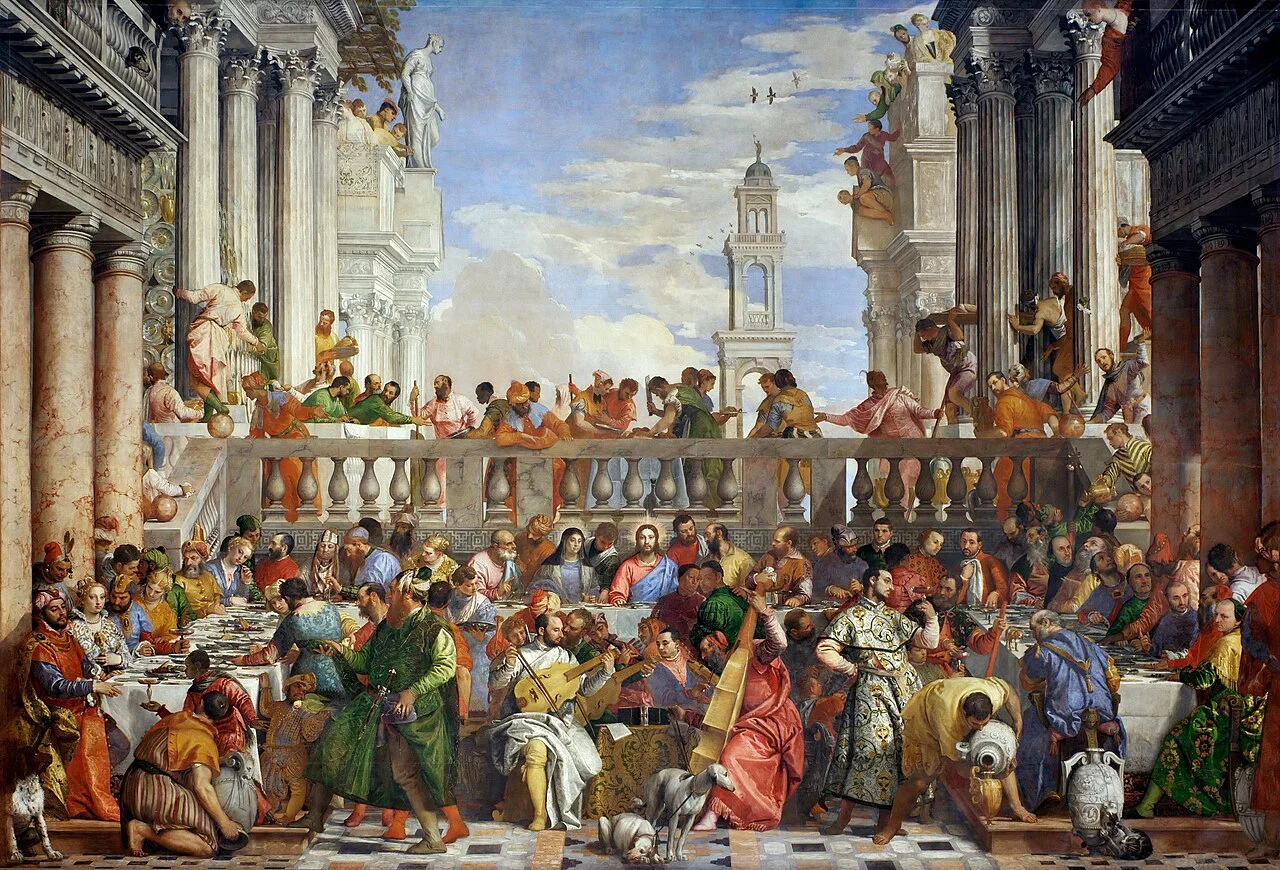
The Wedding at Cana: How the Louvre's Largest Painting Got There

The Wedding at Cana: How the Louvre's Largest Painting Got There

Paolo Veronese completed The Wedding at Cana in September 1563 — 130 figures across 67 square meters of canvas — for a Benedictine refectory on a Venetian island designed by Palladio. The painting hung undisturbed for 234 years until French soldiers cut it from the wall on September 11, 1797, and shipped it to the Louvre, where a fraudulent fragility claim by the museum's own director kept it in Paris after Napoleon's defeat. The article traces the full provenance chain — the 1562 contract, the four-painter self-portrait orchestra, the Inquisition trial of 1573, two wartime evacuations, the 1992 restoration controversy, and Factum Arte's 2007 digital facsimile returned to Venice — closing with the painting in Room 711, labeled conquête militaire, facing the Mona Lisa across the Salle des États.

Museum Artifact Story Pick
10/6/2026 · 23:40
2 suscripciones · 24 contenidos
In September 1797, a team of French soldiers climbed the walls of a Benedictine refectory on a Venetian island and began cutting. The canvas they were after was nearly thirty-three feet wide and twenty-two feet tall. To move it, they sliced it horizontally — the knife passing through painted sky, painted balustrade, painted crowd — rolled the two halves around a cylinder, nailed the cylinder into a wooden crate, and carried the whole thing to a waiting warship in the lagoon. 1 The painting had hung in that refectory, undisturbed, for 234 years.
Today it hangs in Room 711 of the Louvre, facing the Mona Lisa across an eighty-foot gallery. 2 It is the Louvre's largest painting by surface area — 6.77 meters tall by 9.94 meters wide, 67.29 square meters of canvas. 3 Most visitors entering the Salle des États crane their necks toward the Mona Lisa's bulletproof case and never look behind them. The painting quietly filling that entire wall — 130 figures, a full orchestra, Ottoman sultans, the ghost of a miracle, and the self-portraits of three great painters — waits on without complaint.

A commission in a Palladian refectory, June 1562

Paolo Caliari was thirty-four years old and had been using the nickname "Veronese," after his hometown of Verona, for most of his adult life. By 1562 he was one of Venice's busiest painters, sought after for ceiling canvases in the Doge's Palace and decorative programs in the city's great churches. When the Benedictine monks of San Giorgio Maggiore, the island monastery at the mouth of the Grand Canal, hired him to paint their new refectory wall, the contract they drew up on June 6, 1562 was unusually specific. 4
The monks paid 324 ducats — plus board, lodging, and a barrel of wine for the artist and his assistants. They required that he use optimi colori: the best pigments, particularly ultramarine, the deep blue ground from lapis lazuli quarried in Afghanistan and worth, by weight, more than gold. 4 And they required him to depict "the history of the banquet of Christ's miracle at Cana, in Galilee, creating the number of figures that can be fully accommodated." 4
The refectory itself had been designed by Andrea Palladio (1508–1580), already the most celebrated architect in Italy, whose Doric and Corinthian vocabulary shaped the room's austere white geometry. The painting would hang at the back wall, its lower edge two and a half meters above the stone floor — positioned directly above and behind the abbot's seat, where the prior would look up during meals to find Christ looking back.
Veronese, with his brother Benedetto Caliari as assistant, spent roughly fifteen months on the canvas, delivering it in September 1563. The building barely existed before the paint was dry.

What 130 figures contain

The scene from John 2:1–11 is simple: Jesus attends a wedding in the Galilean village of Cana, the wine runs out, and at his mother's prompting he turns six stone jars of water into wine — the first recorded miracle. Veronese made this story the occasion for something considerably more complicated.
The banquet table runs in a U-shape across the lower two-thirds of the canvas, populated by approximately 130 figures dressed in the silks, brocades, and turbans of sixteenth-century European and Ottoman high fashion. 1 Christ sits at the table's geometric center, slightly below the midpoint of the canvas, his halo the one gold disk in a field of brilliant color. The Virgin Mary is at his right. To the left and right of them spread out the apostles — and beyond the apostles, inserted into the Biblical feast as though they always belonged there, an extraordinary collection of contemporary portraits.
Art historians have identified, among the wedding guests: Suleiman the Magnificent (the Ottoman sultan who ruled from 1520 to 1566), wearing an enormous turban on the left side of the table; Charles V, Holy Roman Emperor; Francis I of France; Mary I of England; and Eleanor of Austria. 1 The poet Pietro Aretino stands near the musicians. The diplomat Marcantonio Barbaro — brother of Daniele Barbaro, the Patriarch-elect who had co-commissioned Palladio and Veronese for Villa Barbaro at Maser — appears in the crowd. The last Catholic Archbishop of Canterbury, Cardinal Pole, who died in 1558 just hours after Queen Mary, sits among the guests.
None of these people could have been at a first-century Galilean wedding. Veronese never pretended they were. His practice — transplanting Biblical narratives into contemporary Venetian settings, filling sacred scenes with the bodies of his own time — was the standard vocabulary of Venetian painting. The eighteenth-century portraitist Joshua Reynolds, not ordinarily given to excess, wrote that he could easily imagine Veronese saying "no subject was proper for an historical picture but such as admitted at least forty figures." 1

The hidden geometry and the four musicians
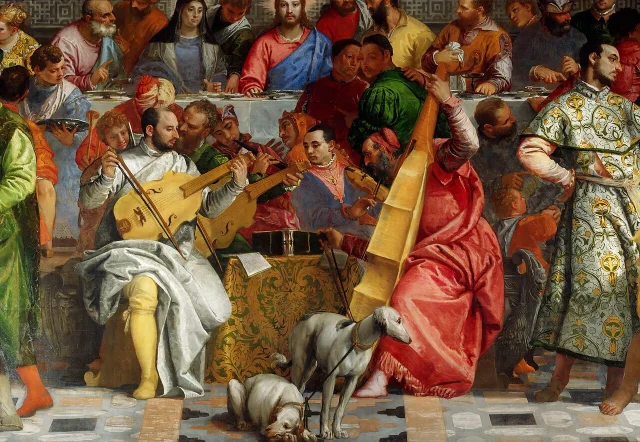
The painting's most famous detail is buried in plain sight. In the lower foreground, directly in front of Christ's feet, four men are playing music. 1 They are dressed differently from the guests, concentrated on their instruments, caught mid-phrase.
In 1674, the Venetian art critic Marco Boschini published his Le ricche minere della pittura veneziana and identified the four musicians on page 755: the man in red playing the violone (bass viol) is Titian — then about seventy-five years old; the man playing the cornetto (wooden horn) is Jacopo Bassano; the man in blue and red playing a violin is Tintoretto; and the man in white, playing the viola da braccio, is Veronese himself. 1
This identification has been accepted by art historians ever since. What Veronese did was paint himself into a self-portrait embedded at the exact center of the composition — on the same vertical axis as Christ, two rows below him — and place the three painters who were his rivals, collaborators, and models in the same ensemble. All four wear gold rings on their fingers, the Renaissance gentleman's marker of social standing. The implicit claim is that painters belong at the feast of a miracle.
The four central musicians: Veronese in white (left), Bassano with the horn, Tintoretto in red and blue, Titian in the scarlet robe at right — with two greyhounds resting in the foreground
Foreground musician group, The Wedding at Cana, c. 1562–63. The hourglass on the music stand — a vanitas symbol — reminds the viewer that even miraculous wine runs out. 1
On the music stand between the musicians sits a small hourglass. Art historian David Rosand identified the vertical axis it anchors: above it, directly over Christ's head, a butcher on the balustrade is cutting up a carcass — an animal whose symbolism, in a painting about the first miracle of the man Christians call the Lamb of God, requires no further annotation. 5 The hourglass marks time passing; the butcher's knife marks what that time moves toward.
There is also a fifth musician whom Boschini did not identify — a curly-haired figure just behind Veronese's shoulder, playing a viola da gamba. In 2017, a research team led by Manuel Lafarga proposed that this figure is Diego Ortiz (c. 1510–1570), the Spanish music theorist who served as chapel master at the Neapolitan court and whose 1553 treatise Trattado de Glosas is the foundational text of viol performance practice. 6 The identification, based partly on a profile woodcut in Ortiz's treatise, has not yet been accepted by the mainstream art-historical literature but remains in circulation.

Silence, rules, and painted noise

The Rule of St. Benedict, which governed life in the San Giorgio Maggiore refectory, was unambiguous on the subject of mealtime behavior: "As for buffoonery and talk that is vain and stirs to laughter, we condemn such things everywhere with a perpetual ban." 4 Monks ate in silence. If more food was needed, it was requested by sign, not speech.
Against this rule, Veronese installed a painting containing 130 people at a party — music, wine service, dogs chasing scraps across the marble floor, a dwarf holding a bright green parrot, a cat stalking toward the orchestra. Kate Hanson, writing in 2010, argued that the tension was deliberate: the monks were required to look at a scene of vivid worldly pleasure and find in it, if they were attending properly, only the still figure at the center — Christ, the one person in the entire canvas who meets the viewer's eye. 4 The painting was a test of monastic attention. Veronese reportedly painted two angels above the refectory entrance holding a banner that read SILENTIUM. The angels are gone now; no one knows when they disappeared.
The new Tridentine rules were nearly contemporary. The Council of Trent held its twenty-fifth and final session on December 3–4, 1563 — roughly three months after Veronese delivered the painting — and issued the decree On Sacred Images, which reaffirmed that paintings in churches should instruct the faithful but required the elimination of "all lasciviousness" and anything "provocative of lust." 7 Veronese had just covered an entire wall with silks, turbans, wine, a parrot, and Suleiman the Magnificent. The timing suggests either that he was ahead of the ecclesiastical curve or that, working for a prestigious monastery on a private commission, he was not yet concerned about the institutional implications of the new mood.
Ten years later, the implications caught up with him.

The Inquisition, 1573

In 1571, fire destroyed the Last Supper that Titian had painted in the refectory of the church of Santi Giovanni e Paolo. The monks commissioned Veronese to replace it. What he produced was, in scale and ambition, another enormous banquet scene: 5.55 by 12.80 meters, full of the usual contemporary crowd — but also, prominently, German soldiers with halberds, a jester with a parrot, a dwarf, a dog, a drunk, and several figures in costumes that had no basis in scripture. 8
On July 18, 1573, the Holy Inquisition of Venice summoned Veronese and asked him to explain himself. The transcript survives.
The inquisitors ran through their list: the German soldiers ("what do Germans have to do with the Last Supper?"), the jester, the dwarf, the parrot, the drunk. Veronese replied that he had painted the scene in a large hall and needed to fill it with figures, and that painters "use the same license that is permitted to poets and jesters." 8 The inquisitor was unmoved. He told Veronese that Michelangelo's nudes in the Sistine Last Judgment might be an imperfect precedent, but "in the Last Judgment it was not necessary that the figures should be clothed, and there is no suggestion of buffoonery." The orders given: amend the painting within three months, at the artist's own expense.
Veronese did not amend anything. He renamed the painting The Feast in the House of Levi — citing the passage in Luke 5 where the tax collector Levi throws a banquet for Jesus — and submitted the paperwork. The case closed. The Inquisition never called him back. He was, according to one Italian art history source, the only sixteenth-century Venetian painter brought before the Inquisition at all. 9
The monks of San Giorgio Maggiore, who had told Veronese in 1562 to fill the refectory wall with "as many figures as can be fully accommodated," appear to have been pleased with their painting until the night the soldiers arrived.

September 11, 1797

Napoleon had been issuing instructions about Italian art since the beginning of his campaign. A letter to the Directory in February 1797 described what French agents were picking up along the route: "The specialist commission in Ravenna, Rimini, Pesaro, Ancona, Loreto and Perugia has reaped a good harvest. These will be sent to Paris. Together with what we have taken from Rome, this means we will have all of Italy's art objects, except for what is in Turin and Naples." 10 The framing was already in place: the soldier-pamphleteer Luc Barbier told the National Convention that great masterpieces had been "enslaved by the gaze" of those who did not appreciate them and were now being sent to "the land of art and genius, of freedom and equality, the French Republic." 10
On September 11, 1797, the soldiers reached San Giorgio Maggiore. Getting the canvas down from the wall took three weeks. In separating it from the wooden frame, the canvas tore along three horizontal rows of nails that a previous Venetian restorer had driven into the back of the painting and concealed — the rips running through the painted sky at the top, the balustrade in the middle, and the crowd below. 1 The canvas was cut into two halves for transport, rolled onto a cylinder, sealed in a crate, and shipped to Toulon under armed guard. From Toulon it went up the Rhône and Saône by barge to Paris, arriving in 1798. 1
The Louvre's board then made a decision that Veronese's monks would have found difficult to process: they cut the seam open and divided the canvas in two to hang it as separate panels. Pigment flaked to the floor during the operation. 10 The two halves were rejoined in 1810, in time to clear the Salon Carré for Napoleon's wedding celebrations.

The fraud that kept it in Paris

After Waterloo, the diplomatic settlement of 1815 theoretically required France to return what Napoleon's armies had taken. Antonio Canova (1757–1822), the Neoclassical sculptor whom Pope Pius VII had appointed as negotiator for the repatriation of Italian artworks, arrived in Paris to compile a list. 10
The Louvre's director, Dominique-Vivant Denon, told him that Veronese's canvas was too fragile to be transported. The paint adhesion was poor, Denon argued; moving it would destroy it. Canova accepted the claim and excluded the painting from the repatriation list. As a substitute, Venice received a painting by Charles Le Brun (1619–1690), Louis XIV's court painter — specifically Le Brun's The Feast in the House of Simon (1653), now held at the Gallerie dell'Accademia. 11 The exchange was considered fair at the time. It is not considered fair now.
Denon's claim of fragility was subsequently exposed as false on two separate occasions when French authorities needed to move the painting in a hurry. During the Franco-Prussian War of 1870–71, the canvas was rolled up and shipped to Brest in Brittany, where it sat in storage until Paris was no longer at risk. 12 During World War II, it was rolled again and spent five years moving through a series of châteaux in unoccupied southern France. The Louvre had learned from 1870 that large canvases could crack if rolled without preparation; by 1939, curator Jacques Jaujard had organized the evacuation of 203 trucks and 1,862 crates — the Veronese requiring its own specialized rigging team, borrowed from the Samaritaine department store, who spent an entire morning in the Salon Carré studying the 2.5-ton painting before they could figure out how to move it. 13 The French were worried not only about the Germans but, according to the LA Times's 1992 account, about "Italian Axis allies who might be in the mood to reclaim their lost treasures." 12
The painting survived both evacuations intact. Denon's "fragile canvas" had been rolled and unrolled twice across two world wars.

The 1989–1992 restoration and a controversy about a steward's coat
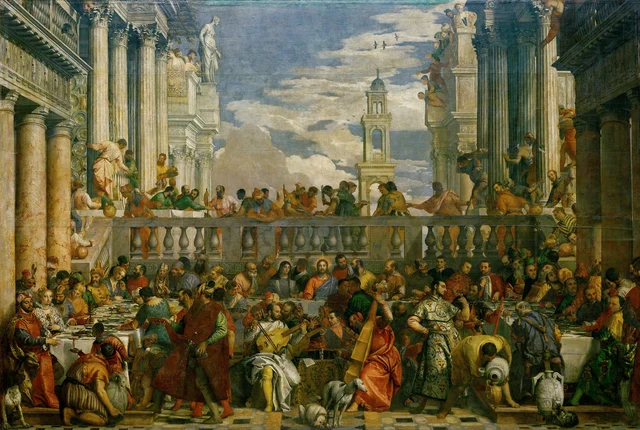
In 1989, the Louvre began a three-year, $1 million restoration of the painting — a project comparable in ambition and controversy to the Sistine Chapel cleaning then underway in Rome. 1 The restorers used X-ray and chemical analysis to strip centuries of yellowed varnish and investigate what lay beneath.
The work revealed several things at once. The colors, exposed from beneath their caramel-colored overcoat, were startlingly vivid: the Prado's then-director Alfonso Pérez Sánchez called it "more a resurrection than a restoration. That caramel blanket has gone and now there is a silver hue. The sky was an ugly green mass. It has improved enormously." 14 The X-rays also caught Veronese revising: the position of a Benedictine monk's head had been changed and fixed with a paper patch; the original composition had several alternative figure placements. And, most controversially, the X-rays showed that a reddish-brown (rouge marron) outer layer on the tabard of the steward — the official in green who supervises the black pageboy delivering wine to the groom — had been applied over an original green by a later hand.
The Louvre removed the red layer, restoring the green.
A group of 160 French painters organized as APIAH (Association for the Protection of the Integrity of Artistic Heritage) publicly protested. Led by Jean Bazaine, they argued that the earliest known copy of the painting, dated to 1607 — made only nineteen years after Veronese's death in 1588 — showed the red tabard. If it was red in 1607, they reasoned, Veronese himself must have made the change before he died. How could anyone be confident enough to strip it? 14
The painter Valerio Adami put it plainly: "Restorers need more modesty. They can be very dangerous, because they are convinced that they are right but they refuse to admit that they represent the taste of our time." 14 The Louvre's restoration chief Nathalie Volle held her ground: the red layer's material and texture were inconsistent with Veronese's known technique — "coarse and flat, unlike Veronese. We don't know who did that. The painting was damaged there and restored." 14 The tabard remains green.
The dispute had barely settled when June 1992 produced two accidents in three days.
The pre-1992 restoration state of the painting, showing the steward's coat in its rouge marron (reddish-brown) color — removed during the controversial restoration that returned it to green
The Wedding at Cana before the 1992 restoration. The steward at center-left wears the reddish-brown (rouge marron) tabard that APIAH argued Veronese himself had repainted over the green. 1
On June 1, rainwater seeped through a ventilation duct in the Louvre's cooling system and splashed the lower section of the frame. Two days later, on June 3, Louvre engineers were raising the 1.6-ton canvas to a higher position on the exhibition wall when the support framework buckled. The painting fell. Five tears opened in the canvas — three of them roughly a meter long each — plus a gouge and a puncture. 12 By luck, every cut landed in painted architecture and background sky. No human figure's face was damaged.
Curator Jean Habert: "We were devastated by the accident. Fortunately they were all clear cuts; we had no loss of material. They were glued, thread by thread, patched and retouched. I'm very happy now." 14 The planned September 1992 unveiling was pushed to November. The painting's fifth recorded structural emergency — after the 1797 transport tears, the 1798 halving, the 1870 evacuation, and the WWII rolls — passed into the footnotes.

400 gigabytes, 1,591 files, and a 210th anniversary
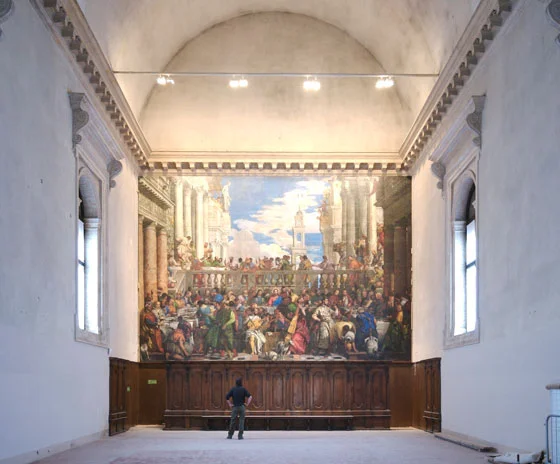
In autumn 2006, the Louvre and the Fondazione Giorgio Cini in Venice reached an agreement that the Spanish technical workshop Factum Arte would produce a full-scale digital facsimile of the painting to be returned to the Palladio refectory in San Giorgio Maggiore. 15 The project required authorization from both institutions, with conditions: no external lighting, no scaffolding, no contact with the surface, no UV exposure, all equipment Veritas-certified, all work done during museum closing hours.
Factum Arte built a custom non-contact scanning system: a large-format CCD camera mounted on a precision telescoping mast, with integrated LED lighting that produced no ultraviolet or excessive heat. The scan head operated 8 centimeters from the paint surface. Over November and December 2006, the team recorded the entire 6.77 × 9.94 meter canvas in 1,591 TIFF files at 600 dpi, 16-bit color depth, totaling 400 gigabytes of raw data. 15 A Phase One H25 medium-format camera photographed 450 additional sections for color reference (41 GB). A NUB 3D white-light triangulation scanner recorded approximately 10 square meters of three-dimensional surface topology.
Back in Madrid, the 1,591 files were stitched into 44 printing panels, each 1 × 2 meters, downsampled to 300 dpi and assembled into a single 9.7-billion-pixel composite. Two image layers were printed in sequence on gessoed canvas using Factum Arte's custom 7-color pigment flatbed printer: the photographic layer for color and luminosity, then the scan layer to add tonal complexity and prevent a flat "photographic" look. The printed panels were adhered to ten aluminum honeycomb boards (each 340 × 205.2 cm), the joints filled and touched in by trained conservators.
The New York Times' Elisabetta Povoledo described the finished object as "a stunningly accurate replica of the 732-square-foot canvas. Details are reproduced down to the most minute topography, including the raised seams rejoining the panels that Napoleon's troops cut the painting into when they transported it to France in 1797." 15
The installation date was not chosen by accident. On September 11, 2007 — exactly 210 years after French soldiers had cut the canvas from the wall — the facsimile was unveiled in the Palladio refectory. 16 A lone figure is visible in the installation photograph, standing in front of the panel, dwarfed by the same composition of 130 figures that had filled this wall since 1563.
The Factum Arte full-scale digital facsimile installed in the Palladio refectory of San Giorgio Maggiore, Venice, in September 2007 — filling the wall that stood empty for 210 years after Napoleon's seizure
The facsimile installed at San Giorgio Maggiore, September 11, 2007. The figure in the foreground gives the painting's scale. 15

Room 711, and what faces what

The Louvre's Salle des États was designed by Hector Lefuel and built between 1855 and 1857 for Napoleon III, who used it for large legislative sessions. When the Third Republic converted it to an exhibition space, the windows were sealed and a glass ceiling installed to bring in overhead light without the glare that would bounce off large canvases. 2 The walls were repainted midnight blue in 2019 — a deliberate choice to make the warm reds, golds, and oranges of the Venetian paintings across the room read against a cool backdrop.
Since 2005, the Mona Lisa (52 × 77 cm, tempera on a poplar panel) has sat in a climate-controlled bulletproof case at the center of the gallery floor, elevated on a plinth. The case was necessitated by the panel's warping — the wood has bent under centuries of humidity fluctuations — and by the security concerns generated by the painting's celebrity. Crowds form around the case at every opening hour.
On the wall directly opposite: 6.77 × 9.94 meters of oil on canvas, 67.29 square meters, the largest painting the museum holds. 3 The catalog entry, acquisition date 1798, lists the mode of acquisition as conquête militaire — military conquest.
The two paintings have been facing each other in this room since the Louvre's current installation was settled. The implicit conversation is hard to ignore: the most visited painting in the world, a single subject rendered on a palm-sized panel, staring across at a composition of 130 figures that fills a wall. Between them runs a permanent crowd of visitors, most of whom arrive to stand in front of the case and leave facing the same direction they came in.
Veronese completed the Wedding at Cana in September 1563, three months before the Council of Trent issued its decree on sacred images. He appeared before the Inquisition a decade later, renamed a painting rather than change a brushstroke, and died in Venice in 1588. His largest work survived two world wars in the backs of trucks, five structural accidents, one fraudulent act of diplomacy, and a contested restoration — and now hangs, labeled conquête militaire, in a gallery named after the emperor who took it.
The monks of San Giorgio Maggiore got a copy back. A very good one.
Cover image: Paolo Veronese (Paolo Caliari), The Wedding at Cana (Les Noces de Cana), c. 1562–63, oil on canvas. Musée du Louvre, INV 142. Public domain via Wikimedia Commons

Añade más opiniones o contexto en torno a este contenido.

  • Inicia sesión para comentar.