1/4

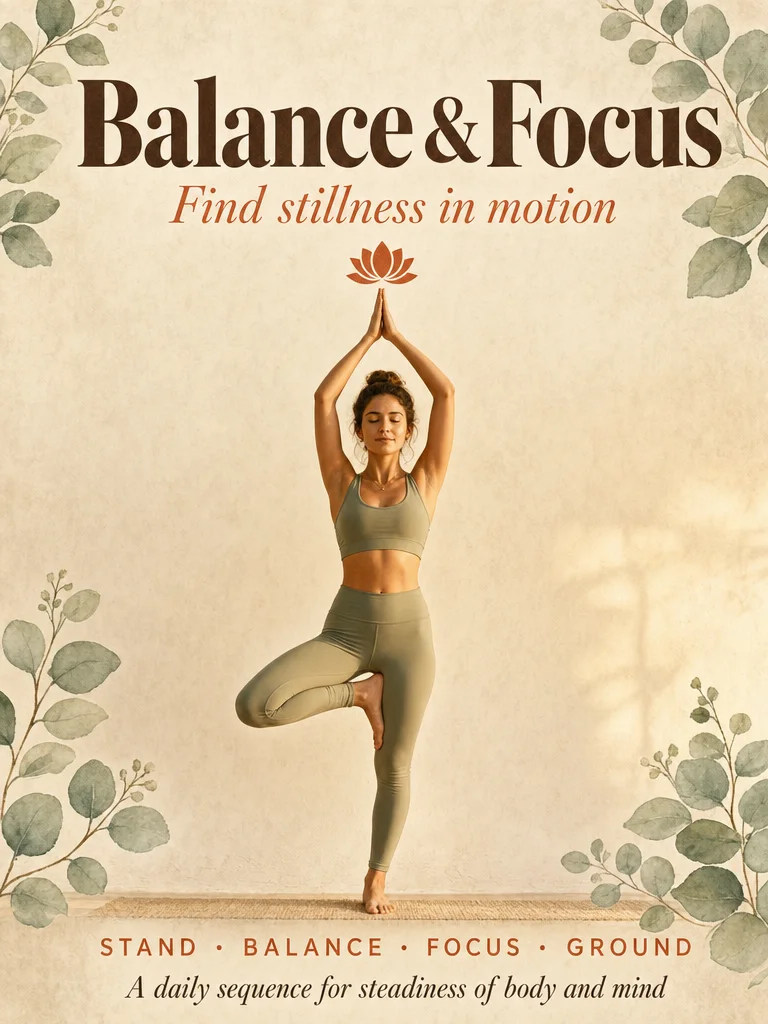
Balance & Focus Flow: 4 Poses + Hakini Mudra
Build steadiness of body and mind with this standing balance sequence — Tree Pose, Warrior III, Half Moon Pose, and Dancer's Pose, paired with Hakini Mudra. Each pose includes anatomy muscle highlights, suitability notes, and Beginner/Moderate/Advanced guidance with props, breath cues, and hold durations.
10/6/2026 · 8:11
Galería
Stillness isn't the absence of movement — it's the quality of attention underneath it. Today's sequence trains exactly that: the ability to remain grounded and clear while the body navigates the wobble, the lean, the reach into uncertain space.
These four standing balance poses build in intensity, moving from the rooted simplicity of Tree Pose through the bold extension of Warrior III and Half Moon into the soaring arc of Dancer's Pose. Each one demands the same thing: a quiet mind, a focused gaze, and honest weight through the standing foot.
Pair the sequence with Hakini Mudra — all fingertips lightly touching — to activate the bridge between the brain's two hemispheres, sharpen concentration, and settle the restless quality that makes balance poses hard in the first place.
The sequence
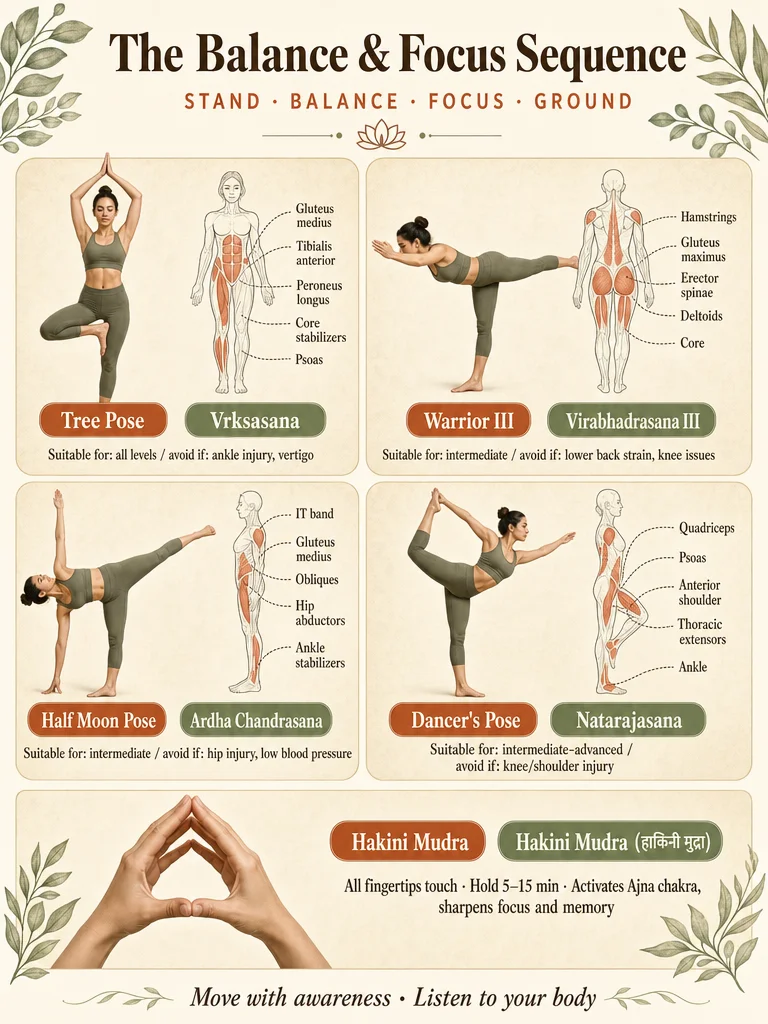
1. Vrksasana — Tree Pose
Body parts activated: Gluteus medius, tibialis anterior, peroneus longus, psoas, core stabilizers, arch of the foot, inner thigh of the raised leg.
Alignment cues: Root through all four corners of the standing foot. Draw the raised foot to the inner calf or thigh — never directly at the knee joint. Stack the pelvis level; avoid hiking the hip of the standing leg. Lift through the crown of the head. Fix a soft, unblinking gaze (drishti) at a still point at eye level. Breathe slow and full.
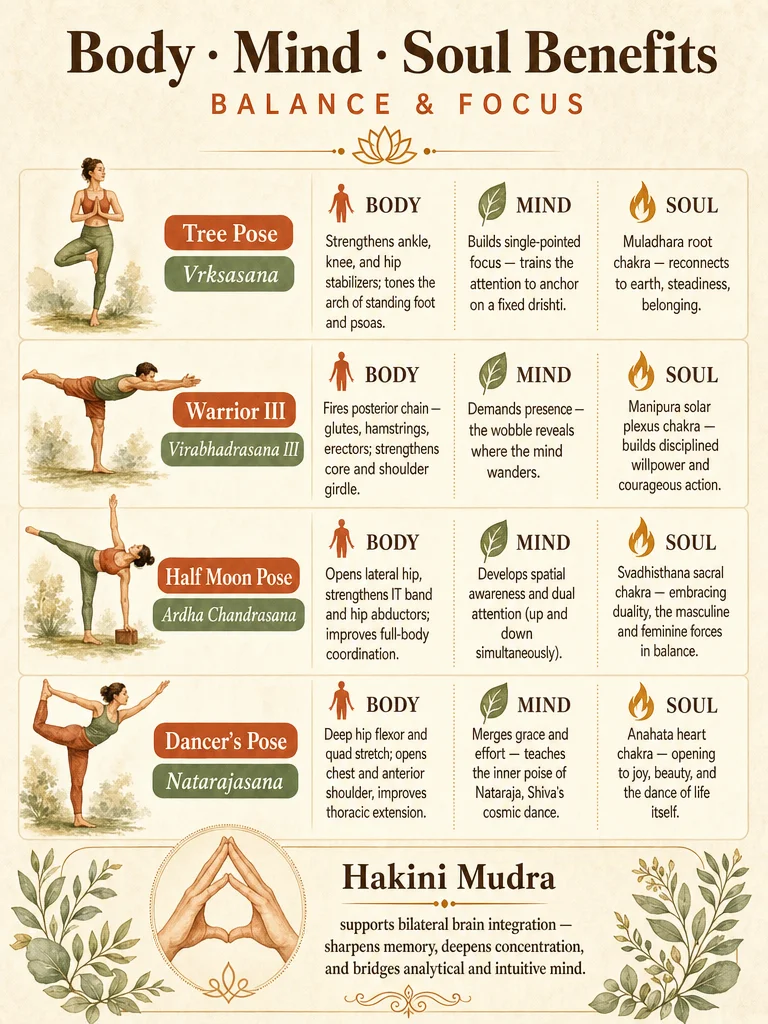
Benefits:
- Body: Strengthens the stabilizing muscles of the ankle and knee; tones the arch; develops proprioception in the hip girdle.
- Mind: Single-pointed drishti practice — trains the attention to anchor before the mind can scatter.
- Soul: Muladhara, the root chakra — a direct reconnection to groundedness, belonging, and the sense of being held by the earth.
Contraindications / suitability: Suitable for all levels. Avoid pressing the foot against the knee joint. Caution with vertigo or severe ankle instability; use the wall freely.
2. Virabhadrasana III — Warrior III
Body parts activated: Hamstrings, gluteus maximus, erector spinae, core (transversus abdominis, obliques), shoulder girdle, hip stabilizers of the standing leg.
Alignment cues: Begin in Warrior I. On an exhale, hinge the entire torso forward as the back leg rises — keep the lifted hip pressing down to stay square rather than open. The body forms one long diagonal from fingertips to heel. Micro-bend the standing knee to protect the joint. Engage the core firmly. Think "long" rather than "high."
Benefits:
- Body: Fires the entire posterior chain; builds core endurance and shoulder stability simultaneously.
- Mind: The wobble is information — the places the mind wanders are the places the body loses alignment. This pose makes the connection visceral.
- Soul: Manipura, the solar plexus chakra — disciplined willpower expressed as physical form. Every second of stability is a small act of courage.
Contraindications / suitability: Suitable for intermediate practitioners. Caution with lower-back pain, hip or knee injury. Use the wall or a chair at hip height for support.
3. Ardha Chandrasana — Half Moon Pose
Body parts activated: IT band, gluteus medius, obliques (lateral), hip abductors, peroneus group, ankle stabilizers, full shoulder girdle of the lifted arm.
Alignment cues: From Warrior II, shift weight into the front foot. Place the fingertips (or a block) about 12 inches forward of the standing foot. As the back leg lifts to hip height, stack the hips and open the chest toward the side wall. The lifted foot is flexed, toes pointing forward. Top arm reaches directly up. The gaze can be downward (easier) or toward the top hand.
Benefits:
- Body: Develops lateral hip strength and the coordination of two very different halves of the body acting simultaneously; opens the inner groin.
- Mind: Dual attention — holding the floor, the wall, the sky, and the body's rotation in simultaneous awareness. It's a full-system integration exercise.
- Soul: Svadhisthana, the sacral chakra — the capacity to hold apparent opposites. The half-moon is not less than the full; it is perfect in what it is.
Contraindications / suitability: Suitable for intermediate practitioners. Avoid with hip flexor or IT band injury. Low blood pressure — come out slowly. A block under the bottom hand makes this pose accessible to most bodies.
4. Natarajasana — Dancer's Pose
Body parts activated: Standing leg: hamstrings, glutes, ankle stabilizers. Lifted leg: quadriceps, psoas, hip flexors. Upper body: anterior shoulder, pectorals, thoracic extensors. Full spinal extension.
Alignment cues: Stand in Tadasana. Bend the right knee, bring the foot toward the right glute, and grip the inner ankle with the right hand (thumb pointing up). On an inhale, lengthen the spine. On an exhale, press the foot into the hand, kicking back and up, while tilting the torso forward and lifting the left arm. Keep the standing hip pressing forward — avoid letting it splay open. The pose is a collaboration between the two forces: the forward lean and the backward kick.
Benefits:
- Body: A rare full-body integration — simultaneously stretches the hip flexors, opens the chest, strengthens the back extensors, and challenges balance.
- Mind: Natarajasana asks for surrender and effort at the same time — the pose only opens when you stop trying to control it. This is the lesson.
- Soul: Anahata, the heart chakra — the pose is named for Nataraja, Shiva as cosmic dancer, the image of grace within transformation. Each time you find the balance, you are practicing that quality of being.
Contraindications / suitability: Suitable for intermediate-advanced practitioners. Avoid with knee, shoulder, or lower back injury. Use a strap around the ankle to make the grip accessible without straining the shoulder.
Hakini Mudra — the mudra of focus
Place all five fingertips of the right hand to touch the corresponding five fingertips of the left hand. Palms are slightly apart; the space between them is like a held breath.
- Element: All five elements in balance — this mudra is uniquely non-elemental, integrating rather than amplifying any single quality.
- Chakra: Ajna — the third eye, the center of perception, intuition, and mental clarity.
- Physical benefits: Stimulates the prefrontal cortex; shown in yogic tradition to improve memory consolidation and sharpen working focus.
- Energetic benefits: Bridges the left and right hemispheres of the brain; calms the scatter of information overload; creates the felt sense of a clear mind.
- Hold duration: 5–15 minutes, eyes half-closed with a downward gaze or gently closed. Breathe naturally.
- Best moment: Before beginning the balance sequence (to settle the mind) or at the close of practice (to consolidate the stillness you built).
Practice guidance
This sequence flows naturally as a standing balance block within a larger practice, or as a 20–30 minute stand-alone session.
Suggested order: Tree → Warrior III → Half Moon → Dancer's, first on the right side, then on the left. End each side with a short Mountain Pose to reset.
Who is best suited: Anyone who wants to build physical balance alongside mental steadiness — practitioners recovering from stress-induced scatter, those preparing for more advanced inversions, or anyone who wants to deepen their drishti practice.
Who should modify: New practitioners, those with ankle or knee sensitivity, or anyone recovering from injury — all four poses have gentler variations accessible with props. The sequence is not recommended during periods of acute low-back pain or in the third trimester of pregnancy without teacher guidance.
Comentar