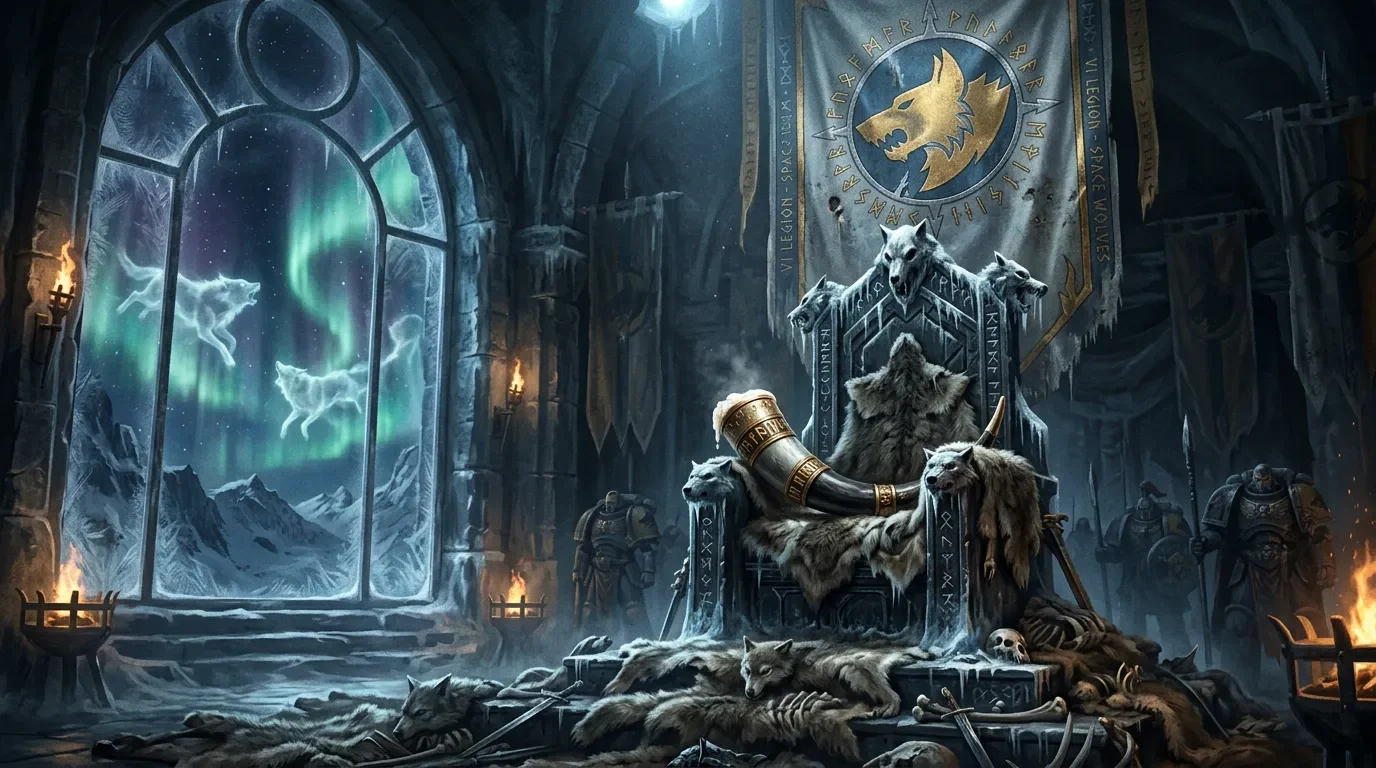
Leman Russ, Part III: The Wolftime
The finale of the Leman Russ arc — how the Space Wolves rebuilt, fought, and endured after their king disappeared into the Eye of Terror: Bjorn the Fell-Handed's ten-thousand-year vigil, Logan Grimnar's stand against the Inquisition in the Months of Shame, Magnus's revenge at the Siege of the Fenris System, the Primaris integration of the Era Indomitus, the thirty Great Hunts that never found their man, and the prophecy that still holds the Chapter together — the Wolftime, and whether it is now.
The chapter that waits
Seven years after Leman Russ walked into the Eye of Terror and did not come back, the Space Wolves stopped setting an empty place at the feast table. Not because they gave up — they still filled his drinking horn each year, still left the high seat vacant, still told every Blood Claw who came of age that the Wolf King had simply gone ahead of them on a very long hunt. But after seven years, the surviving Wolf Lords did what Russ had always done: they faced the truth squarely and made a decision. They elected Bjorn the Fell-Handed as the first Great Wolf of the newly reorganised Space Wolves Chapter, and Bjorn called the first Great Hunt. 1
That first Hunt launched in 218.M31 and ended in failure, the twelve Great Companies returning from separate corners of the galaxy with nothing but tales of hard-won battles and no sign of their primarch. It set the template for everything that followed. The Space Wolves have since launched more than thirty Great Hunts — each one a galaxy-spanning campaign, each one striking what Codex: Space Wolves calls "a decisive blow against the enemies of Mankind," and none of them finding Russ. The Hunt itself has become the point. It is how the Chapter honours his memory, how it justifies its ferocity, how the youngest Blood Claws learn the saga of a king who loved his sons too much to say goodbye properly and too little to explain why.
Bjorn served as Great Wolf until 934.M31, when he led a successful raid against the Dreadsun Fortress during the Proxima Rebellion and took injuries so severe that the Chapter's Iron Priests entombed him in a Dreadnought to preserve what remained of his life. He abdicated as Great Wolf from inside the sarcophagus, then spent the next several centuries serving as the Chapter's living memory and most senior counsellor — woken for the most dire crises and put back to sleep afterward, like a sword sheathed between wars. 2
What he became, over those long millennia, was something the Imperium almost never produces: a living anchor to a past that is otherwise myth. Every Space Wolf who has ever served has done so in the shadow of a primarch none of them have ever met. Bjorn is the only one who has. He fought at Prospero. He pulled Russ back from despair in the Alaxxes Nebula. He was there, that last night in the Fang's great hall, when Russ stood and spoke his final words before walking out into the dark. When Bjorn is roused to tell it — which happens once a millennium, at the Great Feast — the entire hall goes silent. Veterans who have fought Daemon Primarchs and survived Exterminatus campaigns stand open-mouthed. Because what Bjorn describes is not just their Chapter's past. It is the last time any living creature in the Imperium spoke to Leman Russ.
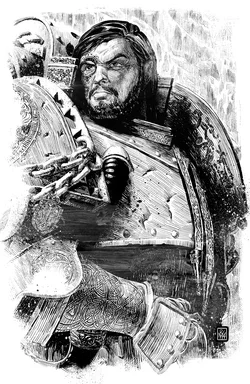
The Months of Shame (444–451.M41)
The Inquisition had never liked Logan Grimnar. Long before the First War for Armageddon, the Great Wolf had accumulated a personal history with the Ordos — enough confrontations and bruising encounters to make him fully aware that the Grey Knights existed, and deeply suspicious of the institutional logic that drove Inquisitorial purges. He had structured his forces on Armageddon accordingly: the civilians were kept away from the most sensitive operations, information about daemonic threats was tightly controlled, and Grimnar had calculated that this would give the Inquisition fewer reasons to "process" the survivors when the war ended. 3
He was wrong, or at least not wrong enough.
The First War for Armageddon in 444.M41 was fought under Grimnar's overall command, against a Khornate daemonic invasion led by the Daemon Primarch Angron and his twelve elite Cruor Praetoria. The Inquisition — including an ad hoc Brotherhood of Grey Knights and a task force of some thirty Inquisitors under the unaligned Lord Inquisitor Ghesmei Kysnaros — arrived to help and to ensure that knowledge of what happened there would not spread. When the war was over and won, Kysnaros ordered the Armageddon Containment: the surviving civilian population and the defenders of the Armageddon Steel Legion would be sterilised, quarantined, and scattered across work camps throughout the galaxy. Not because they were tainted — they were generally considered untainted — but because they knew, and the Inquisition's logic held that one man spreading word of daemonic existence could eventually cost billions of lives in the resulting panic and corruption.
Grimnar found the calculation obscene. He broadcast his objections to all Imperial forces in the system and began manoeuvring his fleet — sixteen warships to the Inquisition's twelve, and generally superior in armament — to help surviving transports reach the Warp jump points before they could be stopped. The first transport, the Trident of Ilmatha carrying four hundred thousand passengers, was caught and scuttled by the Grey Knights frigate Karabela with no survivors. Grimnar ordered the remaining transports to make orbit simultaneously, each escorted by Space Wolves vessels that deliberately placed themselves in the line of fire with orders not to return it. The arrival of reinforcements under the battle barge Gylfarheim forced Kysnaros to stand down. Most transports survived.
The Inquisition's response was to extend the containment beyond Armageddon: every world, installation, or individual that had any contact with the escapees was now liable to purge. Lord Kysnaros' fleet ranged across multiple sectors, conducting Exterminatus actions on worlds — including the planet Tybult, virus-bombed because an Armageddon transport had briefly stopped there for supplies. Within Kysnaros' own armada, dissent began to build. Grey Knight Justicars and several Inquisitors — including the Fenrisian Inquisitor Annika Jarlsdottyr of the Ordo Malleus — grew increasingly uneasy about campaigns that seemed to fall well outside their intended mission parameters. The Grey Knights themselves gave the period its unofficial name: the Months of Shame. 3
Five months in, Grand Master Joros proposed capturing Grimnar. Kysnaros agreed and called a parlay, then immediately violated it: as the Space Wolves' strike cruiser Scramaseax translated into the neutral system of Haikaran for the agreed meeting, the entire Inquisitorial fleet was already waiting and opened fire. The four Wolves escorts were destroyed. The Scramaseax took severe damage. Grimnar — understanding exactly what had happened — agreed to attend the parlay anyway, bringing only three Wolf Guard with him. He boarded Kysnaros' flagship not to surrender but to find out who had broken the armistice. Joros admitted to giving the order. Grimnar killed him on the spot, cleaving his frost-axe Morkai through the Grand Master's breastplate and throat in a single blow, then walked out as the assembled Grey Knights tried and failed to prevent his teleportation.
The war escalated. The Space Wolves stopped holding back. They actively destroyed several Inquisitorial and Grey Knight vessels — including the Glaive of Janus, the 1st Brotherhood's flagship for ten thousand years, lost with all hands and over fifty veteran Grey Knights. Kysnaros brought in the Red Hunters Chapter and their entire fleet. By early 445.M41, eight months of campaigning had proven that the Armageddon containment had failed: too many survivors had been dispersed to too many unknown systems. Kysnaros changed strategy and directed his armada to Fenris itself, intending to hold the Chapter's homeworld hostage.
The Space Wolves Chapter fleet arrived above Fenris at extraordinary speed — driven there by the sacrifice of the Chapter's Rune Priests, who burned out their gifts sustaining the transit. As orbital guns locked onto the Fang, the Inquisitorial delegation landed at the fortress for negotiations. The Space Wolves had awakened Bjorn the Fell-Handed to receive them. 2
Even Kysnaros, an Inquisitor Lord who had ordered Exterminatus actions and broken armistices, went to one knee when Bjorn's Dreadnought entered the room.
"You walked in the Age of the Emperor?" he asked.
"Walked, ran, pissed and killed. I did it all," Bjorn replied. "I met the Allfather, you know. Fought at his side more than once. I do believe he liked me."
The negotiations failed — Grimnar's fleet arrived before any agreement was reached, and a close-quarters naval battle erupted in orbit over Fenris. In the end, the Inquisition's armada was outfought. An uneasy truce was reached in early 451.M41. Neither side formally conceded anything. The deeper dispute between the Space Wolves and the Inquisition remained unresolved, as it does to this day. 3
The Siege of the Fenris System (999.M41)
By the closing years of the 41st Millennium, Warp Storms were erupting across the Imperium with increasing frequency. During one such incursion on the world of Nurades, Harald Deathwolf's Great Company was saved by an unexpected intervention: the mysterious warriors of the 13th Great Company — Space Wolves lost in the Eye of Terror ten millennia ago, transformed into half-wild Wulfen — had re-emerged from the Warp to fight alongside their long-estranged brothers for the first time in millennia. 4
Wolf Priest Ulrik believed the Wulfen's return was a sign — that finding them was the key to locating Leman Russ. Eleven of the twelve Great Companies launched the Hunt for the Wulfen, scattering across the galaxy to recover their transformed kin. Unknown to them, the entire sequence of events was engineered by the Changeling, a daemon of Tzeentch in disguise. Magnus the Red was executing his millennial revenge plot. The Dark Angels, manipulated by the Changeling into believing the Space Wolves had turned to Chaos, joined a coalition fleet to attack Fenris. Magnus and his Thousand Sons arrived in force. In the final stages of the conflict, Magnus descended on the Fenris System personally.
The battle was catastrophic in every direction simultaneously. Thousands of years of magical seeding by the Changeling meant that nearly the entire civilian population of the Fenris System was possessed or corrupted. The Space Wolves and Grey Knights had to purge their own homeworld's people. Bjorn fought Magnus directly — as he had done once before during the Battle of the Fang in M32 — and wounded him again, but could not stop the Daemon Primarch from achieving his real objective. When the dust settled, the Fenris System had been saved in the tactical sense. In the strategic sense, Magnus had won: Sortiarius, the Planet of Sorcerers, had been relocated from the Eye of Terror into the Materium, taking up position directly above the ruins of Prospero. The entire civilian population of the Fenris System was dead or destroyed. The Chapter's homeworld had been savaged. 4
The outcome prompted a period of bitter reflection in the Chapter. The Space Wolves had fought magnificently and lost something they could never get back: the living community of Fenris, the tribes who had given the Chapter its warriors and its culture for ten thousand years. The survivors were too few to rebuild what had existed. In the Primaris era that followed, the population of Fenris would be supplemented by outsiders for the first time in the Chapter's history.
The Great Rift and the sons who came after
The opening of the Great Rift in M42 — the Cicatrix Maledictum, the vast Warp tear that split the galaxy from the Eye of Terror to the Hadex Anomaly — did not destroy the Space Wolves, though it came close. The Warp storms it generated isolated entire star systems, disrupted supply lines, and cut off the Fenris System from much of the Imperium for a significant period. Chapters throughout the galaxy lost contact with each other, with Terra, with their successor chapters. The wolves of Fenris weathered it, as wolves do: by holding together, by fighting forward.
What came out of the Rift's aftermath was the Primaris Space Marines program, engineered over millennia by Archmagos Belisarius Cawl under Roboute Guilliman's sanction, using the gene-seeds of every primarch — including Leman Russ. Grimnar did not receive the new warriors without hesitation. Many in the Chapter questioned whether warriors grown in a laboratory on Mars, who had never heard the wind over Fenris, who had never undergone the Test of Morkai or drunk Fenrisian ale at the Great Feast, could really be sons of Russ. 5
Grimnar accepted them anyway — not because the Codex Astartes said to, and certainly not because Roboute Guilliman commanded it, but because the Space Wolves were depleted in a way they had never been before, and because the warriors Cawl had made were genuine in their lineage. The Canis Helix was in them. The transformation had worked. One of the earliest Primaris warriors accepted into the Chapter was Kjarg Iron-oath, who became the first of his kind to be formally inducted and whose saga was told alongside the old ones at the next Great Feast. Grimnar declared them worthy of the Wolf King's heritage, and that settled the matter for the Great Companies. 5
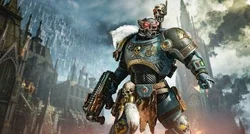
The Era Indomitus also saw the first Space Wolves successor chapters established since the disastrous Wolf Brothers experiment in M31. The Wolf Brothers had catastrophically failed due to uncontrolled Canis Helix mutations — the very reason the Space Wolves had refused to split into standard Codex-compliant chapters at the Second Founding. The Primaris gene-stabilisation that Cawl achieved over three hundred years of careful work had finally created a form of Russ's gene-seed that could be propagated without inevitable mutation, opening the door for successors that had been closed for ten thousand years. 5
The thirty Great Hunts
Since the first Hunt in 218.M31, the Space Wolves have launched over thirty Great Hunts — expeditions explicitly dedicated to finding Leman Russ — and not one has succeeded in its primary purpose. What they have done is fill the Chapter's saga with some of its greatest victories: the recovery of the 2nd Great Hunt's artefact believed to be the Armour of Russ; the 4th Great Hunt into Segmentum Tempestus, which uncovered the Corellian Conspiracy and foiled a coup against the Administratum; the 9th Great Hunt in 671.M34, which cleansed Genestealer infestation from the worlds of the Gehenna System; the 8th Great Hunt into the Ghoul Stars, during which Russ himself was reportedly sighted — though the sighting could not be confirmed. 1
The 30th Great Hunt was launched in 900.M41, somewhere in the century before the Siege of the Fenris System. The sagas of what was found, fought, and lost on that Hunt are told in full only once a millennium when Bjorn is awakened.
The Hunts are not failures, precisely. The Space Wolves have never gone looking for Russ and come home empty-handed in any meaningful sense — they always come home with victories, with dead monsters, with worlds returned to the Imperium. But the one thing they set out to find, they have not found. This is not accidental. The Hunt is, as much as anything, an act of faith. The Space Wolves go looking for their primarch not because they expect to find him on any particular Hunt, but because looking is how they remain worthy of him. Every generation of Blood Claws sets out into the galaxy knowing that the Space Wolves have been searching for ten thousand years and that they will search for ten thousand more if necessary.
The Space Wolves' battle cry is For Russ and the Allfather. They say it in the dialect of Fenris. They say it before every charge, every drop assault, every boarding action. 6
The Wolftime
Before Russ disappeared, he spoke his prophecy. The version recorded most clearly in the sagas runs:
"In ages to come, when our Chapter stands on the verge of destruction, when our enemies mass to annihilate us, my children, whatever realm of death holds me, I shall hear your call and come to you. I shall come to you even if the laws of life and death forbid it. In the end, I shall be there — for the final battle, for the Wolftime."
The Wolftime is the Space Wolves' apocalyptic prophecy. It holds that Russ will return when the Chapter faces its darkest hour, when the Imperium is at the edge of destruction, and that he will lead his sons in a final battle at the end of all things. The Space Wolves interpret this not as a distant legend but as a statement of fact — a promise made by a primarch who had never been known to break one. 2
Where is Leman Russ?
The official answer is: unknown. He entered the Eye of Terror in 211.M31 and no reliable sighting has been recorded since. Multiple theories circulate within the Chapter and among outside observers.
The most persistent belief holds that Russ went in search of the Tree of Life — a mythical source of uncorrupted Warp energy, somewhere within the Immaterium, whose fruit is said to be capable of healing the Emperor and restoring him to full consciousness. If this is true, the mission is either ongoing or already failed in ways Russ has not managed to communicate. This theory has no definitive source and cannot be confirmed.
A second strand of rumour — drawing on visions reported by some Rune Priests — holds that Russ still walks the wilds of Fenris in some form, undetected, watching over the world that made him. The Space Wolves neither confirm nor deny this, but the image has become embedded in Fenrisian oral tradition, where stories are told of an ancient, scarred stranger met on the ice, speaking in the oldest dialect, who knows the names of warriors dead for five thousand years.
The most disturbing element of current lore is a Games Workshop Canada narrative event from 2001 — not formally part of the core continuity but documented and widely discussed — in which a Tyranid Hive Fleet invaded Fenris and captured Leman Russ, who had been journeying the planet's wilds alone and undefended. The Space Wolves launched a massive rescue campaign. The outcome was never definitively resolved. Andy Chambers, who attended the event, believed a Space Wolf victory was "almost guaranteed," but the game may simply have run out of time before reaching a conclusion. Whether this constitutes a canonical hint about Russ's current location — potentially the stomach of the Hive Mind — or a non-canonical curiosity remains open. 7
What every version of the Wolftime mythology shares is that the question of Russ's return is inseparable from the state of the Space Wolves themselves. Bjorn the Fell-Handed, who has known the Wolf King personally and cannot close his eyes without remembering the exact moment Russ left him behind, has said clearly that the only thing that would give him peace is to fight alongside his primarch once more. Every Space Wolf alive understands this, because every Space Wolf alive has grown up in the shadow of the same unresolved question: is the Wolftime now?
The Great Rift is open. Half the Imperium is cut off. Guilliman has returned from stasis to find an empire fractured beyond anything the Codex Astartes was designed to handle. The Warp burns through the sky every night over Fenris, and the Space Wolves are fighting on a dozen fronts simultaneously, stretched thin in ways the old legions never were. If the Wolftime has conditions — when the Chapter stands on the verge of destruction, when enemies mass to annihilate — the era of the Great Rift would seem to qualify.
But the drinking horn at the high seat is still full. The seat is still empty. Somewhere, across whatever realm of death or dream or alien biology holds him, the Wolf King has not yet heard the call loudly enough to answer.
Or perhaps he has heard it. Perhaps he is already on his way back.
The Space Wolves set out another Great Hunt and wait to find out.
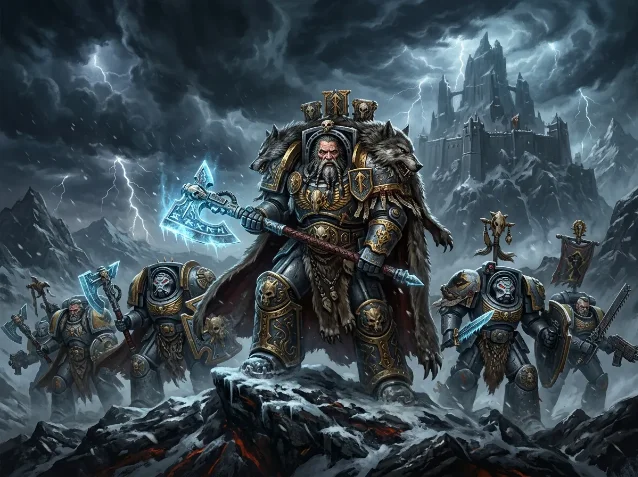
Space Wolves warriors of the Era Indomitus — the Chapter that has been waiting ten thousand years and has not stopped fighting 6
The Leman Russ arc is complete. Part I covered his origins on Fenris, the Great Crusade, and the Burning of Prospero. Part II followed the Siege of the Alaxxes Nebula, his arrival at a broken Terra, the Codex dispute, and his disappearance into the Eye of Terror. This Part III has covered the chapter he left behind, from Bjorn's long vigil through ten thousand years of war to the era of the Great Rift — and the prophecy that keeps ten thousand Space Wolves looking at the sky.
Añade más opiniones o contexto en torno a este contenido.